
If you could put your affiliate offer directly in front of people who have already agreed to receive notifications, how much easier would it be to get your next click?
That is the basic appeal of push advertising.
Push traffic has become a familiar performance-marketing channel because it gives advertisers access to notification-style ad placements without requiring them to build an audience from scratch. In 2026, the market includes established platforms such as PropellerAds, RichAds, Adsterra, EvaDav, Clickadu, AdMaven, Push.House and other specialist networks.
Current industry comparisons also show just how different these platforms can be in terms of GEO coverage, pricing models, targeting, formats and minimum deposits.
But here is the part many affiliate marketers miss:
There is no universal “best” traffic network.
A source that works beautifully for an Android utility offer in one GEO may be a poor fit for an email-list funnel in another. A low CPC does not automatically mean cheap conversions. And a huge impression count does not automatically mean high-quality visitors.
So, if you are researching the best push traffic sources for affiliate marketing in 2026, the goal should not be to blindly copy somebody else’s ranking. Instead, you should compare traffic type, targeting, GEO availability, bidding options, tracking capabilities, minimum budget and most importantly, how well the source matches your offer.
This guide compares 10 options and explains where each can fit into an affiliate traffic strategy.
Key Takeaways
- Push traffic is a paid acquisition channel, not an affiliate network. You buy audience access from an advertising platform and send that traffic to your landing page, funnel or offer.
- The best push traffic sources depend on your GEO, vertical, budget, conversion funnel and optimization experience.
- Classic push and in-page push are not identical. In-page push can be particularly useful when you want mobile reach without relying exclusively on traditional browser subscriptions.
- Do not choose a platform purely because it advertises the lowest CPC. Your real metric is cost per qualified visitor, lead or conversion.
- If your primary goal is building an email list, solo ads can complement push advertising because they use a different acquisition model and can be specifically purchased for click and lead generation.
Build Your Next Traffic Test With OptinSoloAd
Looking for another way to reach targeted prospects? Discover how solo ads can complement push traffic and help generate leads, subscribers, and affiliate opportunities.
What Is Push Traffic?
Before comparing the best push traffic sources, let’s define what we are actually buying.
Push advertising is a notification-style advertising format. In traditional browser push, users have previously opted in to receive notifications from a website or service. Advertisers can then deliver sponsored messages through the available push inventory.
A typical push ad contains:
- An icon or image
- A short headline
- A brief message
- A call to action
- A destination URL
The simplicity is part of the appeal.
Instead of waiting for somebody to discover your advertisement while browsing a page, push campaigns are designed around a notification-like placement that can bring the offer back to the user’s attention.
However, there is an important distinction between classic push and in-page push.
Classic push relies on an existing subscription/notification mechanism. In-page push, by contrast, appears within a webpage in a notification-style format and can expand the available audience, particularly on mobile. Current network comparisons specifically highlight in-page push as an important format in 2026.
That distinction matters when evaluating the best push traffic sources because two networks may both advertise “push” while providing somewhat different inventory.
How We Compared the Best Push Traffic Sources
Rather than judging networks simply by popularity, affiliate marketers should evaluate several practical factors.
1. Traffic volume: A network needs enough inventory in your target GEO to let you test and eventually scale.
2. GEO coverage: A platform with excellent US traffic may not be the right choice if your campaign targets India, Brazil, Indonesia or another market.
3. Targeting: Look for options such as:
- Country
- Region or city
- Device
- Operating system
- Browser
- Carrier
- Connection type
- Language
- Time/day targeting
- Placement or source controls
Exact targeting availability varies by network.
4. Pricing model: Common models include CPC and CPM, while some platforms also offer automated or performance-oriented bidding models. Current comparisons show substantial variation between networks.
5. Optimization tools: Source-level reporting, blacklists, whitelists, automated rules and conversion tracking can make a major difference after the first test.
6. Ad formats: Some platforms specialize in push, while others combine push with native, pop, interstitial, direct-click or other formats.
7. Minimum starting budget: A lower entry requirement can be useful for beginners, but it should never be confused with lower overall acquisition cost.
With these factors in mind, let’s examine 10 platforms worth researching.
1. PropellerAds
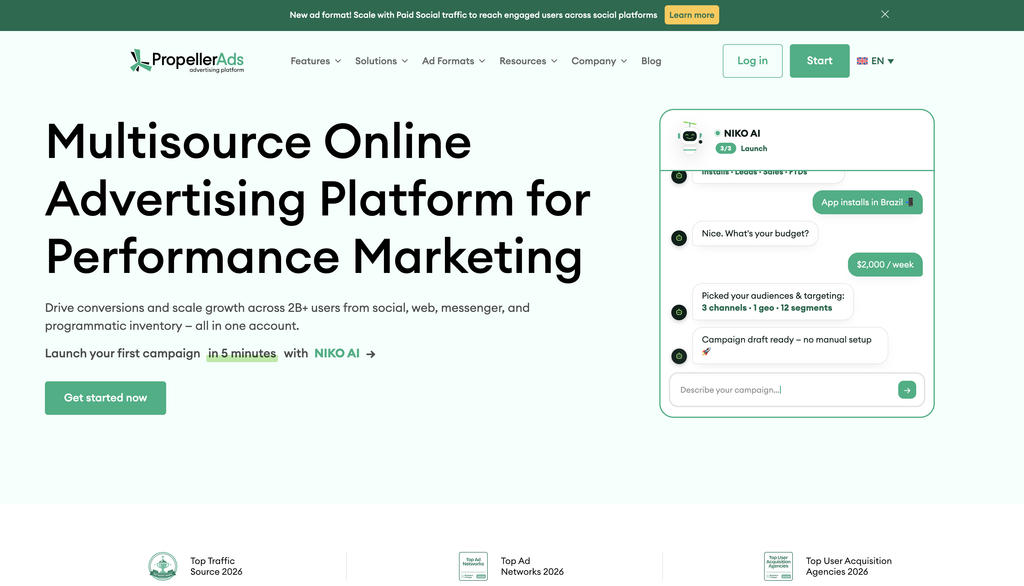
If you are building a shortlist of the best push traffic sources, PropellerAds is one of the established names worth investigating.
PropellerAds has been active in performance advertising for many years and offers multiple advertising formats in addition to push. Current 2026 industry comparisons describe it as a high-volume platform with classic push and in-page push inventory, along with automated campaign and optimization options.
Why affiliates consider it
The main attraction is scale.
If your campaign eventually needs a substantial amount of traffic, a large network can give you more room to expand after identifying profitable combinations of GEO, device, placement and creative.
Potential advantages
- Large international reach
- Push and in-page push formats
- Multiple targeting options
- Performance-oriented optimization tools
- Suitable for experienced media buyers
Watch-outs
Large volume is not the same thing as universally good traffic.
You still need to segment campaigns and monitor individual sources. A campaign that looks profitable at the network level can hide weak placements underneath the aggregate numbers.
Best suited to: Affiliates who want scale and are comfortable optimizing campaigns based on data.
2. RichAds
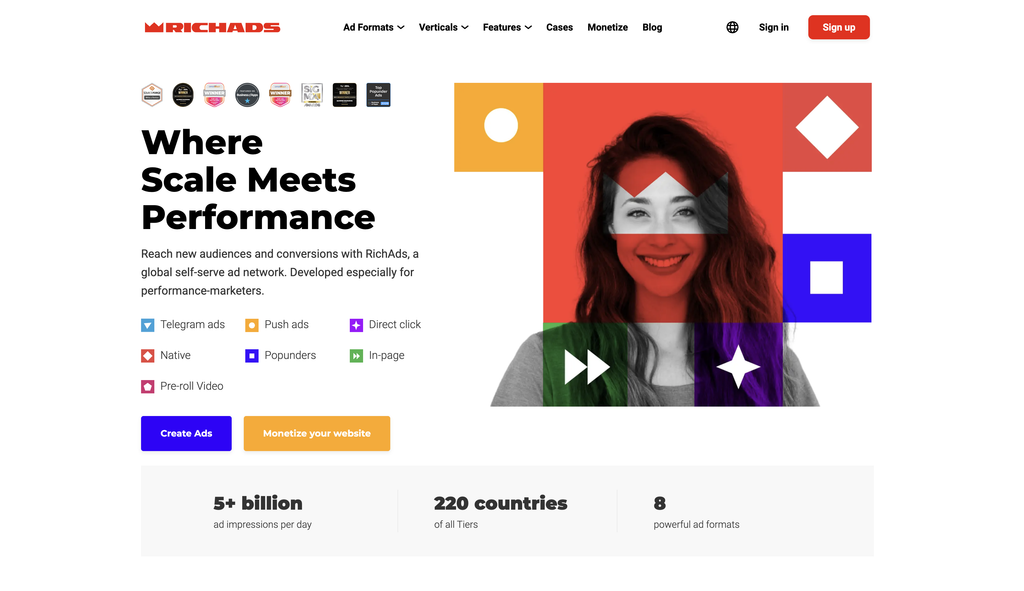
RichAds is another frequently mentioned platform in 2026 discussions about push advertising.
Its own current editorial material describes the platform as a push-focused performance advertising network, while independent comparisons also place RichAds among the major networks used by affiliates. Current published information cites push, in-page push and other formats, with coverage extending across a large number of countries.
Why it deserves consideration
RichAds is particularly relevant to affiliates who want a platform built around performance traffic rather than treating push as an incidental format.
The platform has also published guidance emphasizing that choosing traffic solely on price is insufficient. Audience, inventory and optimization capabilities matter alongside CPC.
Potential advantages
- Push-focused ecosystem
- Multiple advertising formats
- Broad GEO coverage
- Affiliate-oriented tools
- Campaign optimization features
Watch-outs
The cheapest bid is not necessarily the cheapest conversion.
Before increasing your budget, check conversion rate and cost per acquisition by GEO, device and traffic segment.
Best suited to: Affiliates running CPA, lead-generation and performance campaigns who want extensive push inventory.
3. Adsterra
Adsterra is another established advertising platform that frequently appears in comparisons of the best push traffic sources and broader affiliate ad networks.
The important point is that Adsterra is not limited to a single traffic format. Current 2026 comparisons describe it as a broad performance advertising platform with push-related and other advertising formats.
Why marketers test it
A multi-format network can be useful when you want to experiment with different approaches without building an entirely separate media-buying stack.
For example, you might begin with push and later test another format against the same funnel.
Potential advantages
- International reach
- Multiple advertising formats
- Affiliate-oriented campaign options
- Different targeting possibilities
- Useful for testing broader paid-traffic strategies
Watch-outs
Don’t assume a network’s reputation guarantees your campaign will work.
Your offer, landing page and GEO determine a large part of the economics.
Best suited to: Affiliates who want push access alongside other performance advertising formats.
4. EvaDav
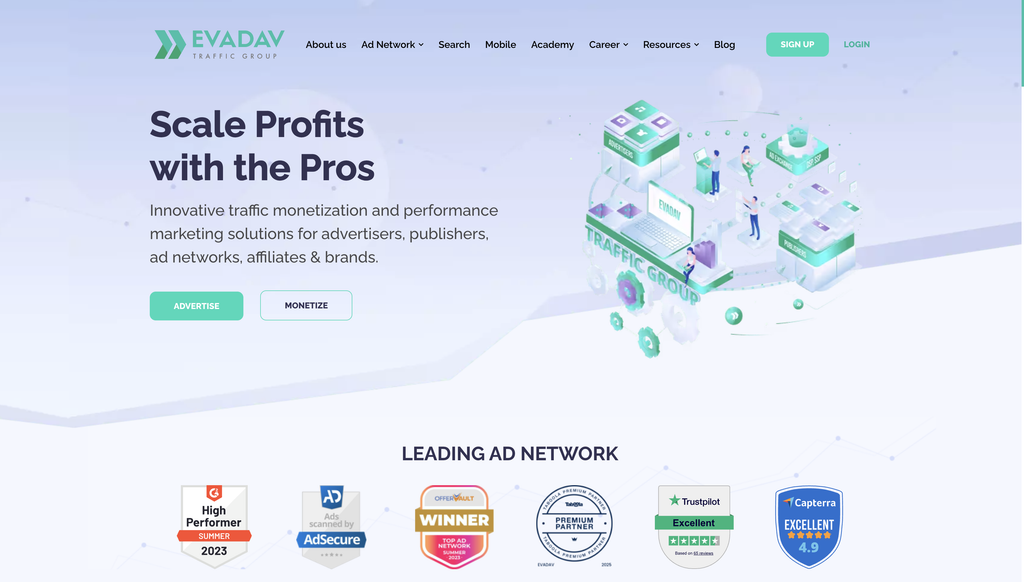
EvaDav is another network that appears repeatedly in current push-network comparisons.
Recent 2026 sources describe EvaDav as offering classic push and in-page push, with broad GEO coverage and targeting capabilities.
What makes it interesting?
EvaDav can be particularly relevant for marketers who want to test international traffic rather than concentrating exclusively on Tier-1 countries.
Current affiliate-focused discussions also mention its use for campaigns where detailed targeting and source optimization are important.
Potential advantages
- Push and in-page push
- International coverage
- Targeting controls
- Scheduling options
- Source optimization capabilities
Watch-outs
Tier-2 and Tier-3 traffic can look extremely attractive when you compare CPC alone.
The real question is whether your offer converts profitably after accounting for the lower purchase power or different user behavior that may exist in certain markets.
Best suited to: Affiliates testing international GEOs and marketers prepared to optimize traffic segments closely.
5. Push.House
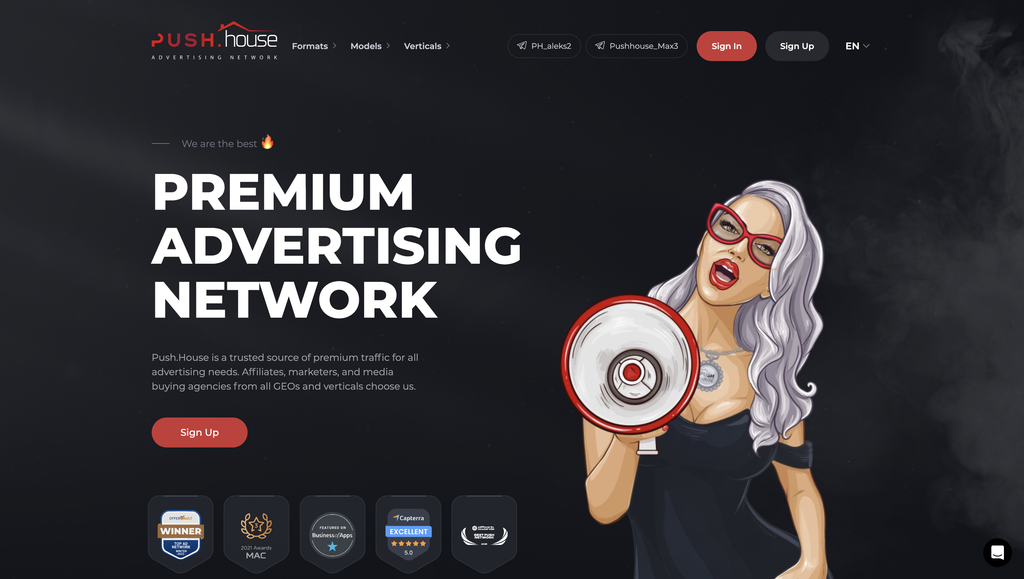
Push.House is a more specialized option to consider when researching the best push traffic sources.
Current affiliate-oriented comparisons list it among networks suitable for push testing and highlight a relatively accessible entry point compared with some larger platforms.
Why it may appeal to beginners
You don’t necessarily need to begin with a huge campaign.
For a first test, the ability to start with a comparatively modest budget can make it easier to learn the mechanics of push advertising without immediately committing a large amount of money.
Potential advantages
- Push-focused platform
- Classic and in-page push options
- Broad GEO selection
- Accessible testing environment
Watch-outs
A small initial deposit does not mean a small test budget is enough to establish statistical confidence.
If your offer converts at a low rate, you may need considerably more clicks before you know whether the campaign is actually viable.
Best suited to: Newer affiliates who want to learn push campaign mechanics with a controlled initial test.
6. Clickadu
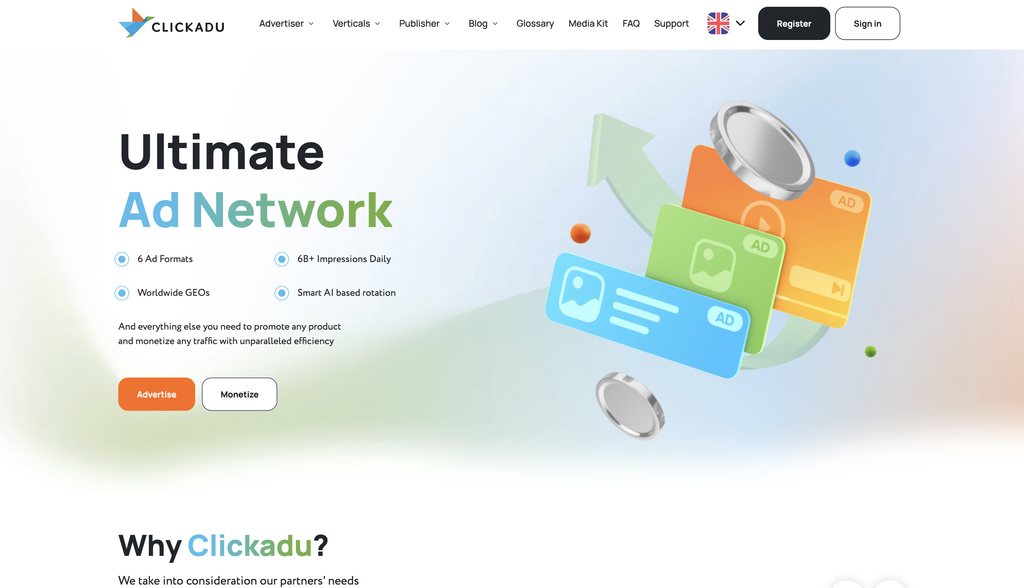
Clickadu is another multi-format advertising network that appears in current comparisons of push and performance traffic.
Recent 2026 industry research lists Clickadu among networks offering large-scale advertising inventory and multiple pricing models, although exact formats and pricing can change over time.
Why consider it?
The attraction is flexibility.
Instead of viewing push as an isolated traffic source, you can consider it as one component of a broader paid acquisition strategy.
Potential advantages
- Large advertising inventory
- Multiple ad formats
- Several bidding models
- International traffic
- Suitable for campaign testing
Watch-outs
More options can also mean more complexity.
If you are brand new to paid traffic, start with one format and one clearly defined objective instead of launching multiple formats simultaneously.
Best suited to: Experienced affiliates who want to test push alongside other paid formats.
7. AdMaven
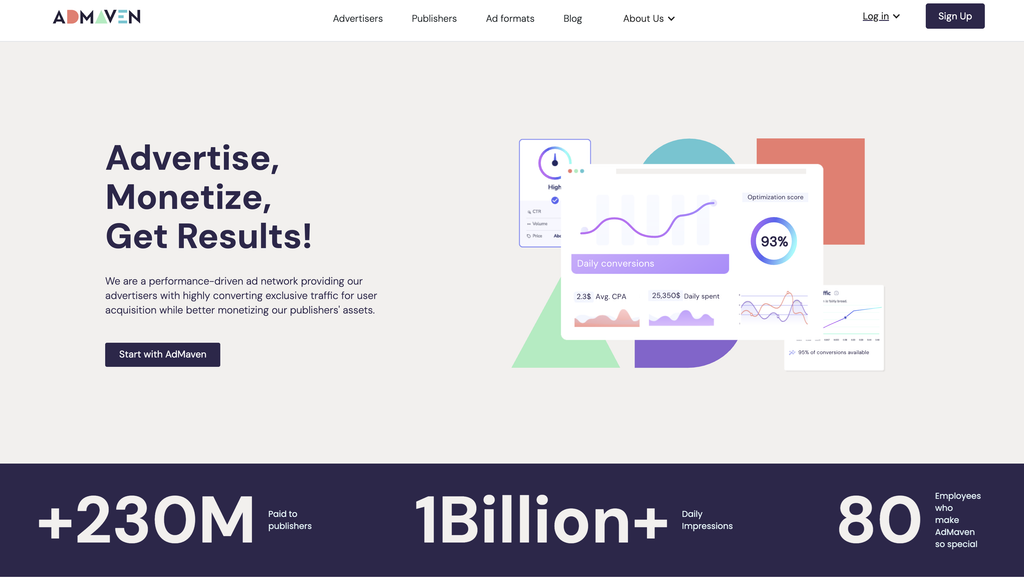
AdMaven is another name appearing in current 2026 comparisons, particularly when discussing in-page push and other performance formats.
One reason in-page push deserves attention is that it can help advertisers reach audiences that don’t necessarily fit the classic browser-push subscription model.
Current industry coverage specifically notes that in-page push can be useful for mobile campaigns and can behave differently from traditional subscribed push inventory.
Potential advantages
- In-page push
- Multiple ad formats
- International traffic
- Mobile-oriented opportunities
Watch-outs
Don’t lump classic push and in-page push together in your reporting.
Track them separately whenever possible. Their audiences and user experiences are different enough that combining them can make campaign optimization unnecessarily difficult.
Best suited to: Affiliates interested in testing in-page push and broader mobile performance traffic.
8. HilltopAds
HilltopAds is another platform appearing in current 2026 affiliate-focused comparisons.
Recent third-party research reports broad international reach and multiple advertising formats, including in-page push-related inventory. However, pricing and traffic figures should always be verified directly in the advertiser dashboard because bids and available inventory can change.
Potential advantages
- Broad international reach
- Multiple advertising formats
- Push-related inventory
- Useful for affiliate testing
Watch-outs
Third-party articles sometimes publish precise traffic numbers or CPC figures that quickly become outdated.
Treat those numbers as a starting point, not a guarantee.
Before launching, check the network’s current pricing and available inventory for your exact GEO.
Best suited to: Affiliates looking for another large international traffic source to test against established networks.
9. RollerAds
RollerAds has long been associated with push and performance advertising, and its current 2026 materials continue to discuss push alongside formats such as OnClick and Direct Click.
That makes it relevant when comparing the best push traffic sources because affiliates often need to evaluate traffic formats rather than networks in isolation.
Potential advantages
- Push-focused experience
- Additional performance formats
- Affiliate-oriented campaign environment
- Useful for testing different traffic approaches
Watch-outs
Don’t automatically switch from one format to another because one has a lower CPC.
A cheaper click can still produce a more expensive lead.
Best practice
Compare campaigns using:
Cost per lead = total campaign spend ÷ qualified leads
and, where possible:
CPA = total campaign spend ÷ conversions
Those numbers tell you much more than CPC alone.
Best suited to: Performance marketers who want to experiment with push and related formats.
10. Adcash
Adcash is another established advertising platform that appears in current comparisons of international performance traffic.
Current 2026 research lists Adcash among platforms offering broad GEO coverage and multiple advertising formats, with push or in-page-push availability depending on the specific inventory being discussed.
Potential advantages
- International audience
- Multiple ad formats
- Targeting capabilities
- Useful for broader paid acquisition testing
Watch-outs
Always confirm exactly which push format is currently available for your GEO.
Advertising inventory changes, and an article published several months ago may not reflect what you see when you log into the platform today.
Best suited to: Affiliates who want an established international advertising platform with multiple acquisition formats.
Want to Test Solo Ads Alongside Push Traffic?
Combine different acquisition channels to discover what converts best. Use OptinSoloAd to reach targeted audiences and bring more potential subscribers and leads into your funnel.
Push Traffic vs Solo Ads: Which Should Affiliates Use?
This is where things become more interesting.
Push traffic and solo ads can both send visitors to an affiliate funnel, but they work differently.
| Factor | Push Traffic | Solo Ads |
|---|---|---|
| Core format | Notification-style advertising | Email-based promotion |
| Audience access | Ad network inventory | Existing email audience |
| Main buying mechanism | Usually CPC/CPM or automated bidding | Usually a specified number of clicks |
| Creative | Short ad | Email copy |
| Common objective | Clicks, conversions, CPA | Clicks, leads, subscribers |
| Optimization | GEO, device, placement, bid, creative | Vendor, email copy, offer, funnel |
| Best measurement | CPA, conversion rate, EPC | Click quality, opt-in rate, CPA |
| Relationship building | Usually limited | Can feed an email funnel |
So, rather than asking which is universally better, ask:
What does your funnel need?
If you need scalable paid impressions and granular campaign controls, push may be worth testing.
If your main objective is to build an owned email audience, solo ads may make more sense.
And in some campaigns, using both can create a diversified acquisition strategy.
How Much Should You Spend on Push Traffic?
This is one of the most common mistakes beginners make.
They ask:
“What’s the minimum amount I need?”
A better question is:
“How much data do I need to determine whether my campaign is viable?”
A network might allow a small deposit, but that doesn’t mean a tiny campaign will produce enough conversions to make a reliable decision.
Your testing budget should depend on:
- Your target CPC
- Expected conversion rate
- Affiliate payout
- Funnel conversion rate
- Target CPA
- Number of variables being tested
- GEO
- Offer type
Suppose your funnel ultimately produces one paid conversion for every 100 qualified clicks.
If each click costs $0.05, 100 clicks cost $5.
But if your conversion rate is actually one conversion per 500 clicks, the required testing budget changes dramatically.
That’s why experienced media buyers don’t optimize around CPC alone.
They optimize around economics.
How to Choose Among the Best Push Traffic Sources
Here’s a practical framework.
Step 1: Define your conversion
Are you trying to generate:
- Email subscribers?
- Affiliate sales?
- App installs?
- Free trials?
- CPA leads?
- Registrations?
- Product purchases?
Your conversion event determines what you should optimize for.
Step 2: Pick one GEO
Don’t start with 20 countries.
Choose one market where your offer is allowed and relevant.
Then collect enough data to understand performance.
Step 3: Separate mobile and desktop
User behavior can vary substantially by device.
If your landing page is primarily designed for mobile, don’t let desktop traffic distort the data.
Step 4: Track every campaign
Use tracking parameters and a reliable analytics system.
At minimum, record:
Source → Campaign → GEO → Device → Click → Landing page → Lead → Sale
Step 5: Test multiple creatives
A push campaign can fail because of the creative even when the traffic is perfectly usable.
Test different:
- Headlines
- Images/icons
- Calls to action
- Angles
- Landing pages
Step 6: Cut weak traffic
Once you have meaningful data, identify placements, sources or segments that spend money without producing the desired action.
This is where source-level optimization becomes extremely important.
Push Traffic Metrics That Actually Matter
If you’re evaluating the best push traffic sources, don’t stop at CTR.
Here are the numbers to watch.
CTR
Click-through rate = clicks ÷ impressions × 100
CTR tells you whether your ad attracts attention.
It does not tell you whether those clicks make money.
Conversion rate
Conversion rate = conversions ÷ clicks × 100
This tells you what percentage of visitors complete your desired action.
CPC
CPC = advertising spend ÷ clicks
Useful for understanding acquisition cost at the click level.
CPA
CPA = advertising spend ÷ conversions
This is often much more meaningful for affiliate campaigns.
EPC
EPC = revenue ÷ clicks
Comparing EPC against CPC can help you understand whether your traffic economics make sense.
ROI
ROI = (revenue − cost) ÷ cost × 100
Ultimately, this is what matters when determining whether you can scale.
Common Mistakes When Buying Push Traffic
Even experienced affiliates can make these mistakes.
Choosing the cheapest click: A $0.01 click isn’t automatically better than a $0.05 click. If the first produces no leads and the second produces buyers, the apparent price advantage disappears.
Testing too many variables: Changing your GEO, creative, landing page and offer simultaneously makes it difficult to identify what caused the result.
Ignoring the landing page: Your traffic source cannot rescue a confusing landing page. Make the message consistent from advertisement to landing page.
Scaling too quickly: One profitable day is not necessarily a profitable campaign. Collect enough data before dramatically increasing your budget.
Ignoring compliance: Always check the advertising network’s current rules and your affiliate program’s rules before launching. Some verticals and claims may be restricted.
Treating all push traffic as identical: Different networks have different audiences, inventory and optimization systems. Your results can vary significantly.
How OptinSoloAd Can Complement Push Traffic
Push traffic can help affiliates bring new visitors to a landing page, but what happens after the click matters just as much. For marketers focused on lead generation and email-list building, OptinSoloAd can complement a push traffic strategy by providing another way to reach targeted audiences through solo ads.
Instead of relying on a single paid traffic channel, affiliates can test push traffic for initial visitors and use solo ads to bring additional prospects into their funnels. This gives marketers more opportunities to test different audiences, offers and acquisition strategies while tracking which source produces the most valuable leads.
If your goal is to build an email list rather than simply generate one-time clicks, combining different traffic sources can also help create a more diversified acquisition strategy.
How Push Traffic Fits Into an Affiliate Funnel
A simple funnel might look like this:
Push Ad → Pre-Landing Page → Opt-In → Email Sequence → Affiliate Offer
The push ad gets attention.
The pre-lander creates context.
The opt-in captures the visitor.
The email sequence builds the relationship.
The affiliate offer creates the monetization event.
This model is particularly interesting for marketers who don’t want to depend entirely on a single paid click.
Once somebody joins your email list, you have an opportunity to communicate with that subscriber again according to your consent, email-provider rules and applicable regulations.
That’s also where a solo-ad platform such as OptinSoloAd can become relevant as an additional acquisition channel.
Instead of asking which channel should replace all others, you can build a diversified acquisition strategy.
Are Push Ads Still Worth Testing in 2026?
Yes but “worth testing” is different from “guaranteed to work.”
Current 2026 industry coverage shows that push advertising remains an active part of the affiliate-media-buying ecosystem, with networks continuing to offer classic push, in-page push and related formats.
At the same time, the market is more sophisticated than simply buying cheap clicks.
Modern affiliates need to think about:
- Traffic quality
- Attribution
- Conversion tracking
- Creative fatigue
- Audience segmentation
- Compliance
- Landing-page experience
- Incremental profitability
In other words, push can still be useful, but the strategy behind the traffic purchase matters more than the traffic format itself.
Final Comparison
Here is a simplified way to think about the 10 options covered in this guide:
| Platform | Main Strength | Good Fit For |
|---|---|---|
| PropellerAds | Scale and broad performance traffic | Experienced affiliates |
| RichAds | Push-focused affiliate traffic | CPA/performance campaigns |
| Adsterra | Multi-format advertising | Broad affiliate testing |
| EvaDav | International push/in-page push | GEO testing |
| Push.House | Push-focused testing | Smaller initial tests |
| Clickadu | Large multi-format inventory | Experienced media buyers |
| AdMaven | In-page push and other formats | Mobile-focused campaigns |
| HilltopAds | Broad international reach | Global campaign testing |
| RollerAds | Push plus related formats | Performance marketers |
| Adcash | International multi-format traffic | Diversified acquisition |
Remember that these aren’t permanent rankings. The best push traffic sources for your business can change as your GEO, offer, funnel and optimization data change.
Ready to Turn Traffic Into Leads?
Put your affiliate funnel in front of targeted audiences with OptinSoloAd. Build your email list, generate leads, and create more opportunities to convert visitors.
Conclusion
Choosing the best push traffic sources in 2026 is less about finding one platform that works for everyone and more about finding the right traffic source for your offer, audience, budget, and conversion goals. Networks such as PropellerAds, RichAds, Adsterra, EvaDav, Push.House, Clickadu, AdMaven, HilltopAds, RollerAds, and Adcash each offer different combinations of traffic, targeting, formats, and campaign tools.
Before investing heavily, start with a controlled test and track clicks, conversions, CPA, EPC, and ROI. Remember that a cheap click means little if it doesn’t generate leads or sales.
If you’re an affiliate marketer looking to build your email list, generate targeted leads, and turn traffic into recurring opportunities, don’t depend on a single traffic channel. Test push traffic alongside proven lead-generation strategies such as solo ads.
Ready to put your affiliate funnel in front of a targeted audience? Explore OptinSoloAd and start driving quality traffic to your offer, landing page, or email funnel today.
FAQs
1. What are the best push traffic sources in 2026?
The best push traffic sources depend on your campaign requirements, but current 2026 industry comparisons frequently discuss PropellerAds, RichAds, Adsterra, EvaDav, Push.House, Clickadu, AdMaven, HilltopAds, RollerAds and Adcash. Instead of choosing based solely on a published ranking, compare each platform according to your GEO, vertical, budget, targeting requirements and conversion economics.
2. Is push traffic good for affiliate marketing?
Yes, push traffic can be used for affiliate marketing, particularly when an affiliate has a clear funnel, compliant offer and reliable conversion tracking. The important point is that push traffic does not automatically equal profitable traffic. Your landing page, offer, creative, GEO and campaign optimization all influence the final result.
3. How much does push traffic cost?
There is no single fixed price. Push CPC and other bidding costs vary by network, GEO, competition, format and targeting. Current 2026 comparisons show substantial differences in advertised starting bids, which is why you should verify current rates directly in each platform before depositing funds.
4. Is push traffic better than Facebook Ads?
Neither channel is universally better. Facebook advertising and push advertising have different audiences, targeting systems, creative requirements and campaign mechanics. The useful comparison is not simply CPC versus CPC. Compare cost per qualified lead, customer acquisition cost, revenue and ROI for the same offer.
5. What is the difference between push and in-page push?
Traditional push advertising generally uses notification-style inventory associated with a user’s previous notification subscription. In-page push displays a notification-style ad within a webpage and can therefore reach users differently from traditional subscribed push audiences. Current industry guides identify in-page push as an important format, especially for mobile traffic.
6. Can I use push traffic to build an email list?
Yes. A common funnel is:
Push ad → landing page → opt-in form → email sequence.
However, the landing page needs to give visitors a clear reason to subscribe, and your email collection and marketing practices must comply with applicable privacy, consent and anti-spam requirements.
7. Is OptinSoloAd a push traffic source?
No. OptinSoloAd is a solo-ad traffic platform, not a push notification ad network. That distinction is important for accurate SEO content and user expectations. OptinSoloAd can instead be discussed as an alternative or complementary paid traffic source for marketers interested in email-list building and lead generation. Its own published material focuses on using solo ads for affiliate marketing and acquiring leads.
8. What should I track when buying push traffic?
At minimum, track:
- Impressions
- Clicks
- CTR
- CPC
- Leads
- Conversion rate
- Revenue
- CPA
- EPC
- ROI
Where possible, break the data down by GEO, device, campaign, creative and traffic source.
9. Can beginners use push traffic?
Yes, but beginners should start methodically. Don’t launch dozens of GEOs, offers and creatives simultaneously. Start with one clearly defined campaign, establish tracking, collect meaningful data and optimize from there. A lower minimum deposit can make a platform easier to test, but it doesn’t necessarily mean that a small campaign will generate enough data to prove profitability.
10. How do I choose between push traffic and solo ads?
Start with your objective. If you want to purchase notification-style paid traffic and optimize campaigns by GEO, device, source and other parameters, push may be worth testing. If your primary objective is acquiring subscribers through an established email audience, solo ads may be more aligned with that goal. You can also use both channels as part of a diversified acquisition strategy, provided you track them separately and evaluate each based on actual conversion economics.
3 thoughts on “Best Push Traffic Sources in 2026: 10 Options Compared for Affiliate Marketers”