
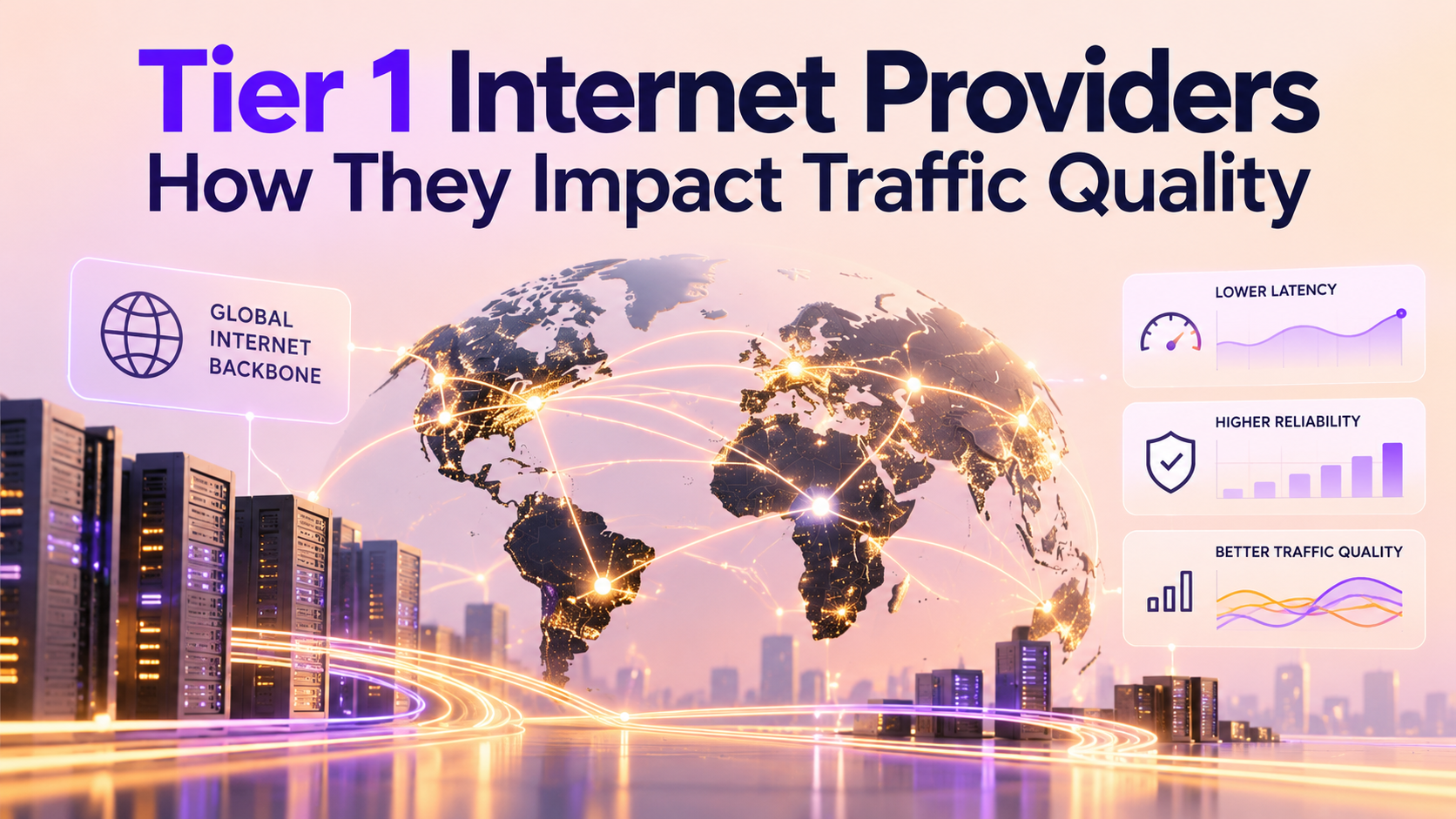
Did you know that just a handful of global networks carry the vast majority of all digital traffic across the planet? These massive organizations, known as tier 1 internet providers, operate the backbone of our modern world, connecting directly with other major networks to ensure data flows across borders. Understanding these tier 1 internet providers is essential for anyone managing high-performance digital infrastructure.
While these companies offer incredible reach, their classification does not automatically guarantee superior performance for your specific needs. You must look beyond the label to evaluate measurable performance factors like latency, packet loss, and jitter. True quality depends on how well a network manages congestion and maintains route stability under heavy loads.
Focusing on these technical metrics ensures your data travels efficiently regardless of the underlying network hierarchy. By prioritizing uptime and consistent delivery, you can build a more resilient connection strategy for your business.
Key Takeaways
- Global backbone networks form the core infrastructure of the modern web.
- Classification as a major network does not inherently ensure high traffic quality.
- Performance depends on critical metrics like latency, jitter, and packet loss.
- Effective congestion management is vital for maintaining stable data flow.
- You should prioritize measurable uptime and route stability over simple provider labels.
Build a More Reliable Network Strategy
Put your affiliate funnel in front of targeted audiences with OptinSoloAd. Build your email list, generate leads, and create more opportunities to convert visitors.
What tier 1 internet providers are and how their networks operate?
Understanding the backbone of the internet requires a look at the elite group of networks that define global connectivity. These organizations form the core infrastructure that allows data to move seamlessly across continents.
What is a tier 1 provider?
When you ask what is a tier 1 provider, and how do tier 1 internet providers work, you are essentially asking about the top of the internet hierarchy. you are essentially asking about the top of the internet hierarchy. These tier 1 internet providers are defined by their ability to reach every other network on the internet solely through settlement-free peering agreements.
Unlike smaller providers, tier 1 internet providers do not need to purchase transit from anyone else to reach any destination. This unique status gives tier 1 internet providers greater control over their traffic paths and routing decisions.
How tier 1 internet carriers reach every destination without buying transit
The primary advantage of tier 1 internet providers is their massive, self-owned global infrastructure. By owning the fiber-optic cables that span oceans and countries, they eliminate the need to pay upstream providers for access.
Tier 1 internet providers maintain this reach by connecting directly to other large networks at major exchange points. This interconnected web maintained by tier 1 internet providers ensures that data packets can travel across the globe without encountering third-party bottlenecks.
The role of peering, transit, and autonomous systems
To manage this complex environment, these providers rely on Autonomous Systems (AS) and the Border Gateway Protocol (BGP). These tools allow networks to communicate and share routing information efficiently.
Settlement-free peering and direct route exchange
Peering is a mutually beneficial arrangement where two networks exchange traffic without charging each other. This is distinct from paid transit, where a smaller network pays a larger one for access to the rest of the internet.
By engaging in settlement-free peering, tier 1 internet providers keep costs low and performance high. This direct exchange of routes is a hallmark of tier 1 internet providers and their truly global networks.
Global backbone ownership and route control
Owning a global backbone provides the physical capacity to handle massive volumes of data. However, even with direct route control, users should note that this does not eliminate every possible source of congestion.
Network performance can still vary based on local conditions and traffic spikes. While these providers offer the most reliable foundation, optimal performance remains a shared responsibility between the carrier and the end-user network.
How tier 1 networks differ from tier 2 and tier 3 providers
When you evaluate connectivity, it is vital to distinguish between tier 1 internet providers and lower-tier alternatives. While tier 1 internet providers and lower-tier networks all work together to form the internet, their underlying business models and physical assets vary significantly. Understanding these differences helps you make informed decisions about your network architecture.
Transit dependence and upstream connectivity
A tier 1 provider operates at the top of the internet hierarchy because tier 1 internet providers do not purchase transit from any other network. These carriers reach every destination on the internet solely through settlement-free peering agreements. In contrast, tier 2 and tier 3 providers must purchase transit from upstream carriers to ensure their customers can reach the entire global routing table.
Regional coverage versus global reach
The scope of a network often dictates its classification. Tier 1 internet providers maintain massive, global backbones that span continents and oceans. Meanwhile, tier 2 and tier 3 providers typically focus on specific geographic regions or metropolitan areas rather than the global infrastructure maintained by tier 1 internet providers. They provide essential “last-mile” or “middle-mile” connectivity that brings the internet to your doorstep.
Network ownership, routing authority, and operational control
Ownership of the physical fiber backbone is a hallmark of tier 1 internet providers and other top-tier carriers. These companies exert significant routing authority, as they control the primary paths that data takes across the globe. Lower-tier providers often lease capacity from tier 1 internet providers, meaning they have less direct control over the physical path of your traffic.
| Feature | Tier 1 | Tier 2/3 |
|---|---|---|
| Transit Purchases | None | Required |
| Backbone Ownership | Global | Regional/Local |
| Routing Control | High | Moderate |
Why a lower-tier provider can still deliver excellent service
You should not automatically assume that a smaller provider offers inferior performance compared with tier 1 internet providers. Many regional carriers excel by providing superior local support and highly optimized connections compared with larger tier 1 internet providers within their specific service areas. If your business operations are localized, a regional provider might offer better latency and more personalized service than a massive global carrier.
Why provider tier alone does not guarantee better traffic quality
The quality of your connection depends on more than just the status of your tier 1 internet provider. Factors such as local access technology, the quality of interconnections, and effective capacity planning play a larger role in your daily experience. Ultimately, the complete path to your destination determines whether your applications run smoothly or suffer from congestion.
- Local Access: The physical connection to your building.
- Interconnection Quality: How well your provider links to others.
- Capacity Planning: How the provider manages traffic spikes.
- Support Responsiveness: How quickly issues are resolved.
How network architecture shapes traffic quality
High-performance traffic relies on the sophisticated engineering choices made by tier 1 internet providers. The way tier 1 internet providers build these networks determines how efficiently data moves from your device to its final destination. By optimizing the physical and logical paths of the internet, these providers ensure that your digital interactions remain smooth and responsive.
Latency, distance, and the number of network hops
Latency represents the time delay between sending a request and receiving a response. Because data must travel across physical fiber-optic cables, the distance between two points is a primary factor in speed. Every time your data passes through a router, it encounters a “hop,” which adds a small amount of processing time.
Tier 1 internet providers can minimize these delays by maintaining direct, high-speed connections across continents. By reducing the number of unnecessary hops, they ensure that your data takes the most direct path possible.
Packet loss, congestion, and queue management
Packet loss occurs when data packets fail to reach their destination, often due to network congestion. When routers become overwhelmed, they must drop incoming traffic to maintain stability. Effective queue management allows a network to prioritize critical data, ensuring that important information is processed before less urgent traffic.
Jitter and its effect on real-time applications
Jitter is the variation in the time it takes for packets to arrive at their destination. While a small amount of delay is often manageable, inconsistent arrival times can disrupt the flow of data. This instability is particularly damaging to applications that require a steady, predictable stream of information.
Voice and video conferencing requirements
Voice and video calls are highly sensitive to jitter and latency. If packets arrive out of order or with significant delays, you will experience choppy audio or frozen video frames. Consistent performance is essential for maintaining professional communication standards in a remote work environment.
Cloud applications, gaming, and financial transactions
Cloud services, online gaming, and financial trading platforms require near-instantaneous data transfer. Even minor fluctuations in network quality can lead to session timeouts or missed opportunities in high-frequency trading. These applications demand the low-latency environment that only robust, well-managed networks can provide.
Availability, redundancy, and route diversity
Reliability is a cornerstone of modern connectivity. Tier 1 internet providers achieve high availability by building redundant fiber paths throughout their global infrastructure. If one route experiences a failure, traffic is automatically rerouted through an alternative path without interrupting your service.
This route diversity ensures that your business remains connected even during major hardware outages or fiber cuts. By investing in multiple physical paths, these providers offer the stability required for mission-critical operations.
How routing and peering affect your internet performance?
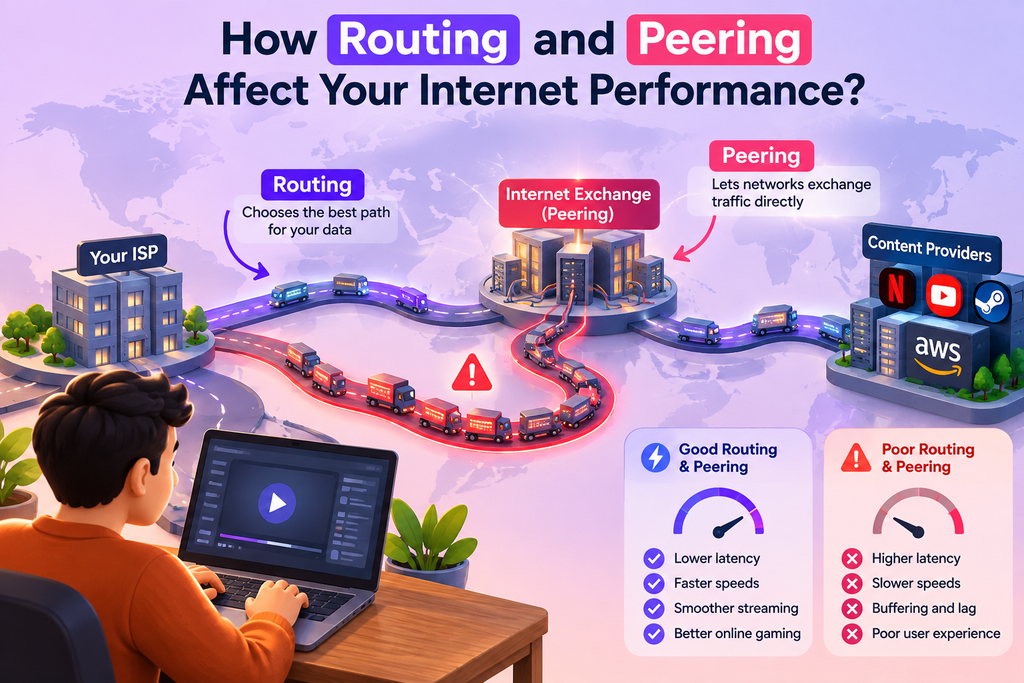
When you investigate what is a tier 1 provider, you quickly discover that the internet is not a single, unified highway. Instead, it is a vast collection of interconnected networks that rely on complex policies to move data. Your connection speed and reliability depend on these invisible decisions made by tier 1 internet providers and other network administrators every second.
Border Gateway Protocol decisions and traffic paths
The Border Gateway Protocol (BGP) serves as the primary language of the internet. It does not simply look for the shortest physical path between two points. Instead, it uses policy-based routing to determine the best path based on business agreements, network health, and traffic volume.
Because BGP prioritizes reachability and administrative policy, your data might travel through a longer path to avoid a congested network. This ensures that traffic remains stable even when specific segments of the global infrastructure face technical difficulties.
Direct peering versus indirect transit routes
Networks connect to each other through either peering or transit. Direct peering allows tier 1 internet providers and other networks to exchange traffic without paying a third party, which can reduce latency. In contrast, indirect transit routes involve paying an upstream provider to carry your data across their infrastructure.
Understanding what is a tier 1 provider helps clarify why these relationships matter. Tier 1 networks maintain massive, global peering relationships that allow them to reach any destination on the internet without purchasing transit from others.
Internet exchange points and regional traffic efficiency
Internet Exchange Points (IXPs) act as physical locations where multiple networks meet to swap traffic. By keeping data local, IXPs prevent traffic from traveling across continents unnecessarily. This regional efficiency is a cornerstone of high-performance networking.
| Routing Method | Primary Benefit | Cost Impact |
|---|---|---|
| Direct Peering | Lowest Latency | Low/Zero |
| Transit Routes | Global Reach | High |
| IXP Exchange | Regional Speed | Moderate |
How route changes can affect users in different locations
Routing tables are dynamic and change frequently to adapt to network conditions. A route change in Europe might have zero impact on a user in the United States, but it could cause significant delays for someone in Asia. These shifts occur because every network has a unique set of interconnections and local congestion levels.
Why the shortest route is not always the highest-quality route
Many users assume that the shortest physical path is the fastest, but this is often incorrect. A shorter path might be heavily congested or rely on older, slower hardware. A longer path that utilizes a high-capacity, modern backbone often provides a much smoother experience for real-time applications like video conferencing.
How tier 1 internet providers manage congestion and reliability
Tier 1 internet carriers utilize advanced engineering to ensure your data travels without interruption. Tier 1 internet providers maintain massive global backbones that require constant oversight to handle the ever-growing demand for bandwidth.
Optimize Your Business Connectivity
Strengthen connectivity with reliable routing, resilient infrastructure, and smarter traffic management for cloud applications, remote teams, and critical business operations.
Backbone capacity, utilization, and traffic forecasting
To prevent bottlenecks, these carriers rely on proactive traffic forecasting. By analyzing historical data and current usage trends, they predict where congestion might occur before it impacts your connection.
Engineers at tier 1 internet providers maintain significant headroom across their links. This extra capacity ensures that even during unexpected traffic spikes, the network remains stable and responsive.
Redundant fiber paths and automatic failover
Reliability is built into the core architecture of these networks. If a primary fiber route experiences an issue, traffic is instantly rerouted through redundant paths.
This automatic failover process happens in milliseconds. Most users never notice a disruption because the network protocols detect the fault and find the next best path immediately.
Distributed points of presence and regional resilience
By deploying distributed points of presence (PoPs), carriers bring the internet closer to the end user. This regional approach minimizes the distance data must travel, which reduces latency and improves overall performance.
Protection against fiber cuts, equipment failures, and outages
Physical infrastructure is vulnerable to accidents, such as construction crews cutting cables. Tier 1 internet carriers mitigate these risks by using geographically diverse fiber routes that do not share the same physical path.
If a specific piece of hardware fails, the network is designed to isolate the fault. This prevents a single equipment failure from cascading into a larger regional outage.
Maintenance planning and service continuity
Scheduled maintenance is a critical part of keeping the network healthy. Providers perform these updates during off-peak hours to ensure service continuity for your business operations.
They communicate these windows well in advance. This allows your IT team to prepare for any potential shifts in traffic patterns or routing changes.
Service-level agreements and performance commitments
Your relationship with a provider is defined by service-level agreements (SLAs). These documents translate technical capabilities into legal commitments regarding uptime and latency.
An effective SLA covers incident response times and clear escalation paths. It ensures that if a performance issue arises, you have a guaranteed process for resolution and communication.
| Feature | Standard Provider | Tier 1 Carrier |
|---|---|---|
| Network Ownership | Leased/Partial | Full Global Backbone |
| Redundancy | Limited | High (Diverse Paths) |
| SLA Coverage | Basic Uptime | Latency & Packet Loss |
| Traffic Management | Reactive | Proactive Forecasting |
How tier 1 connectivity affects business applications
When you select a tier 1 provider, you are investing in the stability of your entire digital ecosystem. Business applications today require more than just raw bandwidth to operate effectively. They demand a reliable path that minimizes interference and ensures data arrives in the correct order.

Cloud platforms, software as a service, and data synchronization
Modern cloud platforms and SaaS tools rely on constant communication between your local office and remote data centers. If your connection suffers from high latency, your applications will feel sluggish and unresponsive. A tier 1 provider ensures that your data synchronization remains fluid, preventing the common “lag” that frustrates employees during file uploads or database updates.
Unified communications, voice, and video performance
Real-time collaboration tools like Zoom or Microsoft Teams are highly sensitive to jitter and packet loss. Even minor fluctuations in network quality can cause audio drops or frozen video frames. By utilizing a robust backbone, you reduce the number of hops your traffic takes, which keeps your communication channels clear and professional.
Content delivery, streaming, and customer-facing websites
Your website serves as the digital storefront for your brand. If your content delivery is slow, visitors will likely leave before the page even loads. High-quality routing ensures that your assets reach customers quickly, regardless of their geographic location, which directly improves your conversion rates.
Remote work, branch offices, and distributed operations
Distributed teams need a reliable way to access centralized resources from various locations. A stable network backbone allows your branch offices to function as if they were in the same building. This level of connectivity is essential for maintaining productivity across different time zones and regions.
Performance considerations for national and international teams
International teams often face the challenge of crossing multiple network boundaries. A tier 1 provider maintains direct peering relationships that bypass the congestion found on public internet exchanges. This creates a shorter, more predictable path for your data, which is vital for teams working across borders.
Why consistent performance matters as much as peak speed
Many organizations focus solely on high-speed plans, but consistency is the true driver of efficiency. Occasional bursts of speed do not help if your connection experiences frequent packet loss or latency spikes. Stable performance ensures that your business processes run without interruption, providing a predictable experience for every user.
| Metric | Low-Quality Connection | Tier 1 Connectivity |
|---|---|---|
| Latency | High and Variable | Low and Stable |
| Packet Loss | Frequent Drops | Minimal to None |
| Jitter | High Impact on Voice | Smooth Real-Time Audio |
| Reliability | Frequent Outages | High Availability |
How to evaluate tier 1 internet carriers for your organization
Selecting the right tier 1 internet providers requires more than just checking a list of global carriers. You need a practical framework to verify that a provider can actually meet your specific traffic demands across your required regions.
Assessing geographic coverage and destination reach
Global reach is a primary indicator of network strength, but it must align with your specific footprint. You should map your primary office locations, data centers, and cloud regions against the provider’s backbone map.
Proximity to your users is essential for reducing the number of hops. Ensure the carrier has a strong presence in the specific metropolitan areas where your employees and customers reside.
Comparing latency, packet loss, jitter, and uptime data
Performance metrics provide the objective evidence needed to validate marketing claims. You should request historical data for your specific routes rather than relying on global averages.
“Reliability is not just about uptime; it is about the consistency of the path your data takes every single millisecond.”
Use the following table to compare potential partners based on their standard service-level agreements (SLAs):
| Metric | Standard Expectation | Critical Requirement |
|---|---|---|
| Latency | ||
| Packet Loss | ||
| Uptime | 99.9% | 99.999% |
Reviewing peering relationships and upstream dependencies
Understanding what is a tier 1 provider helps you identify which companies own their own infrastructure. These providers do not purchase transit from others, which minimizes the risk of third-party congestion.
Questions to ask about routes to your cloud and data center locations
- How many autonomous systems exist between your network and our primary cloud provider?
- Do you have direct peering agreements with major SaaS and cloud platforms?
- Can you provide a traceroute analysis for our specific destination IP ranges?
Questions to ask about congestion monitoring and incident response
- What is your average time to notify customers during a major backbone outage?
- How do you manage traffic during peak hours to prevent packet queuing?
- Do you provide a customer portal for real-time visibility into link utilization?
Balancing network quality, cost, and contract flexibility
While high-performance connectivity is vital, you must also consider the financial terms of the agreement. Knowing what is a tier 1 provider allows you to negotiate better, as you understand the value of their direct backbone access.
Always prioritize tier 1 internet providers that offer scalable bandwidth options. Ensure your contract includes clear renewal terms and the flexibility to adjust your capacity as your business grows.
How to improve traffic quality beyond choosing a tier 1 provider
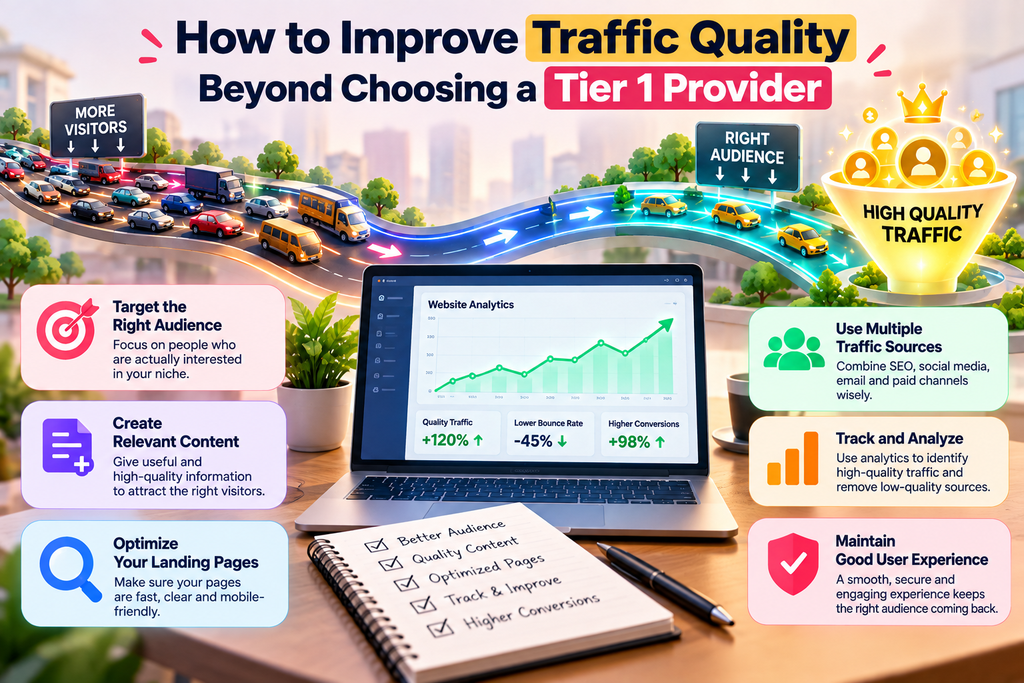
Achieving peak network performance involves integrating several advanced strategies alongside your choice of tier 1 internet carriers. While these providers offer a robust backbone, your overall traffic quality depends on how you manage the entire path from the user to the cloud. A comprehensive strategy ensures that your business remains resilient even when individual components face challenges.
Using dual-carrier connectivity and intelligent failover
Relying on a single connection creates a single point of failure that can disrupt your operations. By implementing dual-carrier connectivity, you ensure that your traffic can automatically reroute if one circuit experiences an outage. Intelligent failover mechanisms detect these issues in real-time, switching traffic to a secondary path without manual intervention.
Combining internet access with SD-WAN and application-aware routing
Software-Defined Wide Area Networking (SD-WAN) adds a layer of intelligence to your network traffic. It allows you to prioritize critical business applications over less important data streams. With application-aware routing, your network can dynamically select the best path based on current performance metrics, ensuring that voice and video calls remain clear and stable.
Monitoring performance from multiple user locations
Visibility is essential for maintaining a high-quality network environment. You should deploy monitoring tools across various branch offices and remote sites to gain a complete picture of your traffic health. This distributed approach helps you identify bottlenecks that might not be visible from a central data center.
Metrics to track: latency, loss, jitter, uptime, and route changes
To maintain high standards, you must consistently track key performance indicators. Focus on latency, packet loss, jitter, and overall uptime to gauge the health of your connections. Monitoring route changes is also vital, as unexpected path shifts can often explain sudden drops in application performance.
Using active and passive monitoring to identify recurring problems
Active monitoring involves sending synthetic traffic across your network to test performance under controlled conditions. In contrast, passive monitoring analyzes real user traffic to provide insights into actual application behavior. Combining these methods allows you to pinpoint whether recurring issues stem from your ISP or internal infrastructure.
Optimizing local networks, Wi-Fi, firewalls, and traffic policies
Even the most reliable tier 1 internet carriers cannot compensate for poor internal network design. You must ensure that your local Wi-Fi, firewalls, and internal traffic policies are configured for maximum efficiency. Regularly auditing your local hardware helps prevent internal congestion from degrading the high-quality service provided by your upstream partners.
Strengthen Your Internet Infrastructure
Discover practical solutions for resilient connectivity, intelligent failover, SD-WAN, and performance monitoring tailored to your organization’s network requirements.
Conclusion
Selecting a tier 1 provider offers your business a robust backbone and direct peering capabilities. These networks provide significant resilience and control over traffic paths. Your user experience depends on more than just the status of your carrier.
You must evaluate measurable performance metrics before signing any service agreement. Look closely at destination-specific routes and congestion management practices. Compare these technical details against your unique operational needs to ensure the best fit.
A tier 1 provider serves as a strong foundation for your digital infrastructure. You should supplement this choice with proactive monitoring and diverse connectivity options. Implement SD-WAN solutions to gain better visibility into your traffic flow.
Local network optimization remains vital for maintaining high quality across your organization. Fine-tune your firewalls and traffic policies to maximize the value of your bandwidth. Consistent oversight of your entire architecture keeps your applications running smoothly for every user.
FAQs
What is a tier 1 provider and how do they differ from other ISPs?
A tier 1 provider is a massive telecommunications network that can reach every other network on the internet without paying for transit. Unlike smaller ISPs, tier 1 internet providers own and operate their own global fiber-optic backbones. They exchange traffic with one another through settlement-free peering, meaning they do not charge each other for the data crossing their networks. In contrast, Tier 2 and Tier 3 providers must pay for upstream transit to reach certain parts of the global internet.
Which companies are considered the top tier 1 internet carriers?
The list of tier 1 internet carriers includes global leaders such as AT&T, Lumen Technologies (formerly CenturyLink), Verizon, NTT Communications, Deutsche Telekom, and Orange Business. These organizations manage the high-capacity autonomous systems that form the foundation of global connectivity, ensuring your data can move across continents with minimal intervention from third-party networks.
Does using a tier 1 internet provider automatically guarantee better traffic quality?
While a tier 1 provider offers extensive reach and control, classification alone does not guarantee superior performance. You must evaluate measurable factors such as latency, packet loss, and jitter. Sometimes, a Tier 2 provider like Zayo or Cogent may offer a more direct path to a specific destination through Internet Exchange Points (IXPs), resulting in better performance for your specific location than a larger carrier might provide.
How do tier 1 internet carriers manage network congestion and reliability?
Leading carriers use advanced Border Gateway Protocol (BGP) configurations and proactive backbone capacity planning to stay ahead of traffic spikes. They invest heavily in redundant fiber paths and distributed points of presence (PoPs) to ensure that if a fiber cut occurs, traffic is automatically rerouted. Organizations like Verizon and AT&T back these infrastructures with robust Service Level Agreements (SLAs) that commit to specific uptime and repair timelines.
Why is backbone quality critical for business applications like SaaS and VoIP?
For real-time applications such as Zoom video conferencing, Microsoft 365, or high-frequency financial transactions, even minor variations in jitter and latency can cause disruptions. Tier 1 internet providers reduce the number of “network hops” your data must take. By maintaining direct peering relationships with major cloud providers like Amazon Web Services (AWS) and Google Cloud, these carriers ensure your business-critical traffic remains stable and responsive.
How should I evaluate which tier 1 internet carriers are right for my organization?
You should look beyond the “Tier 1” label and request data on geographic coverage and route stability relevant to your office locations. Ask potential carriers about their peering density and how they handle congestion management during peak hours. It is also vital to review their incident response protocols and how they communicate during outages. Comparing Lumen against NTT, for example, might reveal that one has a stronger presence in the specific international markets where your teams operate.
Can I improve my internet performance without switching to a different tier 1 provider?
Yes. You can significantly enhance your traffic quality by implementing a dual-carrier connectivity strategy or using SD-WAN (Software-Defined Wide Area Network) technology. These tools allow you to use application-aware routing to send your most sensitive data over the highest-quality path available at any given moment. Additionally, optimizing your local Wi-Fi, firewalls, and internal traffic policies can often resolve bottlenecks that exist independently of your tier 1 internet provider.
What role does BGP play in how a tier 1 provider handles my data?
Border Gateway Protocol (BGP) is the standard routing protocol used to exchange reachability information between autonomous systems. For a tier 1 provider, BGP decisions determine the most efficient path for your traffic. However, BGP often prioritizes the “shortest” path based on network hops rather than the “fastest” path based on current congestion. This is why professional monitoring of route changes is essential to ensure your provider is consistently delivering the performance your applications require.
1 thought on “Tier 1 Internet Providers: How They Impact Traffic Quality”