
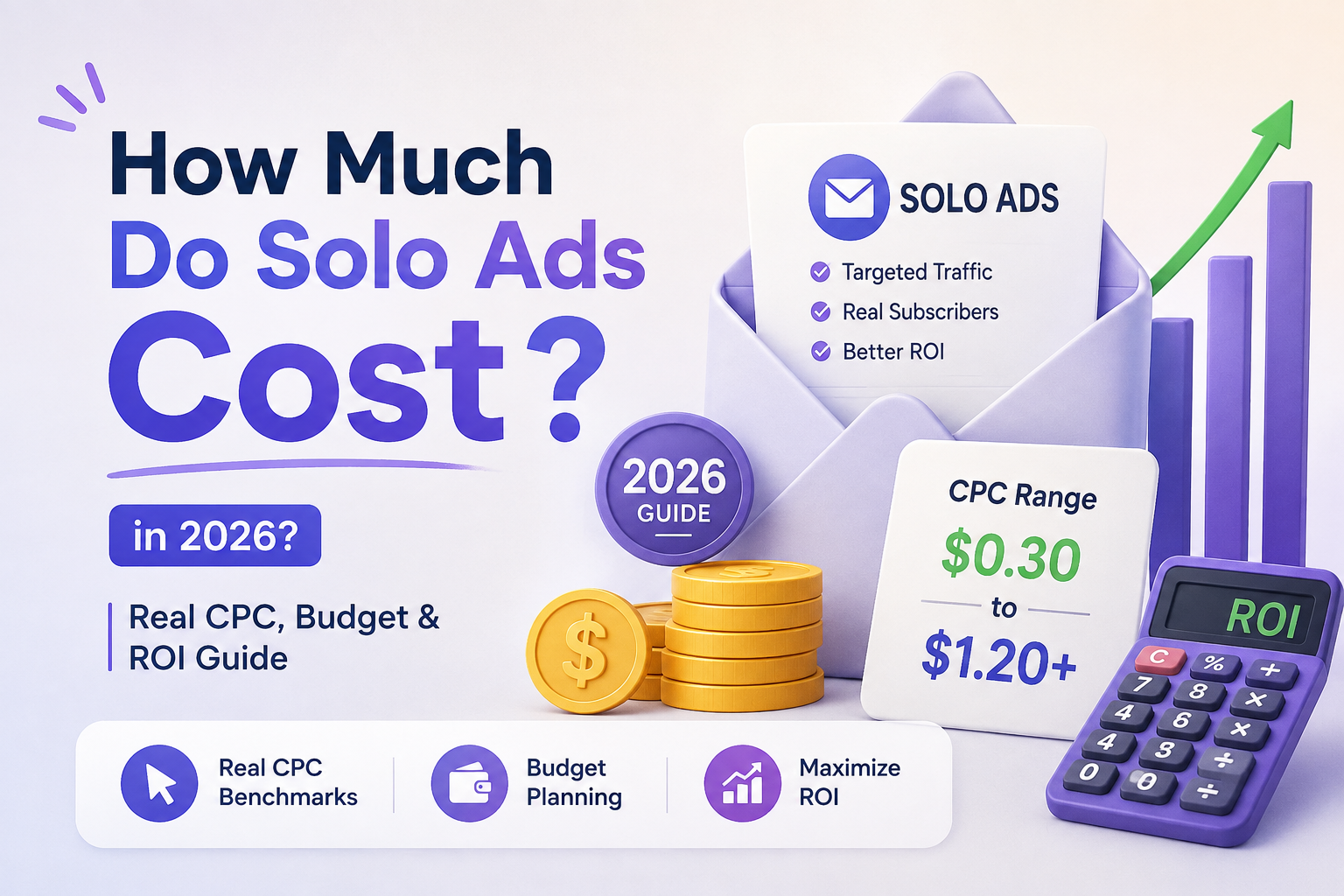
Did you know that over 60% of email marketers struggle to balance traffic volume with actual lead quality? Navigating the digital landscape requires a sharp eye on your spending. When you explore how much do solo ads cost, you must look beyond the initial price tag to understand the true value of your investment.
Successful campaigns in the United States rely on a delicate mix of traffic quality, conversion rates, and your total budget when evaluating how much do solo ads cost. You need to distinguish between the advertised price per click and the final amount required to generate a loyal customer. Calculating your break-even point is the most effective way to ensure your marketing efforts remain profitable.
This guide helps you identify affordable providers without sacrificing the integrity of your list. By mastering these metrics, you will gain the confidence to scale your outreach effectively. Let us examine the strategies that turn simple clicks into sustainable revenue.
Key Takeaways
- Understand the difference between raw traffic prices and actual lead acquisition expenses.
- Learn to calculate your break-even point to protect your marketing budget.
- Prioritize traffic quality over the lowest available price to improve conversion rates.
- Evaluate providers based on historical performance rather than just initial quotes.
- Master the balance between campaign spending and long-term return on investment.
Stop Guessing Your Solo Ad Costs
Stop guessing at solo ad costs. Learn how CPC, traffic quality, and break-even math work together to protect your budget and improve profitability before scaling.
What Are Solo Ads and How Do They Work?
At their core, what are solo ads if not a strategic shortcut for digital growth? These campaigns involve purchasing email-based traffic from a publisher or list owner who has already cultivated a specific audience, which can affect how much do solo ads cost.
Instead of building your own list from zero, you pay to have your offer featured in an email sent to an existing subscriber base, influencing how much do solo ads cost. This allows you to drive immediate traffic to your landing page and test your conversion funnel without waiting months for organic growth.
How a Solo Ad Campaign Reaches Another Person’s Email List
The process begins when you identify a provider whose audience aligns with your niche, which can determine how much do solo ads cost. You provide the email copy and the link to your landing page, which the provider then broadcasts to their subscribers.
When a subscriber clicks the link in that email, they are directed to your site. Success depends on the quality of the list and how well your offer matches the interests of those subscribers.
“The most effective marketing strategies are those that provide value to the audience while respecting their inbox and their time.”
What You Typically Pay For: Clicks, Traffic, and List Access
It is important to understand that you are not buying the provider’s email list when evaluating how much do solo ads cost. You are paying for guaranteed traffic or a specific number of clicks to your destination URL.
In the United States, compliance is non-negotiable. You must ensure that the provider follows CAN-SPAM regulations and that the subscribers have given proper consent to receive third-party offers.
How Solo Ads Differ From Paid Search and Social Advertising
Unlike paid search or social media ads, solo ads rely on the trust established between the list owner and their subscribers. While platforms like Google or Facebook offer granular targeting based on user behavior, solo ads offer a more direct, human-to-human connection.
You have less control over the specific demographic data compared to social platforms, but you gain the benefit of a pre-warmed audience. This often leads to higher engagement rates if your offer is well-aligned with the provider’s niche.
How Much Do Solo Ads Cost in 2026?
Budgeting for email traffic starts with knowing exactly how much do solo ads cost across different industries. In 2026, pricing remains dynamic, influenced heavily by the quality of the list and the specific intent of the subscribers. Understanding these variables helps you avoid overpaying while ensuring you receive high-quality traffic.
Typical Solo Ad CPC Ranges for General Niches
For general niches like personal development or broad interest marketing, you will often find competitive pricing when considering how much do solo ads cost. Most providers operate on a cost-per-click (CPC) model, which simplifies your budget planning. You can generally expect to pay between $0.40 and $0.80 per click for standard, non-specialized traffic.
Expected CPCs for Finance, Health, Business, and E-commerce Offers
Niche-specific traffic commands higher prices because the audience is more targeted and harder to reach, which affects how much do solo ads cost. Finance and business opportunity lists often carry a premium due to the high lifetime value of those leads. Conversely, e-commerce and health offers may fluctuate based on seasonal demand and current market trends.
Low-Cost, Midrange, and Premium Solo Ad Pricing
Pricing tiers help you categorize the type of traffic you are purchasing and understand how much do solo ads cost. These tiers reflect the level of engagement and the historical performance of the email list.
What a $0.30 to $0.60 CPC Usually Indicates
A CPC in this range often points to broad, general-interest traffic and helps explain how much do solo ads cost. These lists are typically larger and less segmented, which makes them ideal for initial testing. You might see lower conversion rates, but the lower cost allows you to gather data without a massive upfront investment.
When a $0.60 to $1.50 CPC Can Be Reasonable
When you pay between $0.60 and $1.50, you are usually buying access to a more responsive, vetted audience, which influences how much do solo ads cost. This price point is common for business-to-business or specific health-related offers. You should expect higher engagement rates and better lead quality at this level.
Why Premium Lists May Charge More Than $1.50 Per Click
Premium lists often charge more than $1.50 per click because the subscribers are highly qualified and exclusive, affecting how much do solo ads cost. These providers often use sophisticated filtering to ensure only high-intent users see your offer. While expensive, this traffic can lead to a significantly higher return on investment for high-ticket products.
Minimum Purchase Requirements and Common Order Sizes
Most providers require a minimum purchase to make the campaign worth their administrative effort. Common order sizes start at 100 to 200 clicks, which provides enough data to evaluate your landing page performance and determine how much do solo ads cost. Always confirm these minimums before finalizing your budget to avoid unexpected cash flow issues.
| Pricing Tier | CPC Range | Best For |
|---|---|---|
| Low-Cost | $0.30 – $0.60 | Broad testing and lead generation |
| Midrange | $0.60 – $1.50 | Targeted niches and sales funnels |
| Premium | $1.50+ | High-ticket offers and exclusive lists |
Real Solo Ad CPC Benchmarks by Traffic Quality
When you explore what are solo ads, you quickly realize that price is only one part of the equation. A promised cost per click (CPC) is often incomplete unless the provider clearly defines their delivery methods, geographic reach, and traffic verification standards.
In 2026, these benchmarks serve as comparison tools rather than fixed guarantees when evaluating how much do solo ads cost. You must look at the specific audience mix and device targeting to understand the true value of the traffic you are purchasing.
How to Interpret a Promised CPC Before You Buy
Before committing your budget, ask the provider how they verify their traffic. Transparency is your best defense against low-quality bot traffic or unengaged subscribers.
Always verify if the promised CPC includes mobile and desktop traffic or if it is restricted to specific regions. A low price might look attractive, but it often hides a lack of filtering that could waste your entire marketing spend when considering how much do solo ads cost.
“Quality is not an act, it is a habit.”
Comparing Cheap, Average, and High-Intent Clicks
Traffic quality generally falls into three distinct categories that dictate your potential return on investment and how much do solo ads cost. Understanding these tiers helps you align your expectations with your actual campaign goals.
- Cheap Clicks: Often sourced from broad, unsegmented lists; best for initial testing of landing page mechanics.
- Average Clicks: Standard traffic from active subscribers who have shown interest in similar niches.
- High-Intent Clicks: Premium traffic from highly segmented lists where subscribers have recently engaged with similar offers.
Why Delivered Clicks and Unique Clicks Can Produce Different Costs
It is vital to distinguish between delivered clicks and unique clicks. A delivered click simply counts every time a link is accessed, while a unique click tracks individual visitors.
If a provider sends multiple clicks from the same person, your cost per unique visitor will be higher than the advertised CPC. Always prioritize unique clicks to ensure you are reaching new potential customers rather than paying for repeat visits from the same individual.
Benchmarks for Testing a New Solo Ad Provider
When working with a new provider, start with a controlled test to gather reliable data. A small order allows you to verify the quality of the traffic without risking a large portion of your budget.
Ensure your test includes clear tracking parameters and defined replacement terms for invalid traffic. By setting these expectations early, you create a professional foundation for scaling your campaigns effectively.
What Determines the Price of a Solo Ad?
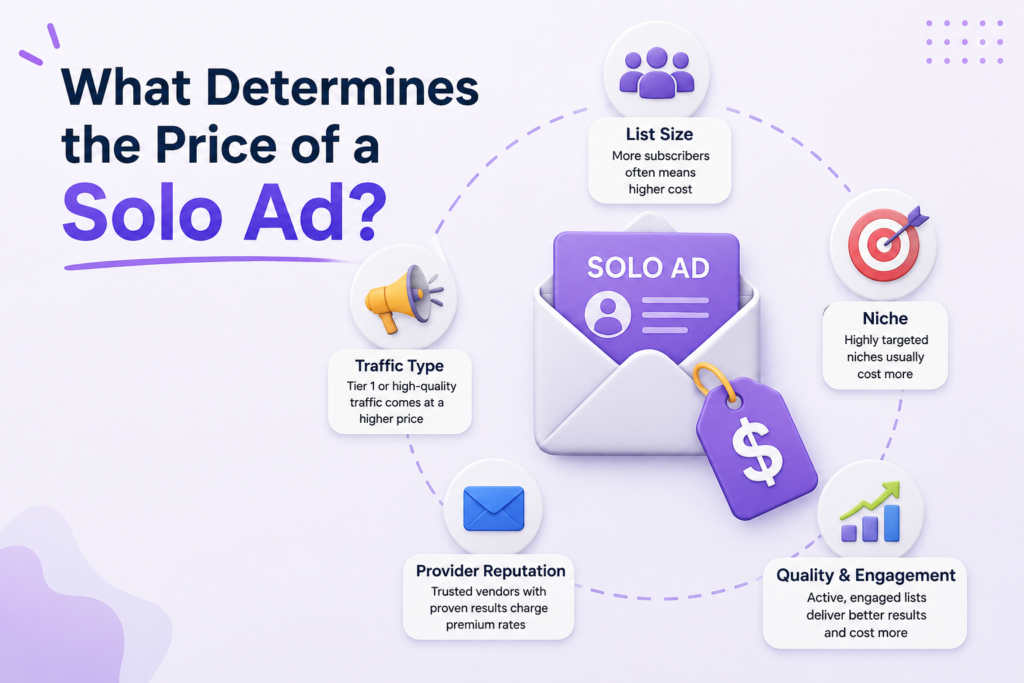
Navigating the pricing landscape of solo ads requires a clear look at the variables that impact your bottom line. Because these campaigns rely on direct access to an established email list, the cost is rarely a flat rate, making it important to understand how much do solo ads cost. Instead, providers adjust their pricing based on the perceived value and performance potential of the traffic they deliver.
Subscriber Engagement, Open Rates, and Click-Through Rates
The most significant driver of cost is the quality of the list itself when determining how much do solo ads cost. Providers with high open rates and consistent click-through rates (CTR) charge a premium because their subscribers are active and responsive.
When you pay for solo ads, you are essentially paying for the attention of a warm audience. If a list is highly engaged, the likelihood of your offer being seen and clicked increases, which justifies a higher price point per click.
Niche Demand and Audience Buying Intent
Market demand plays a massive role in how much you will spend. Niches like finance, health, and business opportunities often see higher costs due to intense competition among advertisers.
Furthermore, an audience with a proven history of purchasing products commands a higher price. You are paying for buying intent, which is far more valuable than general traffic that may never convert into a sale.
List Size, Exclusivity, and Geographic Targeting
Scarcity is a major factor in pricing. If a provider offers exclusive access to a small, highly specialized list, they will charge more than someone selling bulk traffic to a generic audience.
Geographic targeting also shifts the cost significantly when determining how much do solo ads cost. Traffic from the United States is typically more expensive than international traffic because it is highly sought after by domestic businesses looking for high-conversion leads.
Offer Type, Landing Page Quality, and Traffic Requirements
Your own marketing assets influence the price you are quoted. Many reputable providers will review your landing page before agreeing to send traffic to ensure it meets their quality standards.
If your offer is difficult to promote or your landing page has a low conversion rate, some providers may refuse the campaign or charge a premium to compensate for the potential loss of their list’s trust. Maintaining a high-quality funnel is essential to keeping your solo ads costs manageable.
Provider Reputation, Tracking, and Refund Policies
Trust is a currency in the email marketing world. Established providers with a track record of transparency often charge more because they offer reliable, independent tracking and clear refund policies.
- Independent Tracking: Ensures you only pay for legitimate, unique clicks.
- Replacement Policies: Protects your investment if the traffic quality falls below the agreed-upon threshold.
- Reputation: Reduces the risk of receiving bot traffic or low-quality leads.
Investing in a reputable provider might seem more expensive upfront, but it often results in a lower effective cost per lead by avoiding wasted spend on poor-quality traffic and clarifying how much do solo ads cost.
How to Set a Solo Ad Budget That Fits Your Goal
Successful digital marketers treat their advertising budget as a strategic investment rather than a simple expense when considering how much do solo ads cost. By defining your financial boundaries early, you protect your capital while gathering the insights needed to scale. Finding affordable solo ads requires a balance between minimizing risk and securing enough data to make informed decisions.
Budgeting for a Small Initial Test
When you are just starting, your primary goal is to validate your offer without overextending your resources. A small test allows you to gauge the responsiveness of a list before committing to larger buys. Focus on finding affordable solo ads that provide enough traffic to see if your landing page converts.
“The goal of an initial test is not immediate profit, but the acquisition of actionable data that informs your next move.”
Planning a $500, $1,000, or $2,500 Campaign
Your budget size dictates the depth of your market research and the speed of your optimization. A $500 budget is typically reserved for a single, focused test to verify basic conversion metrics. Moving to a $1,000 or $2,500 budget allows you to test multiple providers or different segments of an audience simultaneously.
- $500 Tier: Best for testing one offer with one provider.
- $1,000 Tier: Allows for split-testing two different landing pages.
- $2,500 Tier: Enables broad testing across multiple niches and providers.
Allocating Money Between Traffic, Email Follow-Up, and Conversion Tools
Do not spend your entire budget on traffic alone. You must reserve funds for the infrastructure that turns clicks into long-term customers. Effective campaigns often allocate 60% to traffic, 20% to email automation software, and 20% to conversion optimization tools.
Choosing a Test Size That Produces Useful Data
To make a statistically significant decision, you need a sufficient volume of visitors to understand how much do solo ads cost. If your test size is too small, you cannot determine if a failure is due to the traffic quality or your landing page design. Aim for at least 200 to 500 clicks to establish a reliable baseline for your conversion rate.
Calculating Click Volume From Your Planned Budget
Use the expected cost per click (CPC) to estimate your reach before you finalize your purchase and understand how much do solo ads cost. If you have a $500 budget and the average CPC is $0.50, you can expect roughly 1,000 clicks. Always confirm these numbers with your provider to ensure your expectations align with their delivery capabilities.
Leaving Room for a Second Test or Optimization Round
Never exhaust your entire budget on the first attempt. You should always set aside at least 30% of your total funds for a second round of testing based on the data you collect. This reserve allows you to pivot, refine your headlines, or switch to a better-performing provider without needing to secure new capital when evaluating how much do solo ads cost.
The Total Cost Beyond the Advertised CPC
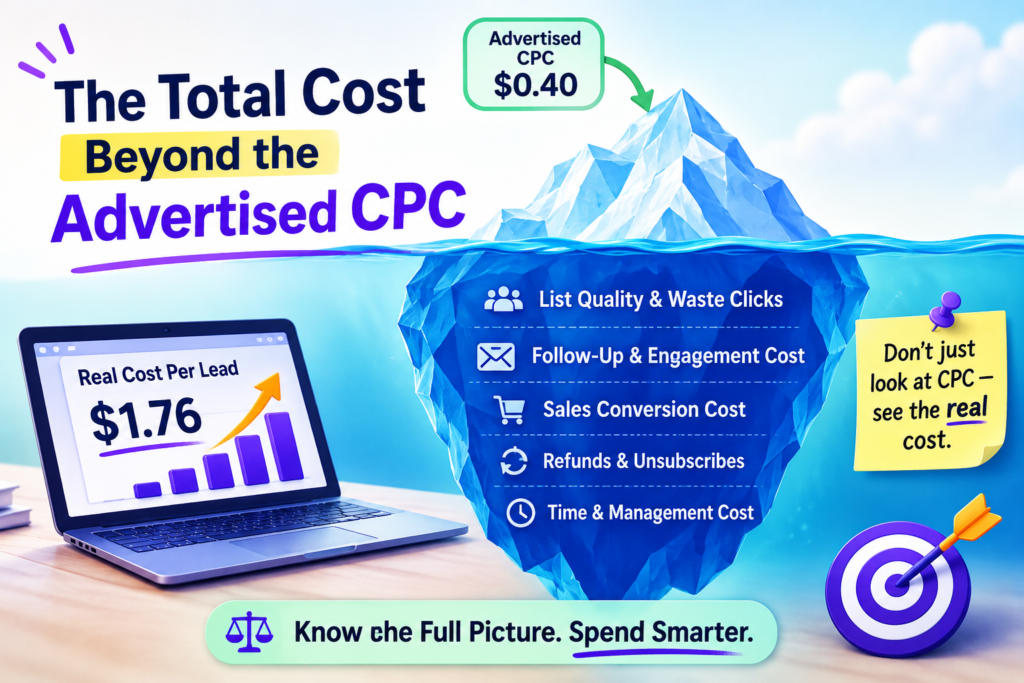
If you want to master what are solo ads, you must account for the hidden infrastructure costs that support every campaign. Many marketers mistakenly believe that the price of a click is the only expense they will face. In reality, the advertised cost per click (CPC) is merely the starting point of your financial commitment.
Landing Page, Funnel, and Lead Magnet Expenses
Before you send traffic to an offer, you need a high-converting landing page to understand how much do solo ads cost beyond the initial click. You will likely spend money on hosting services, domain registration, and funnel-building software like ClickFunnels or Leadpages. Creating a compelling lead magnet also requires time or money to ensure it provides enough value to capture an email address.
Email Marketing Software and Follow-Up Costs
Once a lead enters your system, you need a reliable autoresponder to manage your list and understand how much do solo ads cost beyond the initial traffic. Platforms like ActiveCampaign or AWeber charge monthly fees that scale as your subscriber count grows. These costs are essential because the real profit in email marketing often comes from your follow-up sequence rather than the initial click.
Tracking, Analytics, and Conversion-Rate Testing Costs
You cannot improve what you do not measure when determining how much do solo ads cost. Professional marketers invest in tracking tools like ClickMagick to monitor click quality and conversion rates. Split testing your headlines and call-to-action buttons is another necessary expense that helps you refine your funnel for better performance.
Payment Processing, Refunds, and Compliance-Related Expenses
Running a business involves administrative costs such as payment gateway fees from Stripe or PayPal. You must also account for potential refunds and the cost of maintaining compliance with regulations like the CAN-SPAM Act. These operational expenses are a standard part of doing business in the digital space.
How Additional Costs Change Your Effective Cost Per Lead
When you calculate your true expenses, you should divide your total campaign spending by the number of qualified leads generated to understand how much do solo ads cost in practice. This gives you a much more realistic effective Cost Per Lead (CPL) than looking at media costs alone. Understanding what are solo ads in this context helps you build a sustainable, profitable business model that accounts for every dollar spent.
How to Calculate Solo Ad ROI and Break-Even CPC
Determining your break-even point is essential when you want to know how much do solo ads cost in relation to your actual revenue. Many marketers fail because they only look at the initial price tag rather than the long-term value of the traffic they purchase when evaluating how much do solo ads cost.
The Core Solo Ad ROI Formula
To measure success, you must use a standard Return on Investment (ROI) formula. Subtract your total campaign costs from your total revenue, then divide that number by your total costs.
“The goal of marketing is not just to get a sale, but to build a relationship that provides value over the lifetime of the customer.”
Calculating Cost Per Lead, Cost Per Customer, and Revenue Per Click
You need to track three specific metrics to understand your performance. Your Cost Per Lead (CPL) is the total spend divided by the number of new subscribers. Your Cost Per Customer is the total spend divided by the number of actual sales.
Finally, Revenue Per Click (RPC) is calculated by dividing total revenue by the number of clicks received. If your RPC is higher than your CPC, you are generating a positive return on your traffic.
Using Email Conversion Rates to Estimate Campaign Value
Your email follow-up sequence acts as the engine for your conversion rates. By tracking how many subscribers move from your list to a purchase, you can estimate the future value of every click.
Example: A $1,000 Campaign With a $1.00 CPC
If you spend $1,000 at a $1.00 CPC, you receive 1,000 clicks. If 2% of those visitors buy a $50 product, you generate $1,000 in revenue, resulting in a break-even campaign.
Example: A Higher CPC With Better Customer Intent
Alternatively, paying $2.00 per click for a more targeted list might yield a 5% conversion rate. Even though your costs are higher, you generate $5,000 in revenue, proving that how much do solo ads cost is secondary to the quality of the audience.
| Metric | Low-Intent Campaign | High-Intent Campaign |
|---|---|---|
| Total Spend | $1,000 | $1,000 |
| Cost Per Click | $1.00 | $2.00 |
| Conversion Rate | 2% | 5% |
| Total Revenue | $1,000 | $2,500 |
Finding Your Maximum Profitable CPC
Your maximum profitable CPC is the highest amount you can pay while still maintaining a positive margin and determining how much do solo ads cost for your campaign.You calculate this by multiplying your average order value by your conversion rate. Always keep this number in mind when evaluating how much do solo ads cost from different providers.
Why Immediate Sales Do Not Always Show the Full Campaign ROI
Immediate sales often represent only a fraction of your total profit. Email follow-up sequences, backend offers, and repeat purchases significantly increase the lifetime value of a lead. A campaign that looks like a loss on day one may become highly profitable over the next six months.
How to Find Affordable Solo Ads Without Sacrificing Quality
Navigating the solo ad market effectively means looking beyond the price tag to find real value. While many marketers search for affordable solo ads to keep their initial costs low, the cheapest option is rarely the most profitable. You must learn to distinguish between a genuine bargain and a low-quality traffic source that could waste your entire budget.
Turn Clicks Into Measurable Growth
Turn every click into a measurable growth opportunity. Build a stronger funnel, optimize follow-up, calculate true CPL, and scale campaigns with confidence and better control.
When a Lower CPC Can Be a Smart Testing Advantage
Using a lower cost-per-click (CPC) is a valid strategy when you are running small, initial tests. By spending less on your first 100 clicks, you can gather enough data to see if your landing page converts without risking a large investment. This approach allows you to refine your funnel before scaling up to more expensive, high-intent traffic.
Warning Signs Behind Unusually Cheap Solo Ads
Be cautious when you encounter prices that seem too good to be true. Common warning signs include providers who cannot offer clear, verifiable statistics or those who use vague definitions for “delivery.” If a provider refuses to show proof of engagement or uses recycled, cold audiences, your campaign will likely suffer from poor conversion rates.
Evaluating Traffic Quality Instead of Chasing the Lowest Price
Focus your attention on metrics that actually matter for your bottom line. Instead of just looking at the CPC, analyze the number of unique clicks and the overall engagement level of the list. High-quality traffic often comes from active, responsive subscribers who are genuinely interested in your specific niche.
Ways to Negotiate Volume Discounts and Test-Run Terms
You can often improve your margins by negotiating directly with reputable providers. Ask for volume discounts if you plan to commit to a larger campaign over several months. Additionally, request clear terms regarding replacement clicks if the traffic quality falls below the agreed-upon standards during your test run.
When Paying More for a Specialized Audience Makes Sense
Sometimes, paying a premium is the smartest financial decision you can make. If a provider offers access to a highly segmented, specialized audience that perfectly matches your offer, the higher cost is usually offset by a much higher conversion rate. Investing in quality ensures that your leads are actually interested in your product or service.
| Strategy | Cost Level | Best Use Case | Expected Outcome |
|---|---|---|---|
| Broad Testing | Low | Initial funnel validation | High volume, low conversion |
| Niche Targeting | Medium | Refining lead quality | Balanced cost and ROI |
| Premium Segment | High | Scaling profitable offers | Lower volume, high conversion |
How to Choose and Vet a Solo Ad Provider
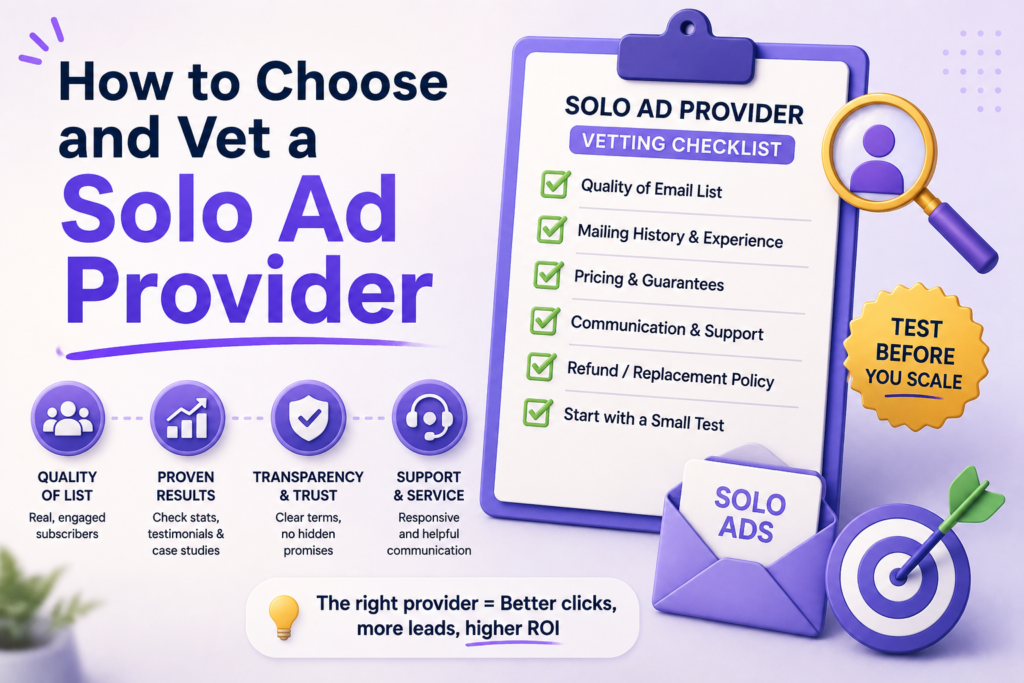
Finding a reliable provider for solo ads requires more than just looking at a price tag. You must carefully vet every potential traffic source to protect your brand and your investment. A professional approach to due diligence ensures that you receive high-quality traffic that actually converts.
Questions to Ask About List Source and Subscriber Consent
Before you commit your budget, you need to understand exactly how the provider built their list. Ask if the subscribers opted in through a specific landing page or if they were acquired through third-party lead generation. Explicit consent is the gold standard for email marketing.
Verify that the subscribers are aware they will receive third-party offers. If a list owner cannot explain their acquisition method, you risk sending your emails to people who never asked to hear from you. This leads to high bounce rates and potential spam complaints.
Evidence to Request Before Purchasing Traffic
Professional providers should be willing to share data that proves their list quality. Do not hesitate to ask for specific metrics before you finalize any purchase of solo ads.
Recent Delivery Statistics and Audience Demographics
Request a screenshot of recent campaign performance to see open rates and click-through rates. You should also ask for a breakdown of the audience demographics, such as age, location, and primary interests. This helps you determine if their subscribers align with your specific offer.
Independent Tracking Data and Customer References
Always ask for links to independent tracking reports from tools like ClickMagick or Voluum. These reports provide an unbiased view of traffic quality. Additionally, request contact information for past clients who have run similar campaigns to verify the provider’s reputation.
Contract Terms, Replacement Clicks, and Refund Conditions
Your agreement should be documented in writing to avoid future disputes. Ensure the contract clearly defines what happens if the traffic does not meet the agreed-upon standards. Replacement obligations are essential if you receive bot traffic or non-unique clicks.
Check the refund policy carefully before sending payment. A reputable provider will offer a clear path for resolution if they fail to deliver the promised number of clicks. Never rely on verbal promises when dealing with traffic delivery.
Privacy, CAN-SPAM, and Consent Considerations for U.S. Campaigns
Operating within the United States requires strict adherence to the CAN-SPAM Act. You must ensure that the provider includes a valid physical address in their emails and a clear way for users to opt out. Compliance is not optional; it is a legal requirement for your business.
Confirm that the provider maintains a clean list by regularly removing inactive or complaining subscribers. If you use a provider that ignores these rules, your own domain reputation could suffer. Always prioritize partners who respect user privacy and data protection laws.
How to Compare Providers on More Than CPC
Comparing providers based solely on the lowest cost per click is a common mistake. Instead, evaluate them based on the total value they bring to your business. Use the following table to compare potential partners effectively.
| Criteria | Low-Quality Provider | High-Quality Provider |
|---|---|---|
| List Source | Unknown or Purchased | Verified Opt-in |
| Transparency | Hides Tracking Data | Provides Full Reports |
| Lead Quality | High Bounce Rates | High Engagement |
| Support | No Refund Policy | Clear Replacement Terms |
How to Improve Solo Ad Results and Lower Your Effective Cost
Improving your results from a solo ad campaign involves more than just picking the right provider when evaluating how much do solo ads cost. By focusing on data-driven adjustments, you can significantly boost your solo ad ROI and lower your effective cost per lead over time.
Matching Your Offer to the Provider’s Audience
Success begins with ensuring your offer aligns perfectly with the provider’s list when evaluating how much do solo ads cost. If you promote a high-ticket business coaching program to a list interested in weight loss, your conversion rates will suffer. Always ask providers about the specific interests and demographics of their subscribers before committing to a purchase.
Creating a Landing Page That Converts Solo Ad Traffic
Your landing page acts as the bridge between a cold click and a qualified lead when considering how much do solo ads cost. A clean, distraction-free design that highlights a single, clear benefit is essential for high conversion rates. Keep your messaging consistent with the ad copy the user clicked to ensure a seamless transition.
Using UTM Parameters and Conversion Tracking Correctly
You cannot optimize what you do not measure accurately. By using unique UTM parameters for every traffic source, you can identify exactly which providers deliver the highest quality leads. This data allows you to cut underperforming sources and double down on those that drive actual sales.
Testing Headlines, Lead Magnets, and Calls to Action
Small changes to your landing page can lead to massive improvements in your acquisition costs and affect how much do solo ads cost. Conduct A/B tests on your headlines to see which hooks resonate most with the incoming traffic. Testing different lead magnets also helps you determine what value proposition drives the highest opt-in rates.
Segmenting Leads and Strengthening the Email Follow-Up Sequence
The initial click is only the beginning of your relationship with a potential customer and can influence how much do solo ads cost overall. Use segmentation to categorize leads based on their behavior and interests immediately after they opt in. A strong, automated email follow-up sequence ensures that you nurture these leads, increasing the lifetime value of every subscriber.
When to Pause, Optimize, or Scale a Campaign
Knowing when to adjust your strategy is vital for maintaining a healthy budget and understanding how much do solo ads cost over time. If your cost per lead exceeds your target threshold after a sufficient sample size, pause the campaign to review your funnel. If the data shows high engagement and positive conversion trends, you should scale your spend to capture more market share.
Test Smarter Before You Scale
Test smarter before you scale. Discover practical ways to vet providers, track unique clicks, control risk, and find traffic that actually converts consistently and profitably.
Conclusion
Navigating the landscape of email traffic requires a shift in perspective. You must look beyond the initial price tag to understand the true value of your investment. Success in 2026 hinges on your ability to balance CPC, audience intent, and the technical performance of your sales funnel.
Many marketers hunt for affordable solo ads, yet low costs often mask poor engagement or low-quality leads. A higher price point frequently signals a more responsive audience that justifies the expense through better conversion rates. You should prioritize the quality of traffic over the lowest possible bid to protect your long-term ROI.
Start your journey with a small, measurable test to gather reliable data. Calculate your break-even point carefully before scaling your spending. Verify that your provider maintains high standards for subscriber consent and delivery transparency to keep your campaigns compliant.
Reserve a portion of your budget for ongoing optimization of your landing pages and follow-up sequences. This approach transforms your traffic into a sustainable asset rather than a one-time expense. Focus on the total cost of acquisition to make informed decisions that drive real growth for your business.
FAQs
What are solo ads and how do they integrate into your digital marketing strategy?
Solo ads are a specialized form of email marketing where you pay an established list owner to send your promotional message to their subscribers. Unlike traditional display advertising, solo ads grant you direct access to a pre-qualified audience. You typically pay for a specific number of clicks, redirecting engaged subscribers from the provider’s email list to your own landing page or sales funnel.
How much do solo ads cost when targeting premium United States audiences in 2026?
When evaluating how much do solo ads cost, you will find that pricing is primarily driven by niche demand and traffic quality. In 2026, affordable solo ads usually fall within the $0.30 to $0.60 CPC range for general business opportunities. However, for high-intent niches such as finance, health, or enterprise B2B, you should expect to pay between $0.60 and $1.50+ per click to ensure you are reaching a responsive, high-quality audience.
Can you find affordable solo ads that still provide a high return on investment?
Yes, finding affordable solo ads is possible if you focus on the “break-even CPC” rather than just the lowest price. Lower-cost traffic can be an excellent way to test new headlines or lead magnets on platforms like Udimi. However, you must vet providers carefully; if the price is significantly below market averages, it may indicate bot traffic or an unengaged list. High-quality, mid-range traffic often yields a better ROI because the conversion rate into sales is substantially higher.
What determines the variance in solo ad pricing between different providers?
Several factors influence the cost, including the provider’s reputation, the list’s engagement levels (open and click-through rates), and geographic targeting. Traffic from “Tier 1” countries like the United States generally commands a premium. Additionally, providers who use robust tracking tools like ClickMagick to verify unique clicks and filter out fraud often charge more because they offer a higher level of transparency and security for your investment.
What total budget should you plan for beyond the initial click cost?
Your total investment involves more than just the media buy. To run a professional campaign, you should budget for essential tools such as an email service provider like AWeber or GetResponse, a landing page builder like ClickFunnels, and tracking software. For a meaningful test in 2026, starting with a budget of $500 to $1,000 allows you to gather enough data to optimize your funnel before scaling to larger spends of $2,500 or more.
How do you calculate the ROI and Cost Per Lead for your campaign?
To find your ROI, subtract your total campaign expenses (traffic plus software) from the total revenue generated by those leads. To find your effective Cost Per Lead (CPL), divide your total spend by the number of new subscribers. For example, if you spend $1,000 on solo ads and generate 400 leads, your CPL is $2.50. Monitoring these metrics helps you decide whether to scale your campaign or pivot to a different provider.
How can you verify the quality of a provider before committing to a large purchase?
Always start with a small test order of 100 to 200 clicks to evaluate the lead quality and responsiveness. Ask the provider for recent delivery statistics and proof of CAN-SPAM compliance. Check for third-party reviews on sites like WarriorPlus or specialized Facebook groups. Reliable providers will offer clear terms regarding replacement clicks and will be transparent about how they built their list and how often they prune inactive subscribers.
Why is the long-term email follow-up sequence critical to solo ad success?
Most solo ads traffic will not convert into a customer on the first visit. The true value is in the “back-end” revenue generated through your automated email sequence. By providing consistent value to your new subscribers through tools like ConvertKit, you can recoup your initial traffic costs and move toward profitability through repeat sales and long-term customer lifetime value.
3 thoughts on “How Much Do Solo Ads Cost in 2026? Real CPC, Budget & ROI Guide”