
Have you ever wondered if paying for visitors could actually accelerate your growth, or are you simply inviting digital noise to your doorstep? As a marketer in the United States, you face a constant pressure to deliver immediate results for your campaigns and new offers.
Deciding to buy targeted organic traffic is a significant choice that requires a clear strategy. While some services promise instant visibility, you must distinguish between legitimate audience acquisition and artificial clicks that offer no real value.
This article explores the complexities of paid visitor acquisition across eleven essential sections. We will cover critical topics like quality standards, compliance, and how to measure success effectively. Remember, purchased visitors should support your measurable business goals rather than replace your core efforts in SEO, content creation, or conversion optimization.
Key Takeaways
- Understand the difference between high-quality visitors and bot-driven clicks.
- Ensure your acquisition strategy aligns with long-term business objectives.
- Prioritize compliance and data transparency when selecting a provider.
- Use paid visitors as a supplement to, not a replacement for, SEO.
- Implement rigorous testing to verify the quality of incoming leads.
Start With a Targeted Traffic Test
Reach relevant visitors with a controlled campaign, transparent sourcing, and measurable goals designed to validate traffic quality before you scale your investment further with confidence.
What “Buy Targeted Organic Traffic” Really Means
The term “buy targeted organic traffic” is frequently misunderstood in the modern digital landscape. While it sounds like a shortcut to success, the reality involves complex technical processes that differ significantly from standard advertising methods. Understanding these nuances is vital before you invest your marketing budget.
Distinguish organic search traffic from paid, referral, and social visitors
To grasp the value of these services, you must first define where your visitors originate. Organic search traffic specifically refers to users who find your site through unpaid results on search engines like Google or Bing.
- Paid Traffic: Visitors arriving via PPC ads or sponsored placements.
- Referral Traffic: Users clicking links from other websites or blogs.
- Social Traffic: Visitors coming from platforms like LinkedIn, Facebook, or X.
True organic traffic is earned through high-quality content and search engine optimization. When you purchase traffic, you are often paying for a service that simulates or directs specific user behavior to your landing pages.
Understand what organic traffic services actually deliver
Professional organic traffic services typically focus on audience segmentation and distribution. They do not necessarily “hack” search engine algorithms to give you higher rankings.
Instead, these providers often offer tools to help you reach specific demographics. They may provide:
- Geographic targeting to reach users in specific regions.
- Device-specific traffic to match your mobile or desktop optimization.
- Detailed reporting on visitor behavior and session duration.
Recognize the difference between targeted website visitors and guaranteed clicks
It is important to distinguish between high-intent visitors and simple, automated clicks. A targeted visitor is someone who matches your ideal customer profile and has a genuine interest in your niche.
In contrast, guaranteed clicks often refer to volume-based packages that prioritize quantity over quality. If a provider promises thousands of hits without vetting the source, you are likely receiving low-intent traffic that will not contribute to your business goals.
Why no legitimate provider can guarantee rankings or conversions
No reputable company can promise that their organic traffic services will improve your search engine rankings or guarantee sales. Search engine algorithms are proprietary and constantly changing, making it impossible for any third party to control your position in the SERPs.
Furthermore, conversions depend on your website’s user experience, pricing, and offer quality. Traffic is merely the first step in the funnel; it is your responsibility to convert those visitors into loyal customers once they arrive.
Why Marketers Consider Buying Website Traffic
You might wonder why successful brands decide to pay for website traffic instead of relying solely on organic growth. While organic search is the gold standard for long-term authority, it often takes months to gain traction. Many marketers use targeted website visitors to bridge the gap between a new launch and established search rankings.
Generate early visibility for a new website or campaign
When you launch a new site, your primary challenge is the “cold start” problem. Without existing data or backlinks, search engines may take time to index and rank your pages. Buying traffic provides an immediate influx of users, allowing you to test your site’s functionality and user experience under real-world conditions.
Reach specific audiences by location, device, interest, or search intent
Modern advertising platforms allow you to filter traffic with incredible precision. You can ensure that your targeted website visitors are located in specific regions, such as the United States, or using specific mobile devices. This level of control helps you reach users who are most likely to engage with your specific offer or content.
Support content distribution without replacing search engine optimization
It is vital to remember that paid traffic is a supplement, not a replacement for SEO. While you can use paid channels to distribute your latest blog post or white paper, this does not build the domain authority required for organic rankings. You should view paid traffic as a way to amplify your reach while your SEO efforts mature in the background.
Identify business goals that traffic alone cannot accomplish
Traffic is merely a vanity metric if it does not lead to meaningful action. You must define what success looks like before you start a campaign. If your website has poor conversion rates or weak messaging, no amount of traffic will fix those underlying issues.
Use qualified visits to support leads, sales, sign-ups, or brand discovery
The ultimate goal of acquiring targeted website visitors is to drive measurable business outcomes. Whether you want to increase newsletter sign-ups, boost e-commerce sales, or improve brand awareness, your traffic strategy must align with these objectives. Use the following table to understand how different traffic goals impact your business strategy.
| Objective | Primary Metric | Business Impact |
|---|---|---|
| Brand Discovery | Impressions/Reach | Increased Market Awareness |
| Lead Generation | Form Submissions | Sales Pipeline Growth |
| E-commerce Sales | Conversion Rate | Direct Revenue Increase |
| Content Engagement | Time on Page | Audience Education |
How to Buy Targeted Organic Traffic Without Misrepresenting Results
If you plan to buy targeted organic traffic, you must first master the art of distinguishing between genuine user interest and artificial inflation. Maintaining data integrity is essential for long-term success in any digital marketing campaign. When you prioritize transparency, you protect your brand from the risks associated with low-quality acquisition methods.
Separate legitimate audience acquisition from artificial traffic generation
Legitimate traffic acquisition focuses on reaching users who have a genuine interest in your content or products. In contrast, artificial generation often relies on bots or click farms designed to inflate session counts without providing real value. Always verify that your traffic source prioritizes human engagement over simple volume metrics.
Check whether visitors arrive through real search behavior or simulated activity
Real search behavior involves a user typing a query into a search engine and clicking on a relevant result. Simulated activity, however, often uses automated scripts to mimic these actions, which can easily be detected by modern analytics tools. You should ensure that your traffic arrives through organic pathways rather than automated browsing or incentivized clicking schemes.
Review search engine, advertising, and analytics platform requirements
Before you commit to a service, you must understand the compliance standards of your primary platforms. Google Analytics and major advertising networks have strict policies regarding how traffic is sourced and tracked. Failure to adhere to these requirements can lead to data discrepancies or even the suspension of your accounts.
Watch for tactics that create invalid clicks, misleading attribution, or policy violations
Be wary of providers who promise guaranteed clicks or specific ranking improvements through traffic alone. These tactics often result in invalid clicks that waste your budget and skew your conversion data. Misleading attribution can also hide the true performance of your marketing channels, making it difficult to optimize your strategy effectively.
Ask providers to explain their traffic sources in plain language
Transparency is the hallmark of a reliable partner. If a provider cannot clearly explain where their visitors originate, you should consider it a major red flag. Ask for specific details about their acquisition methods and ensure they align with your business goals and ethical standards.
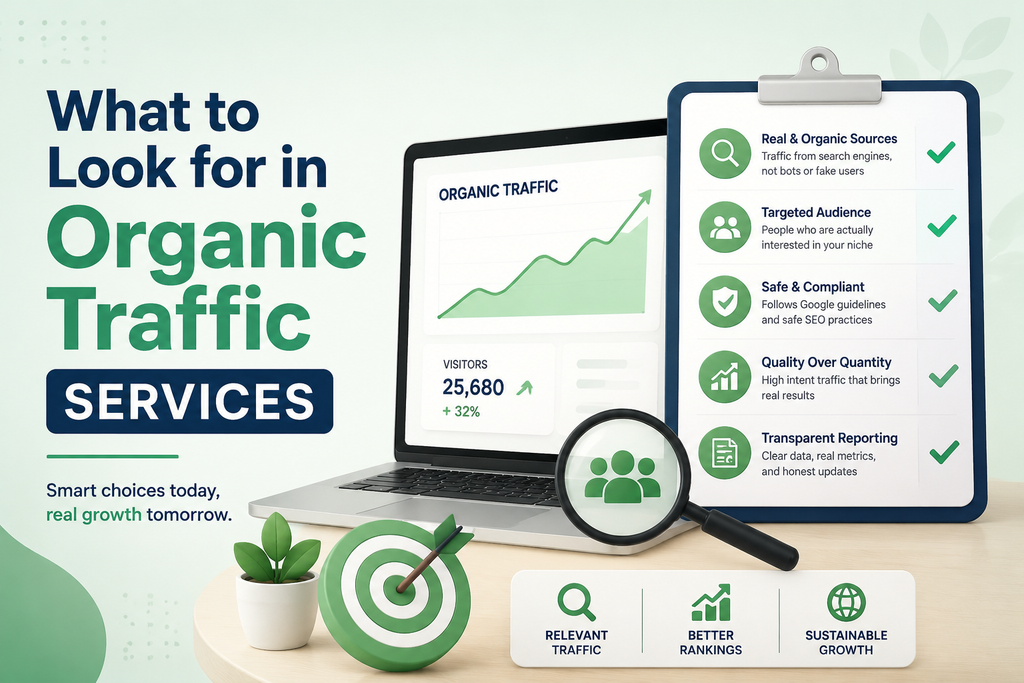
What to Look for in Organic Traffic Services
Selecting the right partner for your website growth requires a rigorous vetting process. Before you commit your budget, you must ensure that the organic traffic services you choose align with your business standards and compliance requirements.
Require transparent traffic-source documentation
A reputable provider should never hide where their visitors originate. You should demand clear documentation that outlines the specific channels and methods used to drive traffic to your site. If a company cannot explain their acquisition strategy in plain language, you should consider it a major red flag.
Evaluate audience targeting capabilities for the United States
When your business operates within the United States, geographic precision is non-negotiable. Ensure the provider can verify that visitors are physically located in your target regions. Furthermore, confirm that their data collection methods comply with local privacy expectations and regulations to protect your brand reputation.
Confirm that visits come from real users rather than bots, proxies, or click farms
The most dangerous threat to your analytics is artificial traffic. You must verify that the organic traffic services you hire deliver genuine human engagement. Ask for proof that their traffic is free from automated scripts, proxies, and click farms that could skew your data and trigger security warnings from search engines.
Review reporting frequency, attribution details, and data retention
Consistent reporting is the backbone of any successful campaign. You need to know exactly how often you will receive updates and how the provider attributes each visit to your site. A professional service will maintain clear data retention policies, allowing you to audit performance over time.
Useful reporting fields include landing page, location, device, source, session quality, and conversions
To make informed decisions, your reports must contain granular data. Ensure your dashboard or spreadsheet includes the landing page URL, the visitor’s geographic location, the device type used, and the source of the traffic. Tracking session quality and conversion events is essential to determine if the traffic actually provides value to your bottom line.
Assess contracts, refund terms, privacy practices, and customer support
Before signing any agreement, read the fine print regarding your rights. A reliable partner will offer clear refund terms and maintain strict privacy practices to keep your data secure. Responsive customer support is also vital, as you will likely have questions as your campaign progresses.
| Feature | High-Quality Provider | Low-Quality Provider |
|---|---|---|
| Traffic Source | Fully Transparent | Hidden or Vague |
| User Type | Verified Humans | Bots and Proxies |
| Reporting | Real-time Analytics | Delayed or Missing |
| Support | Dedicated Account Manager | Automated Responses |
By using this framework, you can effectively compare different organic traffic services. Always prioritize quality and transparency over low costs to ensure your investment yields sustainable results.
How to Judge High Quality Web Traffic
Distinguishing between high quality web traffic and low-value clicks is essential for your bottom line. When you decide to buy website traffic, you must look past vanity metrics to understand the true impact of your acquisition strategy.
Compare engagement quality instead of focusing on visitor volume
Many marketers fall into the trap of prioritizing high visitor numbers over actual user interest. A massive influx of visitors means very little if those individuals leave your site immediately without interacting with your content.
Focusing on volume often masks poor performance. Instead, prioritize sources that deliver users who actively engage with your brand and explore your offerings.
Analyze engaged sessions, time on page, return visits, and conversion paths
True value lies in how users behave once they arrive at your landing page. You should track metrics like engaged sessions, which indicate that a user spent significant time or completed a meaningful action.
Monitor the average time on page and whether visitors return for subsequent sessions. Mapping these interactions to your conversion paths helps you determine if the traffic is actually driving business results.
Inspect traffic patterns that may indicate automation or low-intent users
Automated scripts and click farms often leave behind distinct digital footprints. You must remain vigilant to ensure your budget is not wasted on non-human activity.
Warning signs include identical session durations, unusual geographic clusters, and sudden traffic spikes
Be wary of traffic that arrives in perfectly uniform patterns. If every visitor stays for exactly thirty seconds or originates from a single, irrelevant geographic region, you are likely dealing with bots.
Sudden, unexplained spikes in traffic that do not correlate with your marketing efforts are also major red flags. These patterns suggest that the traffic source is not providing genuine human interest.
Verify that landing pages match visitor intent
High-quality visitors expect your landing page to deliver on the promise of the ad or link they clicked. If the content does not align with their initial search intent, they will bounce immediately.
Ensure your messaging is consistent across all touchpoints. When the landing page provides clear value, you will see higher engagement and better conversion rates.
Use analytics validation before scaling a traffic source
Never commit to a large campaign without first verifying the data through multiple channels. You need to be certain that the traffic you buy website traffic is legitimate and effective.
Compare server logs, Google Analytics 4 data, Search Console data, and conversion records
Cross-referencing your data is the best way to spot discrepancies. If your server logs show a high volume of hits that do not appear in Google Analytics 4, you may be dealing with invalid traffic.
Always check your conversion records against your traffic reports to confirm that the visitors are actually taking the desired actions. Only scale your efforts once you have confirmed that the data is consistent and reliable.
Choose Targeting That Matches Your Customer Journey
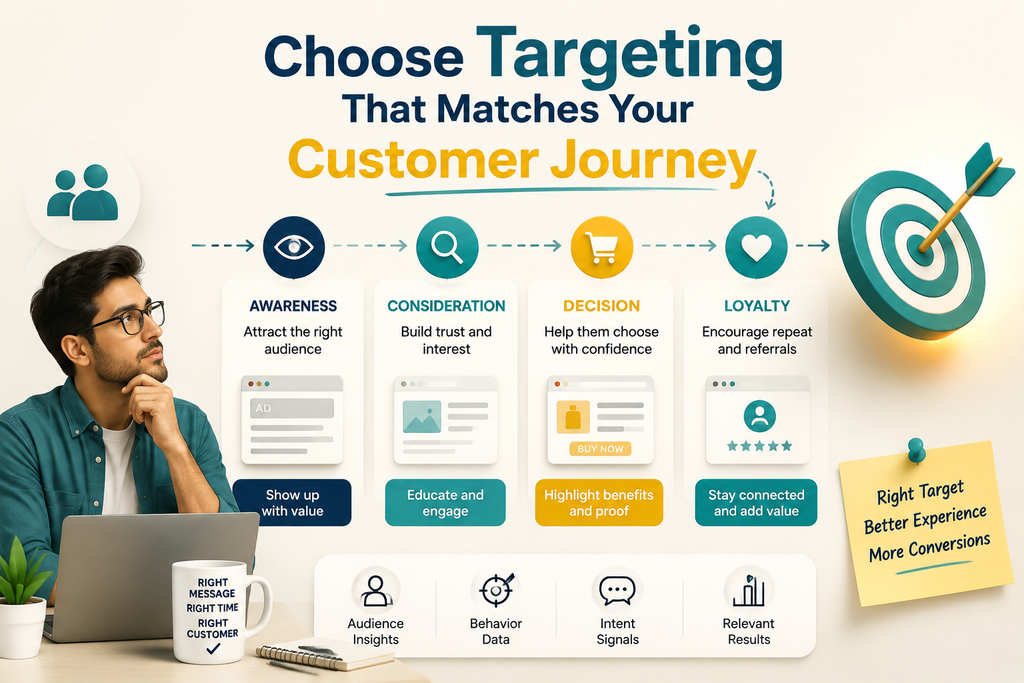
Targeted website visitors are most valuable when their search behavior perfectly mirrors the solution you provide. When you align your acquisition strategy with the specific stage of the customer journey, you reduce wasted spend and increase the likelihood of a conversion.
Target high-intent visitors by problem, query, and buying stage
Focus your efforts on users who are actively searching for solutions to specific problems. By identifying the exact queries that signal a high intent to purchase, you can filter out casual browsers.
Consider whether a user is in the awareness, consideration, or decision phase. Your messaging must speak directly to their current mindset to be effective.
Use geographic targeting for local and regional businesses
If your business operates within the United States, you should leverage geographic filters to ensure your traffic is relevant. Sending visitors from outside your service area rarely results in meaningful business outcomes.
Local businesses benefit most when they restrict traffic to specific states, cities, or zip codes. This precision ensures that every click has the potential to become a local customer.
Match content and landing pages to the visitor’s expected next action
The landing page experience must be a logical continuation of the user’s search intent. If a visitor arrives expecting a comparison, they should not be met with a generic sales pitch.
Align informational, comparison, and transactional pages with different audience needs
Informational pages should educate users who are still researching their options. Comparison pages help those who are narrowing down their choices, while transactional pages are designed for users ready to buy.
Sending all traffic to a single homepage is a common mistake that lowers conversion rates. Instead, route users to the specific page that matches their current stage in the funnel.
Control frequency, pacing, device mix, and referral context
Managing how often a user sees your ads or content is vital for maintaining brand reputation. You should also monitor the device mix to ensure your landing pages perform well on both mobile and desktop.
Referral context provides insight into where your visitors originate. By controlling these variables, you can optimize the quality of your targeted website visitors over time.
Avoid broad targeting when your offer serves a specialized market
Broad targeting often leads to high bounce rates and low engagement for niche products. If your offer serves a specialized market, you must use granular filters to reach the right audience.
| Strategy | Best For | Primary Goal |
|---|---|---|
| Informational | Awareness Stage | Building Trust |
| Comparison | Consideration Stage | Highlighting Value |
| Transactional | Decision Stage | Driving Sales |
Measure Whether Purchased Visitors Create Business Value
Determining the true value of your website traffic requires a shift from vanity metrics to concrete business outcomes. You must look beyond simple visitor counts to understand if your traffic strategy actually drives revenue. Identifying high quality web traffic is only possible when you have a clear framework for success.
Set measurable objectives before buying website traffic
Before you spend your budget, define exactly what success looks like for your campaign. Establish clear benchmarks for what a successful visitor interaction entails. Without these goals, you cannot determine if your investment is yielding a positive return.
Build source-level tracking with UTM parameters and conversion events
You must implement granular tracking to isolate the performance of your purchased traffic. Use UTM parameters to tag every incoming link, allowing your analytics platform to distinguish these visitors from other sources. Configure specific conversion events to trigger whenever a user completes a desired action on your site.
Measure primary and secondary outcomes
Distinguishing between different types of success helps you understand the full impact of your traffic. Not every visitor will buy immediately, but they may still provide long-term value.
Primary outcomes can include purchases, qualified leads, booked calls, or applications
These metrics represent the direct financial impact of your campaign. Focus your primary analysis on these high-intent actions to calculate your immediate return on investment.
Secondary outcomes can include email subscriptions, content engagement, and assisted conversions
Secondary outcomes act as indicators of future potential. These users may not convert today, but they are engaging with your brand and moving through your sales funnel.
Compare traffic quality with organic search and other acquisition channels
Benchmarking your results against established channels provides necessary context. If your purchased traffic shows significantly lower engagement than your organic search visitors, you may need to adjust your targeting strategy. Use the following table to categorize your performance metrics.
| Metric Category | Primary Outcome | Secondary Outcome | Quality Indicator |
|---|---|---|---|
| Conversion Type | Direct Sales | Newsletter Signups | High quality web traffic |
| User Intent | High (Buying) | Medium (Research) | Low Bounce Rate |
| Business Value | Immediate Revenue | Future Pipeline | Long Session Time |
Use cohort and assisted-conversion analysis to avoid premature conclusions
Avoid judging a campaign based on a single day of data. User behavior often follows a non-linear path, especially for complex products or services.
Allow enough time to evaluate repeat visits and delayed conversions
Give your campaigns sufficient time to mature before making final decisions. Many users require multiple touchpoints before they feel comfortable making a purchase. By tracking cohorts over several weeks, you gain a clearer picture of how high quality web traffic contributes to your long-term growth.
Calculate the Cost, Risk, and Break-Even Point
Before you decide to buy website traffic, you must calculate the true cost of every visitor. Many businesses focus solely on the price per click, but this metric rarely tells the whole story. You need to look at the entire funnel to understand if your investment is actually driving growth.
Protect Your Traffic Investment
Compare providers, verify traffic sources, set stop-loss rules, and test small before committing budget to traffic that may undermine your analytics or waste valuable spend.
Compare cost per visitor with cost per qualified lead or customer
The most effective way to evaluate your spend is to look at the cost per acquisition (CPA). If you pay $0.50 per visitor but only 1% convert into leads, your cost per lead is $50.00. You must compare this figure against the lifetime value of your customers to ensure your margins remain healthy.
Estimate the value of each conversion before setting a traffic budget
Before you commit funds, determine exactly what a single conversion is worth to your business. If a new customer generates $200 in profit, you can afford to spend a significant portion of that on acquisition. Setting a clear budget based on these values prevents overspending on low-quality sources.
Account for tracking, landing page, creative, and optimization costs
Your total investment includes more than just the traffic itself. You must factor in the costs of setting up tracking pixels, designing high-converting landing pages, and creating compelling ad copy. These operational expenses are essential for turning raw visitors into measurable business outcomes.
Cheap clicks can become expensive when they produce no meaningful action
It is a common mistake to buy the best targeted organic traffic and clicks based on the lowest price. If those cheap clicks result in high bounce rates and zero sales, they are actually costing you more than premium traffic. Always prioritize engagement quality over sheer volume to protect your bottom line.
| Metric | Low-Quality Traffic | High-Quality Traffic |
|---|---|---|
| Cost Per Click | $0.05 | $0.80 |
| Conversion Rate | 0.1% | 5.0% |
| Cost Per Lead | $50.00 | $16.00 |
Start with a controlled test instead of committing to a large package
Never jump into a long-term contract without verifying the results first. Start with a small, controlled test to see how the traffic performs against your specific goals. This approach allows you to buy the best targeted organic traffic and clicks while minimizing your financial risk.
Define stop-loss rules for poor engagement, invalid traffic, or missing reporting
Establish clear rules for when to pull the plug on a campaign. If your analytics show high levels of bot activity, zero time on page, or inconsistent reporting, you should stop the spend immediately. Having these guardrails in place ensures that you do not waste your budget on ineffective acquisition channels.
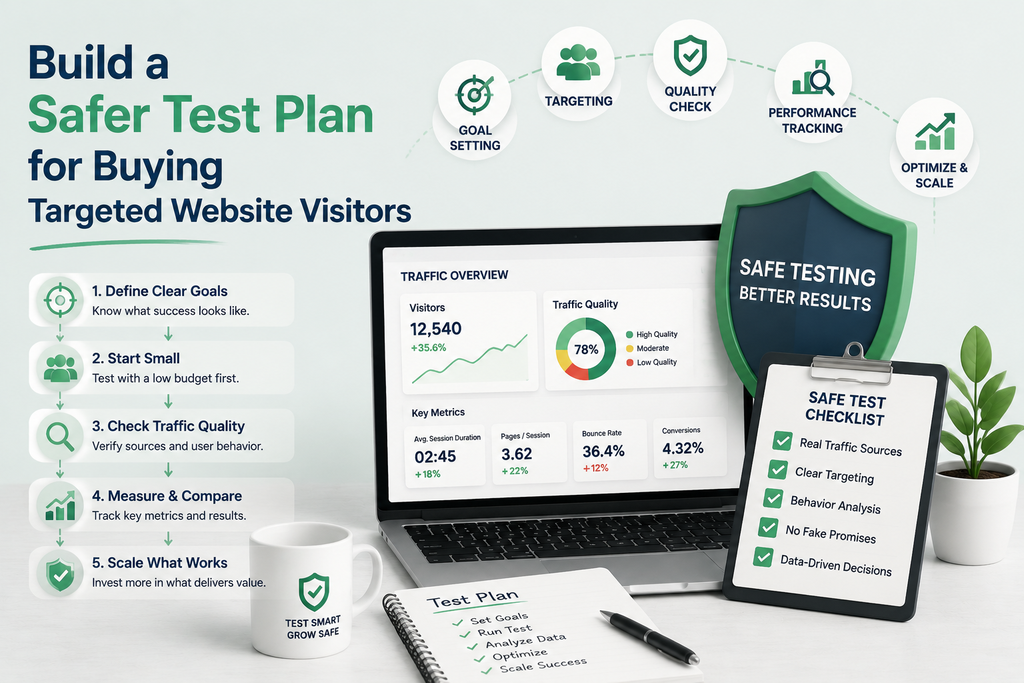
Build a Safer Test Plan for Buying Targeted Website Visitors
Implementing a controlled test plan allows you to verify traffic quality before committing significant resources. When you decide to buy the best targeted organic traffic and clicks, you must treat the process as a scientific experiment rather than a simple purchase. This approach minimizes financial risk while providing clear data on whether the traffic aligns with your business objectives.
Document the campaign goal, audience, offer, and acceptable traffic sources
Start by clearly defining what success looks like for your specific campaign. You should document your target audience demographics, the specific offer being promoted, and the types of traffic sources you consider acceptable. This documentation serves as your roadmap and prevents scope creep during the testing phase.
Choose one focused landing page and one measurable conversion action
Complexity is the enemy of accurate testing. Select a single, high-performing landing page and one clear conversion action, such as a newsletter signup or a product purchase. By isolating these variables, you can easily determine if the incoming traffic is actually interested in your specific value proposition.
Run a small pilot with a defined test period
Limit your initial investment by running a short, time-bound pilot program. This allows you to gather enough data to make an informed decision without overextending your marketing budget. A defined period helps you maintain focus and ensures that you do not continue a failing campaign out of habit.
Establish baseline metrics before the first visitors arrive
Before launching, record your current site performance metrics. You need to know your average bounce rate, time on page, and conversion rate for existing organic traffic. These baselines provide the necessary context to evaluate the performance of your new visitors.
Review traffic quality and conversions at planned checkpoints
Schedule regular intervals to analyze the incoming data. During these checkpoints, compare the behavior of the new visitors against your established baselines. If the engagement metrics are significantly lower than your organic average, you may need to reconsider your provider.
Pause the campaign when source data, engagement, or visitor behavior falls outside expectations
Do not hesitate to stop the campaign if the results are poor. If you notice high bounce rates or suspicious patterns, pausing allows you to investigate the issue before wasting more capital. Protecting your site’s reputation and analytics integrity is always more important than hitting a volume target.
Compare provider claims with independent analytics evidence
Always verify the data provided by your traffic source against your own analytics platform. Discrepancies between the two can indicate issues with tracking or, in some cases, fraudulent activity. Relying on your own independent data ensures that you are making decisions based on reality rather than marketing promises.
Scale only after the traffic source produces repeatable business results
Only consider increasing your budget once you have seen consistent, positive outcomes over multiple test cycles. Scaling too early can lead to wasted spend and poor return on investment. When you buy the best targeted organic traffic and clicks, patience is your greatest asset.
Reinvest in SEO, content, email, and conversion optimization for lasting growth
Purchased traffic should be a supplement to your long-term strategy, not a replacement. Use the insights gained from your tests to improve your core marketing channels. Reinvesting in your own assets ensures that your business continues to grow even when you are not actively purchasing visitors.
| Metric | Baseline Goal | Action if Failed |
|---|---|---|
| Bounce Rate | Below 60% | Review Landing Page |
| Conversion Rate | Above 2% | Adjust Targeting |
| Time on Page | Over 45 Seconds | Verify Traffic Source |
| Repeat Visits | Greater than 5% | Optimize Content |
Measure Traffic That Matters
Stop chasing vanity metrics and start evaluating engagement, conversions, and visitor quality with clear tracking that connects traffic spend to business outcomes and real growth.
Conclusion
Decisions to buy targeted organic traffic represent a calculated experiment rather than a guaranteed path to success. You must treat these acquisitions as data-gathering exercises that require rigorous validation. Protect your analytics integrity by verifying every source before you commit your marketing budget.
Your success depends on how well you match visitor intent with your specific landing page goals. Always calculate your break-even point by comparing the cost of these visitors against the actual revenue generated from conversions. This approach ensures that you remain focused on business value instead of vanity metrics.
The United States market demands high standards for reporting transparency and geographic accuracy. You should prioritize providers who offer clear documentation regarding their traffic sources. This diligence prevents wasted spend on low-quality clicks that fail to move the needle for your brand.
Sustainable growth relies on a balanced marketing mix. Use your findings to refine your long-term strategy, but keep your primary focus on organic search, high-quality content, and email engagement. These foundational pillars provide the stability your business needs to thrive in a competitive digital landscape.
FAQs
What does it actually mean to buy targeted organic traffic for my website?
When you buy targeted organic traffic, you are paying for an acquisition strategy designed to drive visitors who originate from search-related environments to your specific landing pages. Unlike general advertising, organic traffic services aim to connect you with targeted website visitors based on their intent, location, and search behavior. It is important to distinguish this from artificial bot traffic, as legitimate services focus on delivering real users who can support your measurable business goals.
Can organic traffic services guarantee a specific ranking on Google or a set number of sales?
No legitimate provider can guarantee search engine rankings or specific conversion numbers. While you can buy website traffic to increase visibility, rankings are determined by complex algorithms including your SEO, content relevance, and technical authority. Similarly, conversions depend on your offer and user experience. You should view these services as a way to buy the best targeted organic traffic and clicks to test your funnels, not as a guaranteed shortcut to the top of the search results.
Why would a United States marketer choose to buy targeted website visitors instead of relying solely on SEO?
Marketers often buy website traffic to generate early visibility for a new campaign or offer that hasn’t had time to rank naturally. This approach allows you to reach specific audiences by geographic location, device type, and search intent immediately. It serves as a powerful supplement to content distribution, allowing you to gather data on high quality web traffic and user behavior while your long-term SEO strategy matures.
How can I distinguish high quality web traffic from bots or invalid clicks?
To identify high quality web traffic, you must look beyond visitor volume and analyze engagement metrics in Google Analytics 4. Warning signs of low-quality or automated traffic include identical session durations, unusual geographic clusters outside your target area, and sudden spikes without corresponding engagement. Legitimate targeted website visitors will demonstrate varied behavior, such as scrolling, clicking through to other pages, or completing micro-conversions.
Is there a risk to my analytics or advertising accounts if I buy website traffic?
There is a significant risk if you use providers that rely on artificial traffic generation or simulated activity. To protect your brand, you must ensure that you buy targeted organic traffic from sources that comply with search engine and analytics platform requirements. Using deceptive tactics can lead to misleading attribution, invalid click penalties, or even account suspension. Always ask providers to explain their traffic sources in plain language and verify the data against your server logs.
What metrics should I use to measure the ROI of my traffic purchase?
You should establish a measurement framework using UTM parameters to track primary outcomes like qualified leads, sales, and booked calls. Additionally, monitor secondary outcomes such as email subscriptions and content engagement. When you buy the best targeted organic traffic and clicks, the goal is to reach a break-even point where the value of the conversion exceeds the cost per visitor. If “cheap” clicks fail to produce meaningful actions, they ultimately become an expensive mistake.
How should I set up a test plan before I buy the best targeted organic traffic and clicks?
Start with a controlled pilot program by choosing one focused landing page and one measurable conversion action. Document your baseline metrics before the visitors arrive and set stop-loss rules to pause the campaign if you detect poor engagement or invalid traffic. Only scale your investment after the organic traffic services prove they can deliver repeatable business results that align with your United States audience’s needs.
1 thought on “Buy Targeted Organic Traffic: What Marketers Should Know Before Paying for Website Visitors”