
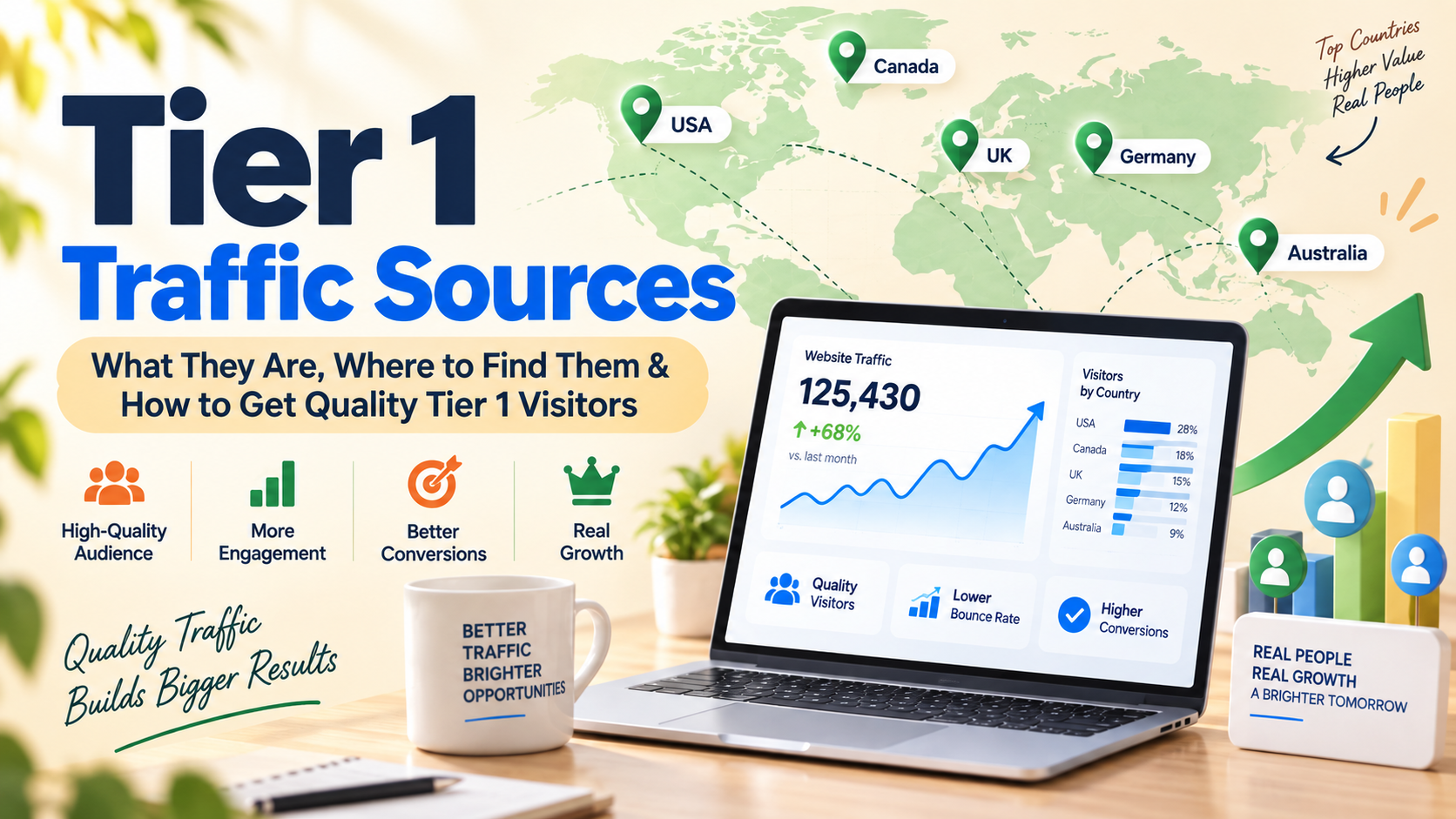
When marketers want to reach audiences in high-value advertising markets, understanding tier 1 traffic sources can help them make more informed decisions about targeting, acquisition costs, and conversion potential. Tier 1 is commonly used in digital advertising as an informal way to describe markets with relatively high purchasing power, mature online economies, and strong digital infrastructure.
However, geographic classification alone does not determine whether a visitor is valuable. The traffic source, audience relevance, user intent, engagement, and conversion performance all matter.
Understanding how location, channel selection, targeting, and monetization work together allows marketers to build a more sustainable traffic strategy.
Key Takeaways
- Tier 1 generally refers to high-value advertising markets, although definitions vary between platforms and traffic providers.
- Purchasing power, digital adoption, and advertising demand can influence the cost and commercial value of traffic.
- Different tier 1 traffic sources serve different purposes, from high-intent search to audience-based social advertising.
- Tier 1 traffic does not automatically mean high-quality or high-converting traffic.
- Tracking engagement, leads, revenue, and customer value is essential when evaluating traffic.
- Solo ads can be one option for reaching targeted audiences, provided the traffic source and delivery are properly evaluated.
Test Tier 1 Traffic Today
Reach targeted audiences from high-value markets with OptinSoloAd. Choose relevant traffic, send visitors to your offer, and measure results with accurate campaign tracking.
What Tier 1 Traffic Sources Mean in Digital Marketing
Global internet users are not all treated equally when it comes to advertising budgets and campaign strategies. Digital marketers often group geographic markets into tiers to simplify targeting and media buying.
Understanding tier 1 traffic sources is useful for marketers who want to reach audiences in markets where advertising costs and potential customer value may be relatively high.
Defining Tier 1 Traffic by Country, Purchasing Power, and Internet Infrastructure
In digital advertising, Tier 1 is generally an informal classification associated with established economies and mature digital markets. There is no single universal list that every advertising platform or traffic provider follows.
Common factors used when classifying a market can include:
- GDP per capita and purchasing power.
- Size and maturity of the digital economy.
- Internet and mobile adoption.
- Availability of online payment methods.
- Advertising demand and competition.
- Consumer access to digital products and services.
For this reason, the exact definition of Tier 1 can vary by advertising network, industry, and traffic provider.
How Tier 1 Traffic Differs From Tier 2 and Tier 3 Traffic
Tier classifications are generally used to describe differences in geographic markets rather than the quality of individual visitors, which is why tier 1 traffic sources should be evaluated beyond geography alone.
Tier 2 markets may include countries with growing digital economies and moderate advertising costs, while Tier 3 classifications are often associated with markets where average purchasing power or advertising costs are lower.
| Traffic Tier | Economic Profile | Digital Market | Typical Ad Cost |
|---|---|---|---|
| Tier 1 | Generally high | Mature | Often higher |
| Tier 2 | Moderate or emerging | Developing/growing | Often moderate |
| Tier 3 | Generally lower | Varies | Often lower |
These are broad industry conventions rather than universal standards. A Tier 2 market can perform extremely well for a particular business, while expensive Tier 1 traffic can perform poorly if the audience or offer is mismatched.
Why Advertisers and Publishers Assign Traffic Tiers
Advertisers use geographic segmentation to determine where their budgets may have the greatest commercial potential. Publishers and traffic providers may also use geographic classifications when pricing advertising inventory.
For marketers, the purpose is not simply to identify the most expensive market. It is to determine whether the cost of acquiring visitors from a particular market makes sense for the business.
This is why tier 1 traffic sources should always be evaluated against actual campaign performance rather than geographic labels alone.
Is Tier 1 Traffic Always High Quality?
No. Tier 1 traffic is not automatically high-quality traffic.
This distinction is important. A visitor can come from the United States, United Kingdom, Canada, Australia, or another commonly classified Tier 1 market and still have little interest in your product.
Traffic quality depends on several factors:
- Whether the visitor is a real person.
- Whether the audience matches your target customer.
- Whether the visitor has relevant intent.
- Where the visitor came from.
- Whether the placement is legitimate.
- How the visitor behaves after arriving.
- Whether the traffic produces qualified leads or sales.
For example, 1,000 visitors from a Tier 1 country may produce fewer customers than 300 highly targeted visitors from another market. Geographic quality and visitor quality are related, but they are not the same thing.
Geography is a useful targeting signal, but it should not be treated as a substitute for audience intent and measurable performance.
The best way to evaluate tier 1 traffic sources is to combine geographic data with behavioral and conversion data.
Tier 1 Countries and the Audiences They Represent
When marketers target specific regions, they are often looking for audiences with particular economic and digital characteristics, especially when evaluating tier 1 traffic sources. Several countries are commonly classified as Tier 1 in advertising, although classifications can differ between networks and industries.
The United States as a Core Tier 1 Market
The United States is one of the largest and most competitive digital advertising markets. It has a large online consumer base, extensive e-commerce adoption, and a mature digital advertising ecosystem.
For businesses targeting U.S. customers, competition can be significant. As a result, marketers need to consider not only audience size but also search intent, targeting precision, acquisition costs, and conversion economics.
The United States is therefore frequently included when marketers discuss tier 1 traffic sources and Tier 1 GEO targeting.
Other Common Tier 1 Countries, Including Canada, the United Kingdom, Australia, and Germany
Beyond the United States, countries such as Canada, the United Kingdom, Australia, and Germany are also frequently included in Tier 1 advertising classifications.
- Canada: A mature digital market with strong e-commerce adoption and close economic ties to the United States.
- United Kingdom: A highly developed online market with strong digital commerce and advertising activity.
- Australia: A mature market with high internet adoption and significant online consumer activity.
- Germany: One of Europe’s largest economies, with a substantial digital consumer market and strong demand for localized content.
The precise list can vary depending on the advertising platform or traffic provider.
Comparing Language, Spending Habits, and Conversion Expectations Across Tier 1 Countries
Grouping countries into one tier does not mean consumers in those markets behave identically. Language, culture, purchasing habits, regulations, and expectations can differ significantly.
| Country | Primary Language | Important Consideration |
|---|---|---|
| United States | English | Large and competitive consumer market |
| United Kingdom | English | Local terminology and cultural differences |
| Canada | English/French | Regional and language considerations |
| Australia | English | Geographic and market-specific differences |
| Germany | German | Localization and privacy expectations |
You should adjust your messaging and landing pages according to the market you are targeting rather than treating all Tier 1 visitors from tier 1 traffic sources as one audience.
How Local Regulations and Cultural Differences Affect Campaign Performance
Even among tier 1 traffic sources, local regulations and cultural differences can affect campaign performance.
For example, businesses targeting European audiences need to consider applicable privacy and data-protection requirements, including GDPR where relevant. Advertising disclosures, consent requirements, and data collection practices should be reviewed for the markets in which you operate.
Cultural differences can also influence creative performance. A campaign that works well in the United States may need different messaging, terminology, imagery, or offers for audiences in Germany, the United Kingdom, or Australia.
Where to Find Reliable Tier 1 Traffic Sources?
Identifying where your best prospects spend their time is an important part of building an effective acquisition strategy and choosing the right tier 1 traffic sources. Different channels provide different forms of traffic, so your choice should depend on your audience, budget, offer, and conversion goals.
Search Advertising Through Google Ads and Microsoft Advertising
Search advertising can provide valuable traffic because users are actively expressing an interest through their search queries.
Google Ads and Microsoft Advertising allow advertisers to target specific geographic markets and keywords. This makes search advertising particularly useful when your audience is already looking for a product, service, or solution.
Among tier 1 traffic sources, search advertising can be especially useful for businesses that understand their customers’ commercial search intent.
Social Advertising on Meta, LinkedIn, TikTok, and Pinterest
Social platforms provide sophisticated targeting capabilities and access to large audiences.
Meta can be useful for consumer audiences, LinkedIn is particularly relevant for many B2B campaigns, and TikTok and Pinterest can be useful for specific consumer and content-driven niches.
However, social traffic is not inherently better simply because it comes from a Tier 1 country. Campaign quality still depends on targeting, creative, audience fit, and post-click performance.
Programmatic and Display Networks With Country-Level Targeting
Programmatic advertising allows advertisers to purchase digital advertising inventory across a large network of websites and applications.
Country-level targeting can help advertisers concentrate spending on specific markets and evaluate tier 1 traffic sources according to their campaign goals. However, marketers should also evaluate placements, viewability, fraud prevention, audience quality, and conversion performance.
A large volume of impressions from a Tier 1 country does not automatically make a campaign successful.
Native Advertising Platforms and Premium Publisher Partnerships
Native advertising places promotional content within or alongside editorial-style experiences. Direct partnerships with relevant publishers can also provide access to audiences with strong contextual relevance.
Before investing, evaluate the publisher’s audience, traffic quality, placement, reporting, and relevance to your offer.
SEO, Content Marketing, Email, and Referral Channels
Organic search, content marketing, email, and referrals can provide sustainable sources of traffic over time.
SEO can attract users who are actively searching for information, while email allows businesses to communicate with an existing audience. Referral traffic can also be valuable when it comes from a trusted and relevant source.
These channels can become important tier 1 traffic sources when they consistently bring relevant visitors from your target markets.
Using Google Analytics 4 and Google Search Console to Identify Existing Tier 1 Visitors
You do not need to guess which channels are producing valuable visitors. Google Analytics 4 can help you analyze traffic by geography, acquisition channel, engagement, and conversions.
Google Search Console can help you understand the search queries and pages generating organic visibility and clicks.
By combining geographic information with engagement and conversion data, you can determine whether your existing tier 1 traffic sources are actually contributing to your business goals.
| Channel Type | Primary Strength | Best For |
|---|---|---|
| Search Ads | High-intent targeting | Immediate demand capture |
| Social Ads | Audience targeting | Discovery and demand generation |
| Organic SEO | Long-term visibility | Sustainable traffic |
| Native Ads | Contextual discovery | Content-led campaigns |
| Direct audience access | Nurturing and repeat engagement | |
| Solo Ads | Targeted email audiences | Lead-generation campaigns |
How Advertising Tiers Affect Cost, Reach, and Conversion Potential
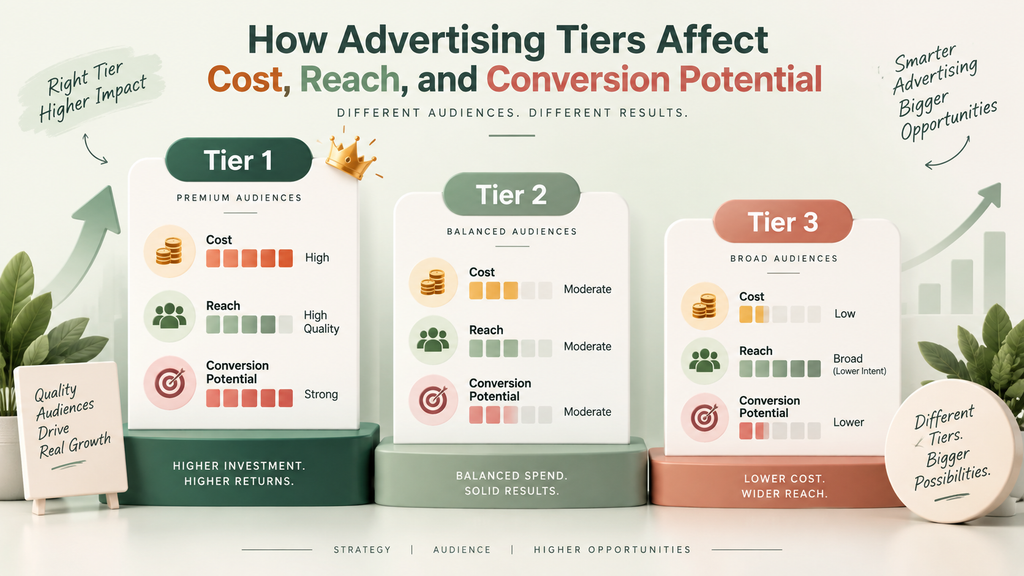
Digital advertising costs vary considerably between countries, industries, platforms, audiences, and campaign objectives, including campaigns using tier 1 traffic sources.
Why Tier 1 Campaigns Usually Have Higher CPMs, CPCs, and CPA Targets
Tier 1 markets can be expensive because advertisers compete for audiences with significant commercial value. High advertiser demand can increase CPM and CPC prices.
However, higher costs do not automatically mean better results.
The right question is whether the traffic generates enough qualified leads, sales, or customer lifetime value to justify the acquisition cost.
When comparing tier 1 traffic sources, look at the relationship between traffic cost and business outcomes rather than cost alone.
Balancing Expensive Inventory Against Customer Lifetime Value
Customer lifetime value can help put acquisition costs into context.
For example, paying more to acquire a customer may make sense for a subscription business or high-ticket service if the customer generates substantial revenue over time. Conversely, a high acquisition cost may not make sense for a low-margin product.
Your acceptable traffic cost should therefore be based on your own economics.
How Auction Competition and Ad Placement Change Traffic Costs
Advertising platforms often use auctions to determine the price advertisers pay for available inventory.
Costs can change depending on:
- Competition.
- Audience size.
- Keyword demand.
- Ad placement.
- Seasonality.
- Device.
- Campaign objective.
- Geographic targeting.
This means there is no single fixed price for tier 1 traffic sources.
Choosing Between Broad Reach, Premium Placements, and High-Intent Campaigns
Your campaign objective should determine the type of traffic you purchase.
| Campaign Type | Relative Cost | Primary Goal | Measurement Focus |
|---|---|---|---|
| Broad Reach | Varies | Awareness | Reach and engagement |
| Premium Placements | Often higher | Visibility and trust | Engagement and conversions |
| High-Intent | Often higher | Direct response | Leads and sales |
A business focused on immediate lead generation may prioritize high-intent traffic, while a brand-building campaign may focus more heavily on reach and engagement.
How to Attract Quality Visitors From Tier 1 Traffic Sources
Reaching users in a valuable market is only the first stage. Your landing page, offer, messaging, and tracking system determine how effectively you turn visitors into meaningful business outcomes.
Reach Targeted Tier 1 Audiences
Looking for targeted solo-ad traffic? Explore OptinSoloAd campaigns designed to help marketers reach relevant audiences and test Tier 1 traffic for their offers.
Match Your Offer and Landing Page to Tier 1 Customer Expectations
Your offer should address a clear problem or need. The landing page should continue the same message presented in the advertisement or traffic source.
If your traffic source promises a specific benefit but your landing page does not immediately explain that benefit, visitors may leave without taking action.
Build Fast, Mobile-Friendly Pages With Clear Value Propositions
Page speed and usability can affect the visitor experience, particularly on mobile devices.
Rather than relying on a universal “three-second” rule, monitor your site’s actual performance and conversion data. Make sure your most important content, offer, and call to action are easy to understand and use.
Use Search Intent, Audience Signals, and First-Party Data for Better Targeting
Understanding why someone visits your website allows you to create more relevant experiences.
Search intent, audience characteristics, previous interactions, and first-party data can all help you segment users and personalize your campaigns where appropriate and legally permitted.
Create Region-Specific Messaging for U.S. States and Other Tier 1 Markets
Even within a single Tier 1 country, audiences can have different preferences.
For example, a national campaign may require different messaging from a campaign targeting a specific state, city, industry, or demographic.
Localization should be based on meaningful audience differences rather than assumptions.
Improve Trust With Transparent Pricing, Reviews, Security Signals, and Support
Trust can reduce friction during the conversion process.
Where appropriate, provide:
- Transparent pricing.
- Clear terms and conditions.
- Customer reviews.
- Contact information.
- Relevant security information.
- Accessible customer support.
Avoid using trust signals that you cannot substantiate.
Align Ad Creative, Landing Page Content, and Conversion Goals
Consistency across the funnel is essential.
If an advertisement promotes a particular offer, the landing page should make that offer easy to find. If the campaign is designed to generate leads, the page should have a clear and relevant lead-generation mechanism.
| Strategy Element | Focus Area | Expected Benefit |
|---|---|---|
| Localized Messaging | Regional relevance | Better audience fit |
| Trust Signals | Transparency | Lower conversion friction |
| Technical Performance | Usability | Better visitor experience |
| Data Utilization | Audience insights | More informed optimization |
How to Evaluate and Optimize Tier 1 Visitor Quality
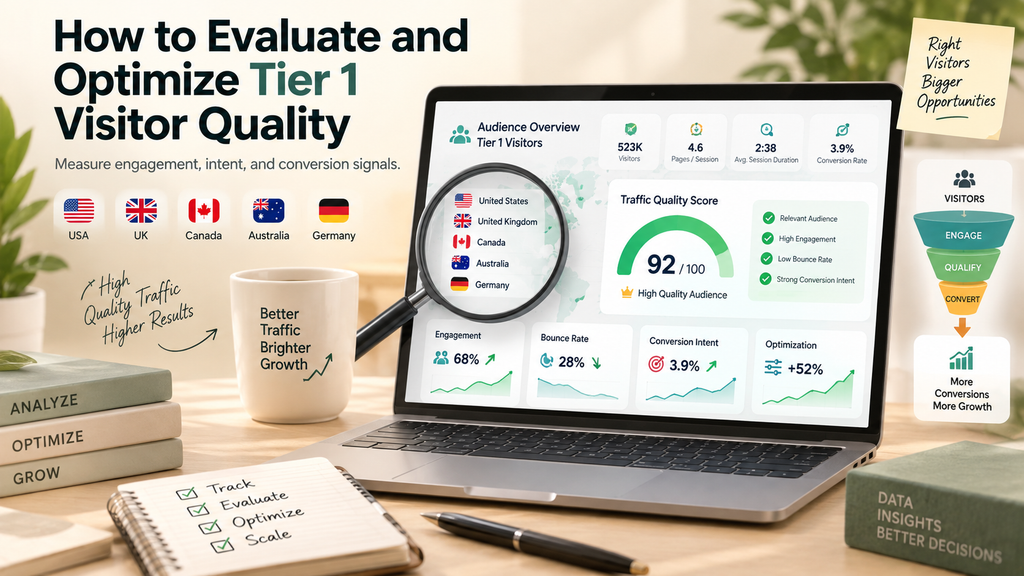
Traffic volume alone does not tell you whether your acquisition strategy is working. You need to connect traffic with meaningful business outcomes.
Track Engagement, Conversion Rate, Revenue, and Customer Lifetime Value
Metrics such as engagement rate, conversion rate, revenue, qualified leads, and customer lifetime value can provide a more complete picture of traffic quality.
The right metrics depend on your business model.
For an e-commerce store, revenue and purchase conversion may be central. For a lead-generation business, qualified leads and eventual sales may be more important.
Separate Human Visitors From Bots, Click Fraud, and Low-Quality Placements
Traffic analysis should account for invalid or automated activity.
Depending on the channel, this may include bot filtering, placement exclusions, fraud detection, and traffic-quality monitoring.
A large number of clicks is not necessarily valuable if those clicks do not represent genuine prospective customers.
Use UTM Parameters, Conversion APIs, and CRM Data to Connect Traffic With Revenue
UTM parameters can help identify where visitors originated. Conversion tracking and CRM data can then help connect the initial visit with subsequent leads or sales.
This is particularly important when comparing different tier 1 traffic sources because the cheapest source is not necessarily the one generating the most valuable customers.
Compare Tier 1 Performance by Country, Channel, Device, and Audience Segment
Performance can vary significantly between countries and channels.
Segment your data by:
- Country.
- Traffic source.
- Campaign.
- Device.
- Landing page.
- Audience.
- Conversion type.
This can reveal where your strongest opportunities actually exist.
Run Controlled Tests on Creative, Bids, Landing Pages, and Offers
Testing allows you to make decisions based on evidence.
You can test different:
- Headlines.
- Calls to action.
- Offers.
- Landing pages.
- Ad creatives.
- Audience segments.
- Traffic sources.
Where possible, keep tests controlled so that you can identify which change contributed to the result.
Set Quality Thresholds for Bounce Rate, Lead Validity, and Return on Ad Spend
Instead of applying universal benchmarks, establish thresholds based on your historical performance and business economics.
Monitor metrics such as lead validity, conversion rate, revenue per visitor, cost per acquisition, and ROAS.
If a source consistently fails to meet your business requirements, investigate the targeting, offer, landing page, or traffic quality before increasing the budget.
Ways to Monetize Tier 1 Traffic Without Reducing Its Value
Once you have relevant visitors, the next challenge is monetization. The right model depends on visitor intent, content type, and the relationship between the audience and your offer.
Match Monetization Models to Visitor Intent and Content Context
A visitor reading a product comparison may have different commercial intent from someone reading an educational article.
Your monetization strategy should fit the context.
The objective should be to provide a useful next step rather than overwhelming visitors with irrelevant advertisements.
Using Affiliate Offers, Lead Generation, Digital Products, and Ecommerce
Common monetization models include:
- Affiliate marketing.
- Lead generation.
- Digital products.
- E-commerce.
- Subscriptions.
- Sponsorships.
The appropriate model depends on your audience and business model.
High purchasing power does not guarantee that visitors will respond to every monetization method.
Balancing Ad Revenue With User Experience and Page Performance
Excessive advertising can interfere with navigation, readability, and page performance.
Use advertising formats carefully and monitor their impact on engagement and conversions. If an advertisement generates revenue but causes visitors to leave before reaching your primary offer, the overall business impact may be negative.
How to Select Advertisers, Affiliate Programs, and Sponsorships Responsibly
Your audience’s trust is an important asset.
Only promote products, services, and advertisers that are relevant to your audience and that you can reasonably evaluate. Clearly disclose affiliate relationships and sponsorships where required.
Protecting Revenue With Consent Management, Privacy Compliance, and Brand Safety
Privacy and consent requirements can differ by jurisdiction.
Businesses should review applicable laws and platform requirements before collecting, processing, or using personal data for advertising.
Brand safety also matters when purchasing advertising inventory. Review placements and partners to reduce the risk of associating your brand with unsuitable content.
| Monetization Model | Best For | Revenue Potential |
|---|---|---|
| Affiliate Marketing | Review and educational sites | Varies |
| Lead Generation | Service and B2B businesses | Varies |
| Display Advertising | High-traffic content sites | Varies |
| Digital Products | Expert content | Varies |
| Ecommerce | Product-focused businesses | Varies |
How to Get Tier 1 Traffic Through Solo Ads
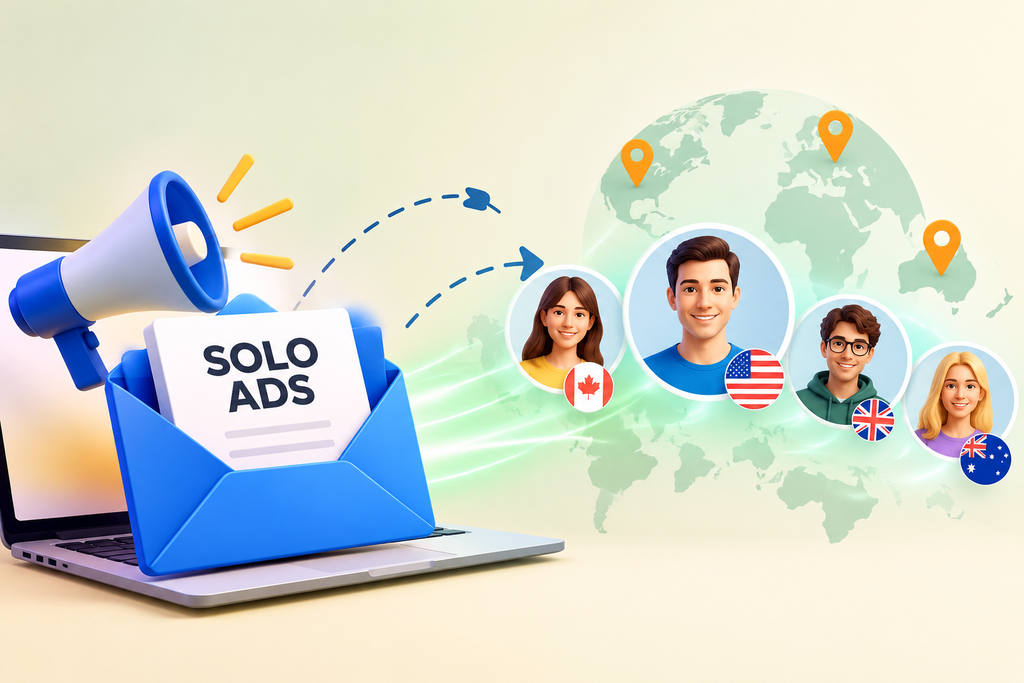
Solo ads can be another option for marketers looking to reach targeted audiences through email-based advertising.
In a solo-ad campaign, an advertiser typically pays a list owner or provider to send a promotional message to subscribers who have opted into that publisher’s email list.
The quality of the campaign depends heavily on the audience, list relevance, targeting, delivery, and the provider’s traffic quality.
When evaluating solo ads as one of your tier 1 traffic sources, consider:
- The percentage of traffic expected from your target GEO.
- The niche and audience of the email list.
- How clicks are tracked.
- Whether traffic is delivered by real subscribers.
- Historical campaign information where available.
- Refund and replacement policies.
- Whether you can independently measure conversions.
A large number of clicks should not be the only reason to choose a provider. Your own tracking should determine whether the traffic produces meaningful results.
Using OptinSoloAd to Reach Tier 1 Audiences
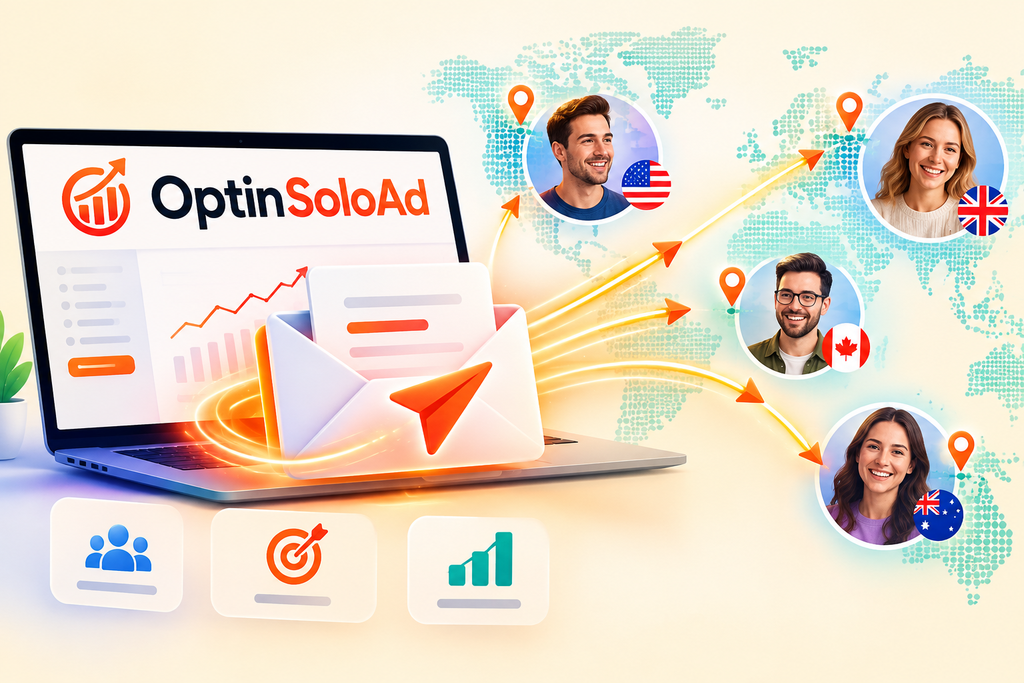
For marketers specifically interested in solo-ad traffic, OptinSoloAd provides solo-ad traffic options with different Tier 1 traffic percentages and U.S.-focused traffic options.
This makes the platform relevant to businesses researching tier 1 traffic sources and looking for a way to test targeted solo-ad campaigns.
Before scaling a campaign, marketers should still use their own tracking to evaluate:
- The geographic distribution of delivered traffic.
- Click volume and delivery.
- Engagement after the click.
- Lead or opt-in conversion rate.
- Lead quality.
- Revenue generated.
- Cost per qualified lead or customer.
For example, a marketer could send Tier 1 traffic to a dedicated landing page, track the campaign using UTM parameters, measure opt-ins, and then compare the resulting cost per lead with other acquisition channels.
This approach allows OptinSoloAd to become part of a broader traffic strategy rather than treating a Tier 1 label as a guarantee of performance.
A Practical Plan for Building a Sustainable Tier 1 Traffic Strategy
Building a reliable traffic strategy requires a clear roadmap and continuous measurement.
Define Your Ideal Tier 1 Customer and Commercial Goal
Start by identifying your target customer.
Consider:
- Location.
- Industry.
- Demographics.
- Problems.
- Purchasing behavior.
- Customer value.
- Desired conversion.
Then define the commercial goal of your campaign.
Select Channels Based on Intent, Budget, and Conversion Economics
Different tier 1 traffic sources serve different purposes.
Search can capture existing demand. Social can create and develop demand. Email and solo ads can reach established audiences. SEO can generate long-term organic visibility.
Choose channels according to your audience and economics rather than assuming one source is universally superior.
Research Competitors, Search Demand, and Available Advertising Inventory
Competitor research can reveal which channels and offers are being used in your market.
Keyword research can help identify search demand, while advertising platforms can provide information about audience availability and targeting options.
Launch With Accurate Tracking, Small Test Budgets, and Clear Success Criteria
Tracking should be installed before you spend significant amounts of money.
Use appropriate analytics, UTM parameters, conversion tracking, and CRM integration where relevant.
Start with a test budget that allows you to gather useful data without exposing the business to unnecessary risk.
Scale the Sources That Produce Profitable and Verifiable Visitors
Once you have enough data, compare sources based on business outcomes.
Look beyond clicks and impressions. Consider qualified leads, sales, revenue, customer value, and acquisition cost.
The tier 1 traffic sources that produce the best business results should receive further testing and optimization.
Refresh Creative, Exclude Weak Placements, and Expand Proven Audiences
Campaign performance can change over time.
Refresh advertising creative when necessary, exclude poor-performing placements, and refine audience targeting based on your data.
If a particular audience segment performs well, test whether similar audiences can produce comparable results.
Maintain Compliance With Privacy, Advertising, and Platform Requirements
Businesses targeting international audiences should understand the privacy, advertising, and data requirements relevant to their campaigns.
Review the rules of each advertising platform and the regulations applicable to the markets you target.
| Strategy Phase | Primary Focus | Success Metric |
|---|---|---|
| Planning | Customer and offer | Target economics |
| Testing | Small controlled campaigns | Conversion data |
| Scaling | Proven sources | Revenue and qualified leads |
| Optimization | Continuous testing | Improved efficiency |
How to Reach Tier 1 Audiences via OptinSoloAd
If you’re looking for a practical way to test tier 1 traffic sources through solo ads, OptinSoloAd can help you connect your offer with targeted email audiences.
OptinSoloAd provides solo-ad traffic options with different Tier 1 traffic percentages, including options focused on U.S. traffic. This gives marketers an opportunity to test solo-ad campaigns according to their preferred GEO and campaign objectives.
But don’t simply buy traffic and hope it converts. Build a measurable campaign.
A simple approach is:
- Choose your target GEO based on your ideal customer.
- Select an appropriate solo-ad campaign for your audience and budget.
- Send the traffic to a dedicated landing page that matches your offer.
- Use tracking links or UTM parameters to identify the campaign.
- Measure opt-ins, leads, sales, and revenue rather than clicks alone.
- Compare your results with other tier 1 traffic sources before scaling.
Ready to Test Tier 1 Solo Ad Traffic?
If your goal is to reach audiences in Tier 1 markets, don’t rely on assumptions about traffic quality. Test the traffic, track the results, and let your own conversion data guide your next campaign.
Explore OptinSoloAd and find a solo-ad traffic option that fits your target audience and campaign goals.
Whether you’re building an email list, promoting an offer, generating leads, or testing a new funnel, starting with a controlled campaign can help you understand how the traffic performs for your particular business.
Your goal isn’t simply to get more clicks. It’s to turn relevant visitors into subscribers, leads, and customers.
Start Your Tier 1 Traffic Campaign
Put your traffic strategy into action with OptinSoloAd. Select your target GEO, launch a controlled campaign, track conversions, and evaluate your traffic performance.
Conclusion
Understanding tier 1 traffic sources is useful for marketers who want to reach audiences in established, high-value digital markets. However, the Tier 1 label should be treated as a geographic targeting concept rather than a guarantee of visitor quality.
The most effective approach is to combine market selection with audience relevance, intent, accurate tracking, strong landing pages, and measurable conversion goals.
Search advertising, social advertising, SEO, email, native advertising, referrals, and solo ads can all play different roles in a broader acquisition strategy. The right combination depends on your business model, audience, budget, and customer economics.
For marketers considering solo ads, platforms such as OptinSoloAd can provide another way to test targeted audiences, including options focused on Tier 1 and U.S. traffic. As with any paid traffic channel, the results should be evaluated using independent tracking and actual conversion data.
Ultimately, the goal is not simply to acquire visitors from a particular country. The goal is to acquire relevant visitors who engage with your offer and contribute to measurable business results.
Start by auditing your existing traffic by country, source, engagement, leads, and revenue. Then test the channels that align with your audience and commercial objectives.
FAQs
What exactly are tier 1 traffic sources, and why do marketers use them?
Tier 1 traffic sources are traffic channels capable of delivering visitors from markets commonly classified as Tier 1, such as the United States, United Kingdom, Canada, Australia, and other mature advertising markets. The classification varies by platform and provider.
Marketers may target these markets because they can offer significant commercial opportunities, but higher purchasing power does not guarantee higher conversion rates.
Which nations are typically classified as Tier 1 countries?
The most commonly cited tier 1 countries include the United States, Canada, United Kingdom, Australia, and several other developed markets. However, there is no universal Tier 1 country list used by every advertising platform.
Always check how the specific advertising network or traffic provider defines its geographic tiers.
Is Tier 1 traffic always high quality?
No. Tier 1 traffic sources can deliver visitors from valuable geographic markets, but geography alone does not establish traffic quality.
You should evaluate whether visitors are genuine, relevant to your offer, engaged with your website, and capable of producing qualified leads or sales.
What are the best tier 1 traffic sources?
There is no single source that is best for every business. Potential tier 1 traffic sources include search advertising, social advertising, SEO, email, native advertising, referrals, publisher partnerships, and solo ads.
Your choice should depend on audience intent, acquisition cost, conversion performance, and customer lifetime value.
How does a Tier 1 market affect advertising costs?
Tier 1 markets can have higher advertising costs because competition for valuable audiences can be strong. CPM, CPC, and CPA can vary considerably depending on the platform, niche, audience, season, and campaign objective.
The important measurement is whether the resulting traffic produces sufficient business value to justify its cost.
How can I buy Tier 1 traffic?
You can acquire Tier 1 traffic through platforms such as search and social advertising networks, publisher partnerships, native advertising networks, and certain traffic providers offering geographic targeting.
If you purchase traffic directly from a provider, verify how the traffic is generated, what GEO is included, how clicks are tracked, and how you can measure conversions.
Can solo ads be a Tier 1 traffic source?
Yes. Solo ads can be used to reach audiences in Tier 1 GEOs when the provider’s email audience and campaign targeting match those markets.
However, the Tier 1 label does not guarantee that the traffic will convert. Evaluate the list, targeting, delivery, engagement, and conversion results.
How can OptinSoloAd help with Tier 1 traffic?
OptinSoloAd offers solo-ad traffic options with different Tier 1 percentages and U.S.-focused traffic options. This can make it relevant for marketers researching tier 1 traffic sources and testing targeted solo-ad campaigns.
Marketers should track each campaign independently and evaluate the resulting traffic based on opt-ins, lead quality, conversions, and revenue.
How do I verify the quality of Tier 1 traffic?
To evaluate tier 1 traffic sources, combine geographic data with behavioral and conversion metrics.
Use analytics and tracking tools to monitor:
- Country and GEO.
- Traffic source.
- Clicks.
- Engagement.
- Conversion rate.
- Lead validity.
- Sales.
- Revenue.
- Cost per acquisition.
This provides a more accurate picture than relying on geographic classification alone.
How can I convert Tier 1 visitors into leads and customers?
Start with a relevant offer and a landing page that matches the visitor’s intent. Make the value proposition clear, ensure the page works well on mobile devices, use appropriate trust signals, and make the desired action easy to complete.
Then track the entire journey from traffic source to lead or sale. This helps you identify which tier 1 traffic sources are actually contributing to your business.
6 thoughts on “Tier 1 Traffic Sources: What They Are, Where to Find Them & How to Get Quality Tier 1 Visitors”