
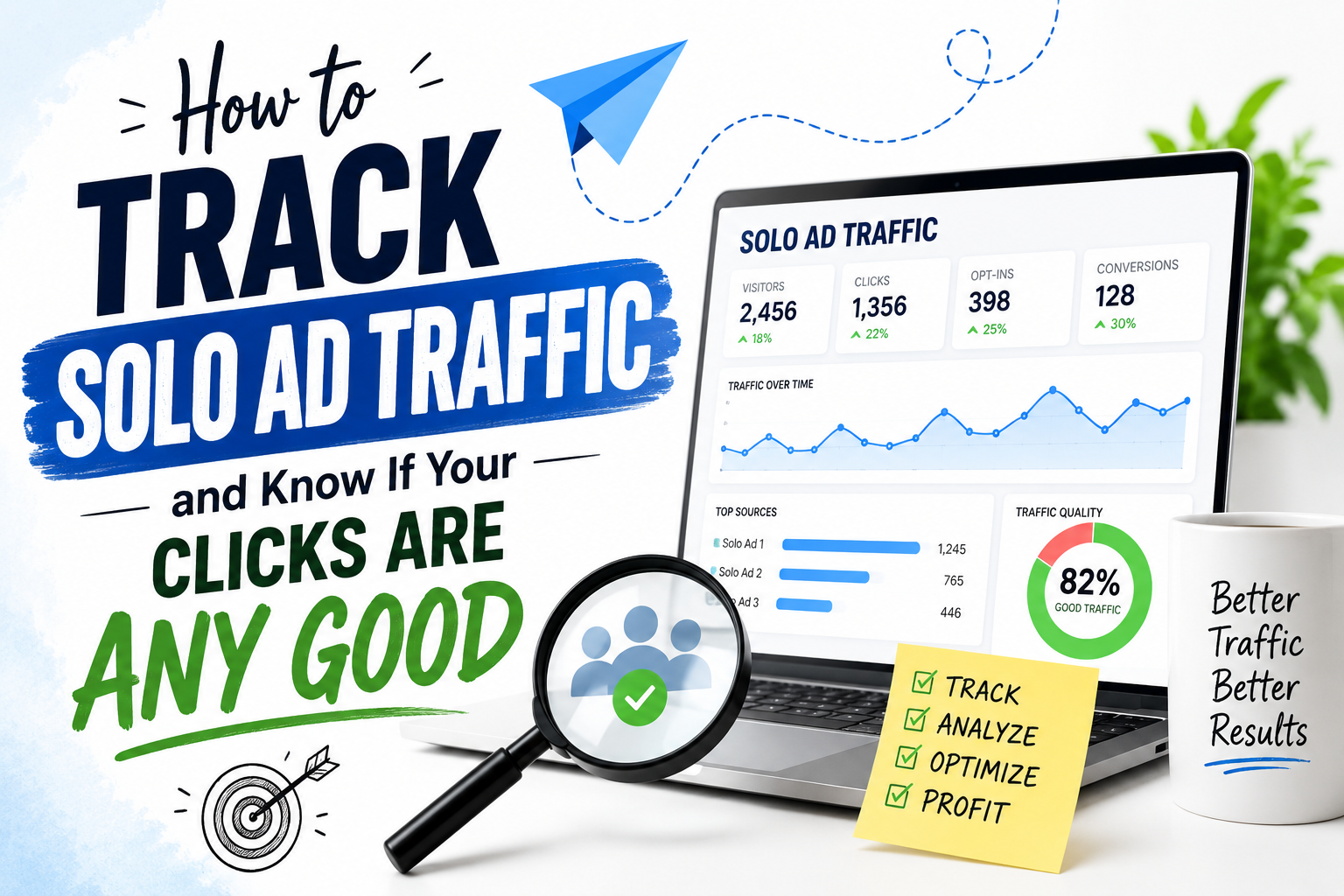
Did you know that nearly 40% of digital clicks are flagged as low-quality or automated by sophisticated filtering systems? When you invest in solo ad marketing, simply trusting the numbers provided by your solo ad traffic vendor is a recipe for wasted budget. You need a reliable way to verify the actual value of every visitor hitting your site.
Measuring solo ad traffic requires a proactive approach that goes beyond basic click counts. By utilizing dedicated landing pages, UTM parameters, and Google Analytics 4, you can gain total clarity on your campaign performance. This process allows you to track conversion events and revenue with precision.
True success is not found in vanity metrics but in analyzing engagement, lead quality, and return on investment. You must judge your results by the customers you acquire rather than the raw volume of visitors. Let’s explore how to transform your data into actionable insights for better growth.
Key Takeaways
- Avoid relying solely on vendor-reported click counts for your campaigns.
- Use UTM parameters to track the specific source of your visitors.
- Implement Google Analytics 4 to monitor user behavior and engagement.
- Focus on conversion events rather than just raw visitor numbers.
- Calculate your return on investment by tracking actual revenue generated.
Track Every Click
Stop guessing which clicks are valuable. Choose a plan that helps you track traffic, measure conversions, and protect every dollar of your advertising budget today.
Set Clear Goals Before You Buy Solo Ads
Jumping into solo ad marketing without a clear destination for your solo ad traffic is a recipe for wasted budget. You must establish a concrete plan to ensure your investment yields measurable results. By defining your objectives early, you gain the ability to track performance accurately and pivot when necessary.
Define the conversion that matters most
Choose between leads, sales, booked calls, and revenue
Every campaign needs a primary metric to determine success. You should decide if you are looking for immediate email subscribers, direct product sales, or high-ticket booked calls. Focusing on one specific outcome prevents data fragmentation and helps you optimize your funnel effectively.
If you buy solo ads to build an email list, your primary conversion is a lead. Conversely, if you are selling a digital product, your focus shifts to revenue and return on ad spend. Clearly identifying this goal allows you to tailor your solo ad traffic landing page experience to the specific action you want your visitors to take.
Set a baseline for acceptable traffic performance
Estimate your target cost per lead and return on ad spend
Before you spend money, calculate your maximum allowable cost per lead (CPL). Knowing your numbers prevents you from overpaying for solo ad traffic that does not convert into profit. You should also establish a minimum return on ad spend (ROAS) to gauge the long-term viability of your campaigns.
| Metric | Goal Type | Performance Target |
|---|---|---|
| Cost Per Lead | Lead Generation | Under $3.00 |
| Conversion Rate | Sales Funnel | Above 2.5% |
| ROAS | Revenue Growth | 200% Minimum |
Match your goal to the right solo ad provider
Not all solo ad providers offer the same quality of traffic. You must align your specific business goals with the audience demographics and list health of the vendor. High-quality, targeted solo ads require a provider who maintains an active, engaged, and relevant subscriber base.
When evaluating potential partners, consider the age of their list and their geographic reach to ensure your solo ad traffic reaches the right audience. A provider with a list focused on personal development may not be the right fit if you are selling B2B software. Always verify that their audience interests match your offer to ensure the highest possible conversion rates.
Build a Tracking System Before Sending Traffic
Success with solo ad traffic starts long before the first visitor clicks your link. You must establish a reliable technical foundation to ensure every cent of your budget is accounted for. Without a proper system, you are essentially flying blind when managing solo ad traffic.
“Measurement is the first step that leads to control and eventually to improvement. If you can’t measure it, you can’t improve it.”
Create a dedicated landing page for each campaign
Never send solo ad traffic to your generic home page. Instead, build a specific landing page tailored to the exact offer promised in your advertisement. This ensures that the message remains consistent from the click to the final conversion.
Use UTM parameters to identify every traffic source
UTM parameters act as digital tags that tell your analytics software exactly where your solo ad traffic originated. By appending these tags to your URLs, you gain granular visibility into your marketing performance.
Assign consistent source, medium, campaign, and content values
Consistency is vital for clean data reporting. Always use the same naming conventions for your source and medium fields across all your marketing efforts. This practice prevents your analytics dashboard from becoming cluttered with fragmented data.
Connect your landing page to Google Analytics 4
Google Analytics 4 (GA4) is the industry standard for monitoring user behavior. Ensure your landing page has the tracking code installed correctly before you launch any campaign. This connection allows you to see how visitors interact with your content in real time.
Track leads and purchases with conversion events
Tracking solo ad traffic clicks is only half the battle; you must also track the actions that generate revenue. Configure specific events in your analytics platform to trigger whenever a user completes a desired goal. This setup provides the data needed to calculate your true return on investment.
Verify form submissions, checkout completions, and thank-you pages
Before going live, test your conversion path thoroughly. Submit your own forms and complete test checkouts to ensure the tracking pixels fire correctly. Confirming that your thank-you pages record the event is the best way to validate your solo ad traffic quality.
Use unique tracking links for each solo ad provider
Assign a distinct trackable link to every provider you work with. This strategy allows you to isolate the performance of individual sources easily. By keeping your links unique, you can quickly identify which partners deliver high-quality solo ad traffic and which ones fall short of your expectations.
Measure Solo Ad Traffic From Click to Conversion
Understanding the true performance of your solo ad traffic campaigns starts with measuring every step from the initial click to the final sale. You must look beyond simple click counts to see how your solo ad traffic actually behaves on your website.
Optimize With Confidence
Turn campaign data into actionable insights with a plan built to help you monitor engagement, conversions, and revenue so you can scale confidently profitably faster.
Separate vendor-reported clicks from your analytics data
Vendors often provide a total count of solo ad traffic clicks sent to your link, but this number rarely matches your internal analytics. You should treat vendor reports as a baseline for delivery rather than a definitive measure of engagement.
Compare delivered clicks with unique sessions
When you analyze solo ad traffic, compare the vendor’s delivery report against your unique session count in Google Analytics. A significant discrepancy often indicates that your tracking setup needs adjustment or that the traffic quality is lower than expected.
Account for duplicate clicks, bot activity, and tracking loss
Several factors can cause your analytics to show fewer visitors than the vendor reported. Duplicate clicks from the same user, automated bot activity, and browser-based tracking blockers often result in lost data. Always account for these technical gaps when evaluating your return on investment.
Track the full funnel from visit to revenue
To truly understand your solo ad traffic, you must monitor the entire journey from the first landing page view to the final purchase. Tracking only the initial click provides an incomplete picture of your campaign’s success.
Measure landing-page views, opt-ins, sales, and refunds
Focus on key performance indicators like opt-in rates and conversion percentages. It is vital to track not just initial sales, but also refunds, as these can quickly turn a profitable campaign into a loss.
Use spreadsheets or dashboards to organize campaign data
Maintaining a centralized record is essential for long-term success. Using a spreadsheet or a custom dashboard allows you to compare solo ad traffic performance across different providers over time.
Record purchase date, click volume, conversions, costs, and revenue
Your tracking system should capture specific data points for every campaign you run. This granular approach helps you identify which sources provide the highest quality leads.
| Campaign Metric | Data Source | Purpose |
|---|---|---|
| Click Volume | Vendor Report | Verify delivery |
| Unique Sessions | Analytics | Measure engagement |
| Conversion Rate | CRM/Sales Data | Calculate ROI |
| Net Revenue | Payment Processor | Determine profitability |
Allow enough time for delayed conversions
Not every visitor will purchase immediately upon their first visit. Many customers require multiple touchpoints before they decide to buy. Give your campaigns at least two weeks to account for these delayed conversions before you make a final judgment on the quality of your traffic.
Judge Click Quality With the Right Metrics
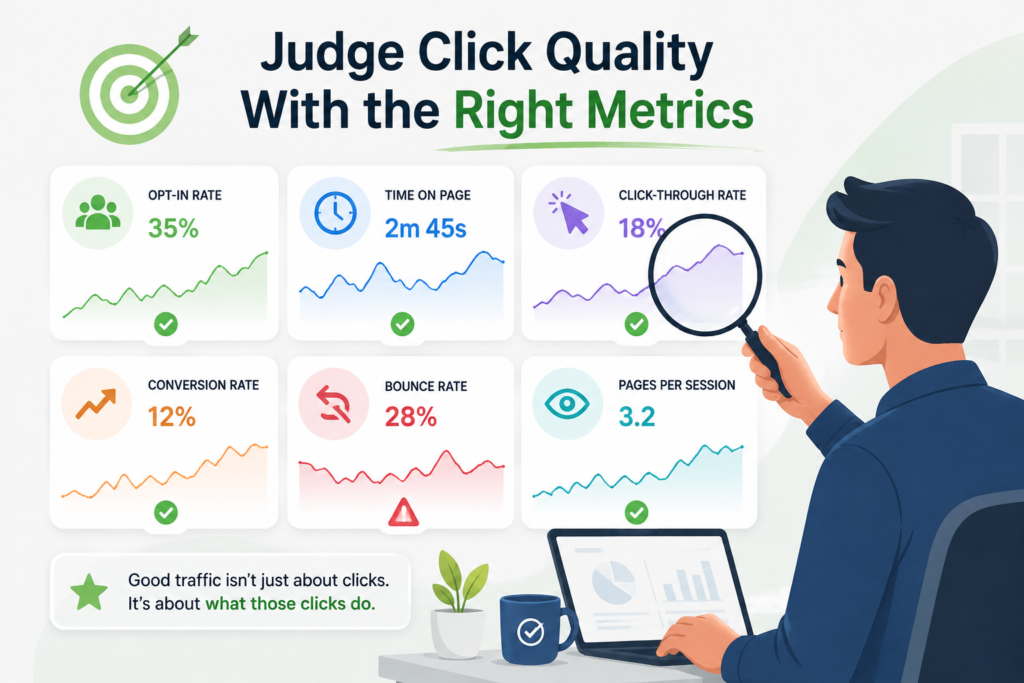
Many marketers make the mistake of focusing only on volume, but quality metrics tell the real story of your solo ad traffic. Relying solely on the number of clicks reported by a vendor can lead to poor financial decisions. Instead, you must look at how visitors interact with your site to determine if the traffic is actually valuable.
Evaluate click-through and landing-page engagement
Engagement metrics provide the first signal of whether your audience is genuinely interested in your offer. If users arrive and leave immediately, the traffic is likely low-quality or poorly targeted.
Review bounce rate, engaged sessions, time on page, and scroll depth
A high bounce rate often indicates that the landing page does not match the promise of the ad. You should monitor engaged sessions to see if visitors stay longer than ten seconds or trigger a conversion event. Furthermore, tracking time on page and scroll depth helps you understand if users are actually reading your content before deciding to opt in.
Calculate the opt-in rate for each campaign
The opt-in rate is a critical indicator of lead quality. By dividing the number of new subscribers by the total unique visitors, you can see how well your landing page converts cold solo ad traffic into prospects. If your opt-in rate is consistently below your industry average, you may need to refine your headline or offer.
“Data is the compass that guides your marketing ship; without it, you are simply sailing in the dark.”
Measure cost per lead and cost per customer
Financial metrics are the ultimate test of your campaign’s health. You must look beyond the initial click price to understand your true expenses.
Include ad spend, software fees, and follow-up costs
To calculate an accurate cost per lead, you must aggregate all expenses. This includes your direct ad spend, monthly software fees for your funnel builder, and the follow-up costs associated with your email marketing platform. Failing to account for these variables will lead to an inflated view of your profitability.
Analyze conversion rate beyond the initial click
A visitor who opts in is only the beginning of the journey. You must track how many of these leads eventually move through your funnel to become paying customers. This deeper analysis ensures that your solo ad traffic is not just generating email addresses, but actual revenue.
Use revenue and return on ad spend to make final judgments
The final verdict on any campaign should be based on your return on ad spend (ROAS). If the revenue generated exceeds your total costs, the campaign is a success. Use the following table to compare how different traffic quality levels impact your bottom line.
| Metric | High-Quality Traffic | Low-Quality Traffic |
|---|---|---|
| Bounce Rate | Below 40% | Above 80% |
| Opt-in Rate | Above 30% | Below 5% |
| Cost Per Lead | Profitable | Unsustainable |
| ROAS | Positive | Negative |
Identify Low-Quality or Wasted Solo Ad Traffic
Not all clicks are created equal when you purchase solo ad traffic. To protect your investment, you must actively monitor how visitors interact with your landing pages. Identifying poor traffic early prevents you from wasting your budget on clicks that will never convert into loyal customers.
Recognize suspicious click patterns
Look for rapid bursts, repeated visits, unusual geographies, and zero engagement
Watch your solo ad traffic analytics dashboard for unnatural activity. A sudden, massive spike in traffic that arrives in seconds often indicates automated bots rather than real people. You should also be wary of visitors from regions outside your target market or users who visit your page multiple times without ever clicking a button.
Compare traffic behavior across solo ad providers
It is helpful to maintain a log of how different solo ad providers perform over time. If one source consistently sends traffic that bounces immediately, you can compare this against your top-performing partners. This data helps you identify which vendors prioritize quality over sheer volume.
Investigate clicks that never produce meaningful sessions
Check redirects, broken URLs, blocked scripts, and mismatched tracking parameters
Sometimes, a lack of engagement is not the fault of the audience, but a technical error. If your tracking links are broken or your landing page scripts are blocked, you will see clicks that fail to register as sessions. Always verify that your tracking parameters are correctly configured to capture every visitor accurately.
Distinguish poor targeting from technical tracking problems
You must determine if your campaign is failing because the audience is irrelevant or because your tracking system is flawed. If your analytics show zero time on page, check your technical setup first. If the technical side is sound, the issue likely lies in the provider’s list quality or targeting settings.
Watch for inflated vendor reporting
Request raw delivery data and clarify the provider’s click definition
Some vendors may report higher click counts than your own analytics software shows. You should ask for raw delivery logs to see exactly where the traffic originated. Clarify whether the provider counts every click or only unique visitors, as this definition significantly impacts your perceived return on investment.
Document evidence before requesting a replacement or refund
If you find clear proof of low-quality traffic, gather your data before contacting the vendor. Screenshots of your analytics, bounce rates, and session durations serve as strong evidence. Presenting this information professionally increases your chances of securing a replacement or a refund for the wasted spend.
| Metric | High-Quality Traffic | Low-Quality Traffic |
|---|---|---|
| Session Duration | Above 30 seconds | Under 5 seconds |
| Bounce Rate | Below 60% | Above 90% |
| Engagement | Clicking buttons/forms | Zero interaction |
| Traffic Source | Verified human users | Bots or automated scripts |
Improve Attribution and Validate Your Results
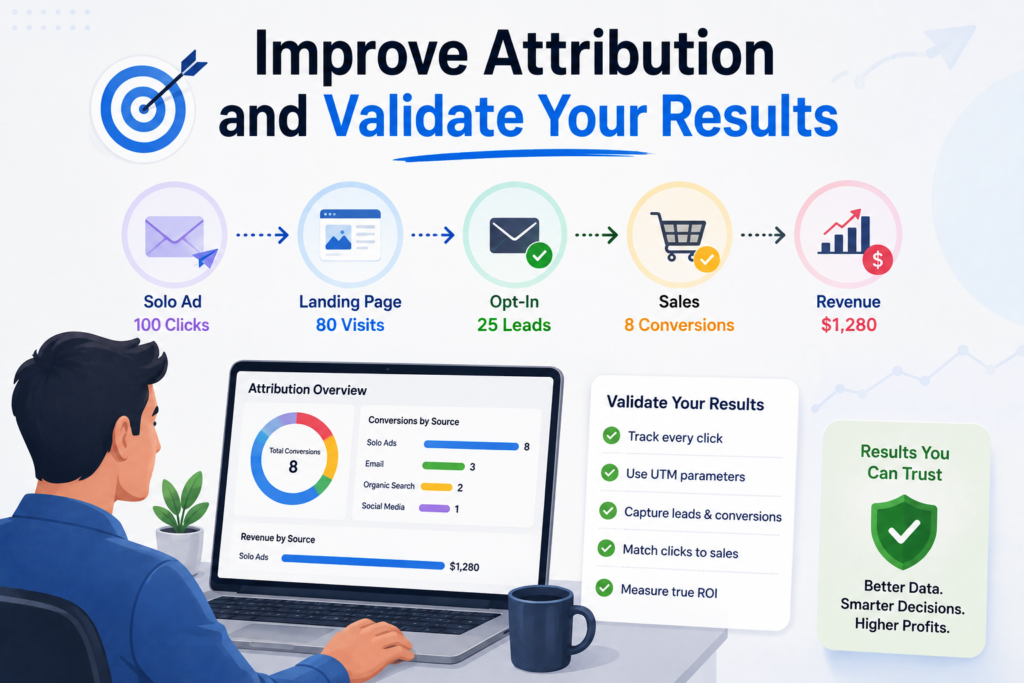
Validating your traffic sources requires more than just looking at a dashboard. To ensure your solo ad traffic is actually driving growth, you must look deeper into your internal systems. Relying solely on third-party reporting often leads to inflated numbers and missed insights.
Use first-party data to confirm reported conversions
Your internal records serve as the ultimate source of truth for your business. By integrating your email marketing platform, CRM, and payment processor, you create a closed loop of data. This allows you to see exactly which visitors turned into paying customers.
Connect email, CRM, and payment data to each campaign
When a lead enters your funnel, ensure your system captures the source information immediately. You should map every sign-up to the specific campaign ID generated by your tracking software. This connection is vital for calculating the true lifetime value of your leads.
Match subscriber records to UTM values and purchase activity
You can verify the quality of your solo ad traffic by cross-referencing subscriber email addresses with your UTM parameters. If a specific campaign shows high clicks but zero corresponding purchase activity in your CRM, you have identified a potential quality issue. Always look for the direct link between the initial click and the final sale.
Test links and tracking before launching a campaign
Never send live traffic to a broken tracking link. A simple error in your URL structure can cause you to lose all visibility into your campaign performance. Proactive testing saves you from wasting your budget on untracked visitors.
Complete a test visit on desktop and mobile devices
Perform a manual test by clicking your tracking link on both a desktop browser and a mobile device. Verify that the landing page loads correctly and that your analytics platform registers the session. Testing across devices ensures that your tracking pixels fire regardless of how the user arrives.
Account for privacy restrictions and lost attribution
Modern privacy settings and browser updates often block tracking cookies, leading to gaps in your data. You should expect some level of lost attribution in every campaign. Use server-side tracking where possible to minimize these losses and maintain a clearer view of your results.
Compare multiple data sources instead of relying on one dashboard
Do not trust a single platform to tell the whole story. Compare your ad network reports against your Google Analytics data and your internal sales logs. Significant discrepancies between these sources often signal technical errors or low-quality traffic patterns.
Use post-purchase surveys to identify the original traffic source
Sometimes, the best way to know where a customer came from is to ask them directly. A simple “How did you hear about us?” survey on your thank-you page provides qualitative data that complements your quantitative metrics. This helps you validate if your solo ad traffic is reaching your intended audience.
| Validation Method | Primary Benefit | Data Reliability |
|---|---|---|
| CRM Integration | Tracks long-term value | High |
| UTM Matching | Identifies specific sources | High |
| Manual Testing | Prevents data loss | Medium |
| Customer Surveys | Confirms user intent | Medium |
Optimize Your Campaigns After the First Traffic Test
Turning a modest initial test into a high-performing funnel is the hallmark of successful solo ad marketing. Once you have gathered your first set of data, you must move from experimentation to strategic refinement. This process ensures that every dollar spent contributes to a more profitable outcome.
Start with a controlled test instead of a large purchase
Avoid the temptation to commit your entire budget to a single vendor immediately. When you buy solo ads, start with a small, controlled test to establish a performance baseline. This approach protects your capital while you verify the quality of the traffic.
Change one campaign variable at a time
Isolating variables is the only way to understand what truly drives your results. If you change too many elements at once, you will never know which adjustment caused the shift in performance.
Test the provider, audience, landing page, offer, and follow-up separately
Focus on testing one component per cycle. You might test a new landing page headline while keeping the traffic source and offer identical. By isolating these factors, you gain clear insights into what your audience prefers.
Improve the landing page when clicks engage but do not convert
If your analytics show high engagement but low conversion rates, your landing page is likely the bottleneck. Targeted solo ads should lead to a page that clearly matches the promise made in the ad copy. Consider testing different calls to action or simplifying your opt-in form to reduce friction.
Refine targeting when engagement is weak from the start
Weak engagement from the moment of the solo ad traffic click often points to a mismatch in audience targeting. If visitors leave your site immediately, the traffic source may not align with your offer. You should communicate these findings to your provider to tighten the audience parameters for future sends.
Scale only campaigns that meet your quality standards
Scaling is a reward for proven performance, not a gamble. Only increase your spend when you have consistent data showing a positive return on investment. This disciplined approach keeps your solo ad marketing efforts sustainable over the long term.
Increase volume gradually while monitoring conversion efficiency
When you decide to scale, do so in small, incremental steps. Monitor your conversion efficiency closely during each increase to ensure that quality does not drop as volume grows. If efficiency dips, pull back immediately to investigate the cause.
Pause sources that consistently waste budget
Not every traffic source will work for your specific offer. If a provider consistently fails to meet your quality benchmarks despite your best efforts to optimize, stop the spend. It is better to buy solo ads from sources that deliver results rather than trying to force a bad fit to work.
Work With Solo Ad Providers More Effectively
Building a strong partnership with your traffic source is the secret to long-term success. When you treat your vendors as strategic partners, you gain better insights into the quality of your traffic. This collaborative approach is essential for anyone looking to master solo ad marketing.
Ask providers how they build and segment their email lists
Always inquire about the methods used to grow an email list. Reputable solo ad providers should be able to explain their lead generation strategies clearly. Understanding whether they use organic content or paid lead generation helps you gauge the quality of the subscribers you are reaching.
Confirm audience relevance before you buy solo ads
You must ensure that the audience aligns with your specific offer. If the list is not relevant to your niche, your conversion rates will likely suffer. Taking the time to verify this alignment is a critical step before you buy solo ads.
Review subscriber interests, list age, engagement, and geographic reach
Dig deeper into the data by asking for a breakdown of the list demographics. Subscriber engagement is often more important than the total size of the list. Check if the audience is active and if their geographic location matches your target market.
Agree on delivery, replacement, and refund terms
Establish clear ground rules regarding how your traffic is delivered. You should have a written agreement that outlines what happens if the clicks are not delivered as promised. Knowing the replacement and refund policy protects your investment from unexpected issues.
Provide compliant copy and a clear tracking link
To get the best results, provide your vendor with high-quality, compliant ad copy. Always include a unique tracking link so you can monitor the performance of the traffic in real-time. This transparency helps you identify targeted solo ads that actually convert.
Protect your budget with written performance expectations
Never leave your campaign goals to chance. Document your expectations regarding click quality and conversion benchmarks before the campaign begins. Having these standards in writing ensures that both you and your partner are working toward the same measurable outcomes.
Buy Smarter, Scale Better
Ready to stop wasting budget on questionable clicks? Choose a plan that gives you a stronger tracking process, clearer performance insights, and smarter buying decisions.
Conclusion
Success in solo ad marketing relies on your ability to turn raw clicks into measurable business growth. You now possess the framework to move beyond simple click counts and focus on real revenue.
Reliable solo ad traffic measurement starts with clear conversion goals and a robust tracking system. You must compare vendor reports against your own unique session data to ensure accuracy. Validating your results through first-party data keeps your budget safe from poor performance.
You have the tools to reject suspicious traffic patterns and identify high-value sources. Use these insights to refine your landing pages and email funnels for better engagement. Scaling your efforts becomes a predictable process when you only invest in providers that meet your documented quality standards.
Take control of your advertising spend by applying these rigorous testing methods today. Your commitment to data-driven decisions will distinguish your campaigns in a crowded marketplace. Start auditing your current traffic sources to build a more profitable future for your brand.
FAQs
Why should I define specific goals before I buy solo ads?
Setting clear objectives is essential because it allows you to measure solo ad traffic based on business outcomes rather than vanity metrics. By defining whether you need leads, sales, or booked calls, you can establish a target cost per lead (CPL) and return on ad spend (ROAS). This baseline helps you determine if the targeted solo ads you purchased are actually profitable for your specific sales funnel.
How do I set up a reliable tracking system for solo ad marketing?
You should build a foundation using Google Analytics 4 and dedicated landing pages for every campaign. By using UTM parameters, assigning specific values for source, medium, and campaign, you can identify exactly which solo ad providers are sending high-quality visitors. Tools like ClickMagick can also help you verify form submissions and checkout completions to ensure every click is accounted for accurately.
How can I distinguish between vendor-reported clicks and my own data?
It is common for a provider’s report to differ from your internal analytics. To accurately measure solo ad traffic, you must separate raw clicks from unique sessions. Your tracking should account for duplicate clicks, bot activity, and tracking loss. By comparing the Udimi or provider-specific dashboard with your Google Analytics 4 data, you can identify the true volume of human engagement reaching your site.
What metrics should I use to judge the quality of targeted solo ads?
Quality should be judged by engagement and financial performance. Review the bounce rate, engaged sessions, and scroll depth on your landing page. Beyond the initial click, calculate your opt-in rate and cost per customer. High-quality solo ad marketing will result in users who spend time on your page and move through your funnel, rather than bouncing immediately.
What are the signs of low-quality or wasted solo ad traffic?
Watch for suspicious patterns such as rapid bursts of hundreds of clicks in seconds, repeated visits from the same IP addresses, or traffic from geographic regions that do not match your target audience. If you notice zero engagement or clicks that never result in sessions, investigate potential technical issues like broken URLs or blocked scripts. Always document this evidence before requesting a replacement from solo ad providers.
How do I improve conversion attribution for my campaigns?
To validate your results, connect your CRM or email platforms like ConvertKit or ActiveCampaign to your tracking data. By matching subscriber records to specific UTM values, you can see which source leads to a final purchase. Using post-purchase surveys and testing your links on both desktop and mobile devices will also help you account for privacy restrictions and lost attribution data.
What is the best way to scale after a successful test?
Once you buy solo ads for a small test and see positive results, scale gradually. Do not jump to a massive order immediately; instead, increase volume while monitoring your conversion efficiency. Change only one variable at a time, such as the landing page copy or the email creative, to isolate what is driving the performance. Only continue to work with solo ad providers who consistently meet your documented quality standards.
What questions should I ask solo ad providers before starting a campaign?
Before committing to targeted solo ads, ask the provider how they build and segment their lists. Inquire about list age, subscriber interests, and recent engagement rates. It is also vital to confirm delivery, replacement, and refund terms in writing. Providing compliant copy and a clear tracking link ensures both parties have a transparent understanding of the campaign’s performance expectations.
5 thoughts on “How to Track Solo Ad Traffic and Know If Your Clicks Are Any Good”