
Have you ever wondered if your digital presence could thrive without pouring thousands of dollars into paid advertisements? Many business owners in the United States feel trapped by rising click costs, yet a sustainable path exists to grow your audience organically and generate more quality website traffic.
Learning how to attract more visitors to your website relies on mastering search visibility and user experience. By focusing on helpful content and smart conversion tactics, you can build a loyal following that lasts for years.
This guide explores how to optimize your digital footprint to ensure your brand reaches the right people and attracts more quality website traffic. You will discover how to turn casual browsers into dedicated customers through strategic planning and consistent effort.
Key Takeaways
- Prioritize high-value content to improve your search engine rankings naturally.
- Enhance user experience to keep your audience engaged longer on every page.
- Use data-driven insights to refine your outreach and capture new leads.
- Focus on long-term growth rather than short-term paid advertising spikes.
- Implement conversion optimization to maximize the value of every single visitor.
Get More Quality Website Traffic
Stop relying only on expensive ads. Discover practical ways to attract targeted visitors, improve engagement, and turn more website traffic into valuable leads.
Set Clear Goals for More Quality Website Traffic
Driving more quality website traffic starts with a clear understanding of who you are trying to reach. Without a defined target, you risk wasting resources on visitors who have no intention of engaging with your brand or purchasing your services.
Define the Visitors You Want to Attract
Identify audience needs, search intent, location, industry, and purchase readiness
To attract the right people and generate more quality website traffic, you must build a detailed profile of your ideal customer. Consider their specific pain points, the industry they operate in, and their geographic location. Understanding their search intent, whether they are looking for information, comparing options, or ready to buy, is essential for crafting content that resonates and attracts more quality website traffic.
Separate Traffic Volume From Traffic Quality
Use engagement, qualified leads, conversion rate, and revenue as success metrics
Many marketers fall into the trap of chasing high visitor counts that do not translate into business growth. You should prioritize more quality website traffic that actually moves the needle on your bottom line. Focus on metrics that indicate genuine interest and help you attract more quality website traffic rather than just page views.
| Metric Type | Focus Area | Business Impact |
|---|---|---|
| Volume Metric | Total Page Views | Low (Vanity) |
| Quality Metric | Conversion Rate | High (Revenue) |
| Quality Metric | Qualified Leads | High (Pipeline) |
| Quality Metric | Engagement Time | Medium (Interest) |
Establish a Baseline With Google Analytics 4 and Google Search Console
Review current acquisition channels, landing pages, queries, and conversion paths
Before you can improve, you need to know where you stand today. Use Google Analytics 4 to track how users behave once they arrive on your site and which paths lead to the most conversions. Simultaneously, leverage Google Search Console to see which queries bring users to your pages and identify opportunities for growth.
“Data is the compass that guides your strategy; without it, you are simply guessing where your audience is hiding.”
By reviewing your current acquisition channels, you can identify which sources consistently deliver more quality website traffic. This baseline allows you to double down on what works, attract more quality website traffic, and cut out the strategies that fail to provide a return on your investment.
Find High-Value Search Opportunities Before Creating Content
Strategic content creation begins with a deep dive into the specific search queries your ideal customers use, helping you attract more quality website traffic. By identifying these opportunities early, you ensure that your efforts lead to targeted website visitors rather than just empty traffic spikes.
Map Keywords to Customer Problems and Buying Stages
Understanding the intent behind a search is vital for success. You must align your content with the specific stage of the buyer’s journey to provide the most value.
Match informational, commercial, and transactional queries to relevant pages
Informational queries often start with “how to” or “what is,” signaling that a user is looking for answers and helping you attract more quality website traffic. Commercial queries show that a user is comparing options, while transactional queries indicate a readiness to buy. Matching these to the right page type is the most effective way to learn how to attract more visitors to your website who are ready to engage.
“Content is the bridge between the problem your customer has and the solution you provide.”
Prioritize Long-Tail Keywords With Specific Intent
Long-tail keywords are phrases that are longer and more specific than broad terms. These phrases often have lower search volume but much higher conversion potential, making them valuable for attracting more quality website traffic.
Evaluate relevance, competition, search results, and realistic ranking potential
When you focus on these specific phrases, you face less competition from massive brands. You should evaluate the current search results to see if your content can provide a better, more comprehensive answer than what is currently ranking.
Use Competitor Research to Discover Content Gaps
Your competitors often leave gaps in their content strategy that you can exploit. By analyzing their top-performing pages, you can identify topics they have missed or failed to cover in depth and create opportunities to attract more quality website traffic.
Compare competing pages for topic coverage, usefulness, freshness, and backlinks
Look for pages that lack recent updates or fail to answer common follow-up questions. If you can create a more useful, updated version of that content, you will naturally draw more targeted website visitors to your domain.
Build Topic Clusters Around Core Services or Products
A topic cluster strategy organizes your content into a central “pillar” page supported by several related articles. This structure signals to search engines that you are an authority on the subject and can help attract more quality website traffic.
Connect supporting content to authoritative commercial pages with logical internal links
By linking your supporting articles back to your main service pages, you pass authority where it matters most. This logical flow helps search engines understand your site architecture and improves the overall user experience.
- Identify the core problems your customers face.
- Research long-tail keywords that reflect those problems.
- Create content that solves those problems better than the competition.
- Link everything back to your primary commercial offerings.
Improve Existing Pages to Boost Website Traffic From Search
Improving your current web pages is a highly efficient way to boost website traffic without increasing your ad budget. Rather than constantly chasing new topics, you can leverage the authority your existing pages have already earned. This approach allows you to capture more quality website traffic by simply polishing what you have already built.
Refresh Pages That Already Receive Impressions
Update outdated facts, examples, statistics, screenshots, and recommendations
Search engines prioritize content that remains current and relevant to user needs. When you update outdated statistics or replace old screenshots with modern versions, you signal to Google that your page is still a valuable resource. This simple maintenance helps maintain your rankings, attract more quality website traffic, and prevents your content from becoming stale.
Strengthen Titles and Meta Descriptions for Qualified Clicks
Set accurate expectations while highlighting the page’s most valuable outcome
Your title tag and meta description serve as the primary advertisement for your content in search results. By crafting compelling, accurate summaries, you encourage users to click through to your site and attract more quality website traffic from search. Clear value propositions ensure that the visitors arriving on your page are genuinely interested in your solution.
Make Content Easier to Scan and Act On
Use descriptive subheadings, concise paragraphs, lists, tables, and prominent next steps
Modern readers rarely read every word on a page. They scan for information that solves their immediate problems. You can improve engagement by organizing your content into digestible chunks that guide the reader toward a specific goal and help you make the most of more quality website traffic.
| Element | Benefit | Action |
|---|---|---|
| Subheadings | Improved readability | Use H2-H4 tags |
| Bullet Points | Quick scanning | List key features |
| Tables | Data comparison | Summarize findings |
Optimize Images, Videos, and Supporting Page Elements
Compress media, write useful alt text, and improve accessibility without keyword stuffing
Large media files often slow down your site, which can negatively impact your search performance. Compressing your images and videos ensures a faster experience for your users and helps your site retain more quality website traffic. Additionally, writing descriptive alt text helps search engines understand your visual content while making your site more accessible to everyone.
- Always compress images to reduce load times.
- Use descriptive, natural language for alt text.
- Ensure your page layout remains clean and accessible.
Create Content That Attracts Targeted Website Visitors
Attracting the right people to your site starts with listening to the conversations already happening in your business. When you align your content with the actual needs of your audience, you naturally become a magnet for targeted website visitors and more quality website traffic that are ready to engage with your brand.

Answer the Questions Your Best Customers Ask
Turn sales calls, support tickets, reviews, and customer interviews into content topics
Your internal data is a goldmine for content ideas and can help you create content that attracts more quality website traffic. By reviewing transcripts from sales calls or common support tickets, you can identify the exact pain points your prospects face. This approach is one of the most effective ways to learn how to attract more visitors to your website who are genuinely interested in your solutions.
Choose Formats That Fit Search Intent
Develop guides, comparisons, case studies, calculators, templates, and original research when appropriate
Different search queries require different delivery methods. If a user is in the research phase, they likely want a comprehensive guide or a comparison table. If they are further down the funnel, they might prefer a calculator or a template that helps them solve a specific problem immediately.
- Guides: Best for top-of-funnel awareness.
- Comparisons: Ideal for middle-of-funnel decision making.
- Calculators: Excellent for high-intent engagement.
Demonstrate Expertise With Evidence and Firsthand Insight
Include expert commentary, practical examples, transparent methods, and verifiable sources
Search engines and users alike prioritize content that shows real-world experience. You should avoid generic advice and instead share your unique methodology or internal data. Providing verifiable sources and expert commentary builds the trust necessary to attract more quality website traffic and convert casual readers into loyal customers.
Give Every Content Asset a Clear Conversion Path
Connect educational content to relevant tools, consultations, product pages, or lead magnets
Every piece of content you publish should serve a business purpose and help generate more quality website traffic. Once you have successfully learned how to attract more visitors to your website, you must guide them toward the next step. Whether it is a free consultation or a downloadable lead magnet, a clear call to action ensures your targeted website visitors have a path to follow.
Build a Strong Internal Linking and Site Architecture Strategy
A well-structured internal linking strategy is one of the most effective ways to boost website traffic. By organizing your site architecture, you create a clear path for both users and search engine crawlers to discover your most important content. This structural foundation ensures that your site remains intuitive and easy to navigate.
Turn Targeted Traffic Into Leads
Attracting visitors is only half the job. Use the right strategies to guide quality traffic toward your offers, lead magnets, and conversion-focused pages.
Link From High-Authority Pages to Priority Destinations
Use relevant contextual links from pages that already earn traffic and backlinks
You should identify pages on your site that currently attract the most organic traffic or hold the highest number of backlinks. These pages possess significant authority that you can distribute to other areas of your site, helping you attract more quality website traffic to priority destinations. By placing contextual links within these high-performing pages, you direct visitors toward your priority products or services.
- Audit your top-performing blog posts for relevant linking opportunities.
- Ensure the destination page is highly relevant to the source content.
- Use these links to guide users deeper into your sales funnel.
Write Descriptive Anchor Text That Sets Expectations
Help users and search engines understand the topic and purpose of the linked page
The text you use for your links, known as anchor text, plays a vital role in your SEO success. Avoid generic phrases like “click here” or “read more.” Instead, use descriptive keywords that clearly explain what the reader will find on the destination page.
Clear anchor text helps search engines understand the context of your site structure. When users know exactly what to expect, they are more likely to click, which helps to boost website traffic naturally.
Reduce Click Depth for Important Pages
Ensure key services, products, resources, and conversion pages are easy to reach
Click depth refers to the number of clicks it takes for a user to reach a specific page from your homepage. Ideally, your most important pages should be no more than three clicks away, making it easier to guide more quality website traffic toward important pages. Reducing click depth ensures that search engines can crawl these pages more frequently and efficiently.
Repair Broken Links and Redirect Outdated URLs
Preserve useful referral paths and prevent visitors from encountering avoidable dead ends
Broken links create a poor user experience and signal to search engines that your site is not well-maintained. You should regularly audit your site to identify 404 errors and broken paths. Implementing proper redirects for outdated URLs allows you to preserve the authority of old pages while guiding visitors to current, relevant content.
By maintaining a clean and functional link structure, you prevent visitors from hitting dead ends. This proactive approach is essential to boost website traffic and maintain long-term search visibility.
Earn More Organic Visibility Through Authority and Digital PR
If you want to know how to attract more visitors to your website, look toward building lasting industry authority. Relying solely on paid ads is expensive and temporary, but establishing your brand as a trusted voice creates a permanent asset. This approach helps you boost website traffic by earning links and mentions from reputable sources.
Publish Original Data and Research Worth Citing
Use surveys, internal benchmarks, customer insights, and transparent methodology to create linkable assets
Original research is a magnet for backlinks and social shares, helping your website attract more quality website traffic over time. When you publish unique data, you provide value that others in your industry cannot find elsewhere. Ensure your methodology is transparent so that journalists and bloggers feel confident citing your work.
Contribute Expertise to Relevant Publications and Communities
Provide genuinely useful commentary instead of relying on low-quality guest-posting schemes
Avoid the trap of mass-producing low-quality guest posts. Instead, focus on providing deep, actionable insights for high-authority industry outlets. Authentic contribution builds your reputation and signals to search engines that your site is a credible source of information.
“Authority is not something you claim; it is something you earn through consistent, high-value contributions to your community.”
Build Relationships With Industry Partners and Local Organizations
Develop co-marketing campaigns, expert roundups, webinars, and community resources
Collaboration is a powerful way to expand your reach. By working with partners on webinars or shared resources, you tap into their existing audience. This strategy is a proven way to boost website traffic while strengthening your professional network.
| Strategy Type | Focus | Outcome |
|---|---|---|
| Low-Quality PR | Mass guest posting | Risk of penalties |
| High-Quality PR | Original research | Earned backlinks |
| Partnerships | Co-marketing | Shared audiences |
Promote New Content Without Paying for Additional Ads
Use email outreach, social distribution, sales enablement, and employee advocacy
You do not need a massive ad budget to get eyes on your content and attract more quality website traffic. Leverage your internal team to share updates through their professional networks. Use targeted email outreach to notify industry peers who might find your new research relevant to their own work.
Use Email and Social Channels to Bring Visitors Back
Relying solely on new acquisition is a costly mistake that ignores your most valuable asset: your existing audience. By leveraging email and social media, you can consistently attract targeted website visitors back to your platform without needing to increase your advertising spend.
Turn One-Time Visitors Into Subscribers
Offer relevant resources and explain the ongoing value of joining your email list
Most people will not return to your site unless you give them a compelling reason, making it important to turn existing visitors into an audience that can generate more quality website traffic through referrals and sharing.
You should provide high-value lead magnets, such as industry reports or exclusive checklists, to encourage sign-ups. Clearly communicate the ongoing benefits of your newsletter, such as weekly insights or early access to new tools.
Segment Messages by Interest and Buying Intent
Send different content to prospects, customers, returning visitors, and inactive subscribers
Generic blasts often lead to high unsubscribe rates. Instead, tailor your communication based on where the user is in their journey. You can use the following strategy to keep your audience engaged:
- Prospects: Send educational content that solves specific pain points.
- Customers: Provide advanced tips and product updates to drive loyalty.
- Returning Visitors: Share case studies that reinforce your authority.
- Inactive Subscribers: Send a “we miss you” campaign with a fresh resource.
Repurpose High-Performing Content Across Organic Channels
Adapt articles into LinkedIn posts, YouTube videos, short-form content, and newsletters
You do not need to create new content from scratch every day. Take your best-performing articles and transform them into different formats to reach targeted website visitors where they spend their time. A single long-form guide can become a series of LinkedIn posts, a short video summary, or a deep-dive newsletter segment.
Use Communities Without Spamming
Answer questions directly, disclose your affiliation, and link only when it adds genuine value
Online communities like Reddit or industry-specific forums are excellent for driving traffic if you approach them with integrity. Focus on being helpful rather than promotional. When you provide a thorough answer to a user’s question, you build trust, which makes your eventual link much more effective and welcomed by the community.
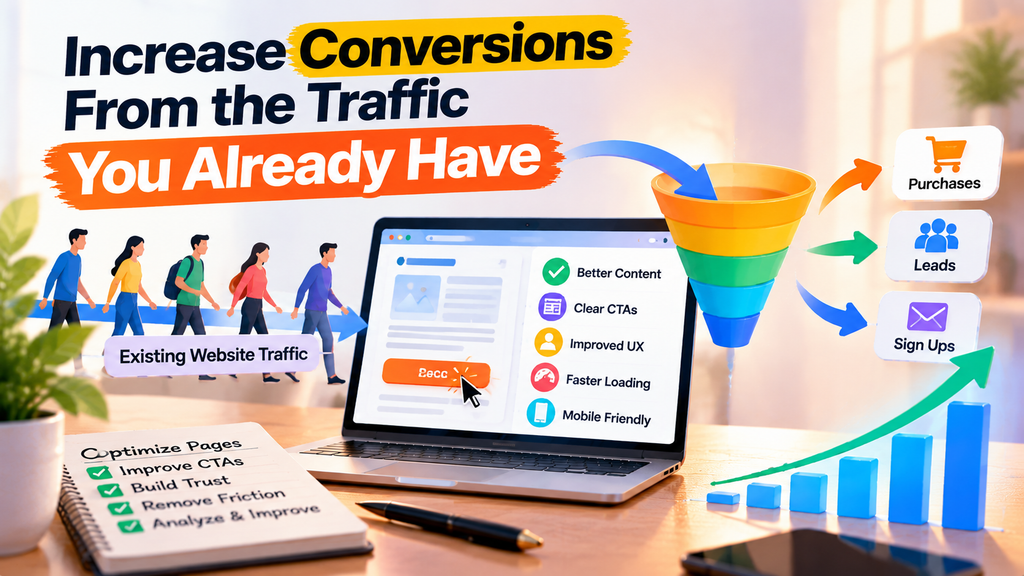
Increase Conversions From the Traffic You Already Have
You do not always need more visitors to see a significant jump in your bottom line. When you focus on more quality website traffic, you gain the opportunity to refine how those visitors interact with your brand. By optimizing your existing pages, you turn casual browsers into loyal customers without spending extra on advertising.
Align Each Landing Page With Visitor Intent
Make the headline, offer, proof, and call to action match the visitor’s expected outcome
Every visitor arrives at your site with a specific goal in mind. Your landing page must immediately confirm that they are in the right place by mirroring their search intent. When your headline and offer align perfectly with their needs, you build instant rapport, reduce bounce rates, and make the most of more quality website traffic.
Improve Calls to Action With Clear Value
Replace vague labels with specific, benefit-focused actions that reduce decision friction
Generic buttons like “Submit” or “Click Here” often fail to inspire action, even when you are already attracting more quality website traffic. Instead, use labels that highlight the specific value the user will receive, such as “Get My Free Guide” or “Start Saving Today.” These benefit-focused labels clarify the outcome and encourage users to take the next step.
Add Trust Signals at Key Decision Points
Use customer results, testimonials, reviews, guarantees, security details, and recognizable credentials
Visitors often hesitate before making a final decision. You can overcome this hesitation by placing trust signals exactly where they are needed most. Displaying verified reviews, security badges, or money-back guarantees provides the reassurance necessary to complete a transaction.
Test Forms, Offers, and Page Layouts Systematically
Change one meaningful variable at a time and evaluate results with sufficient data
Optimization is a scientific process that relies on accurate data. To achieve more quality website traffic results, you must test one element at a time, such as a headline or a button color. This method ensures that you know exactly which change caused an improvement in your conversion rate.
| Optimization Tactic | Primary Benefit | Implementation Effort |
|---|---|---|
| Headline Alignment | Higher Relevance | Low |
| Benefit-Focused CTAs | Increased Click-Through | Low |
| Trust Signal Integration | Reduced Friction | Medium |
| Systematic A/B Testing | Data-Driven Growth | High |
Strengthen Technical SEO and Website Performance
Technical excellence acts as the silent engine driving your digital presence forward. When your site functions flawlessly, you create a stable environment that encourages website traffic growth and keeps users engaged. Neglecting these backend elements often leads to missed opportunities, regardless of how high-quality your content might be.
Improve Core Web Vitals and Mobile Usability
Address slow loading, layout shifts, interaction delays, intrusive elements, and mobile navigation issues
Search engines prioritize sites that offer a smooth, fast experience. You must minimize slow loading times and prevent unexpected layout shifts that frustrate users. By removing intrusive elements and ensuring mobile navigation is intuitive, you provide a seamless path for your audience.
“Performance is not just a technical metric; it is a fundamental aspect of user experience that directly influences how people perceive your brand and interact with your content.”
Make Your Site Easy for Search Engines to Crawl
Check indexing, XML sitemaps, robots.txt, canonical tags, redirects, and duplicate content
If search engines cannot find or understand your pages, they cannot rank them. You should regularly audit your XML sitemaps and robots.txt files to ensure they point to the right locations. Using canonical tags helps you avoid issues with duplicate content, which is essential when you want to know how to attract more visitors to your website.
Use Structured Data Where It Accurately Applies
Help search engines interpret products, articles, organizations, local businesses, and other eligible content
Structured data provides search engines with clear context about your pages. By implementing schema markup, you help platforms display rich snippets that increase your visibility in search results. This extra layer of information makes your content more appealing to potential visitors.
| Technical Element | Primary Benefit | Action Required |
|---|---|---|
| Core Web Vitals | Improved Ranking | Optimize Image Sizes |
| XML Sitemap | Better Crawling | Submit to Search Console |
| Structured Data | Rich Snippets | Validate Schema Markup |
| Mobile Design | User Retention | Test Touch Targets |
Protect the Experience Across Browsers and Devices
Test forms, menus, checkout flows, readability, and accessibility on common screen sizes
Your site must perform consistently, whether a user is on a desktop or a smartphone. You should test your checkout flows and contact forms to ensure they function without errors. Prioritizing accessibility and readability ensures that you maintain website traffic growth by welcoming every potential customer.
Ultimately, technical reliability is the most effective way to learn how to attract more visitors to your website. When you remove barriers to entry, you allow your content to shine. Consistent testing across all devices keeps your site competitive in a crowded digital landscape.
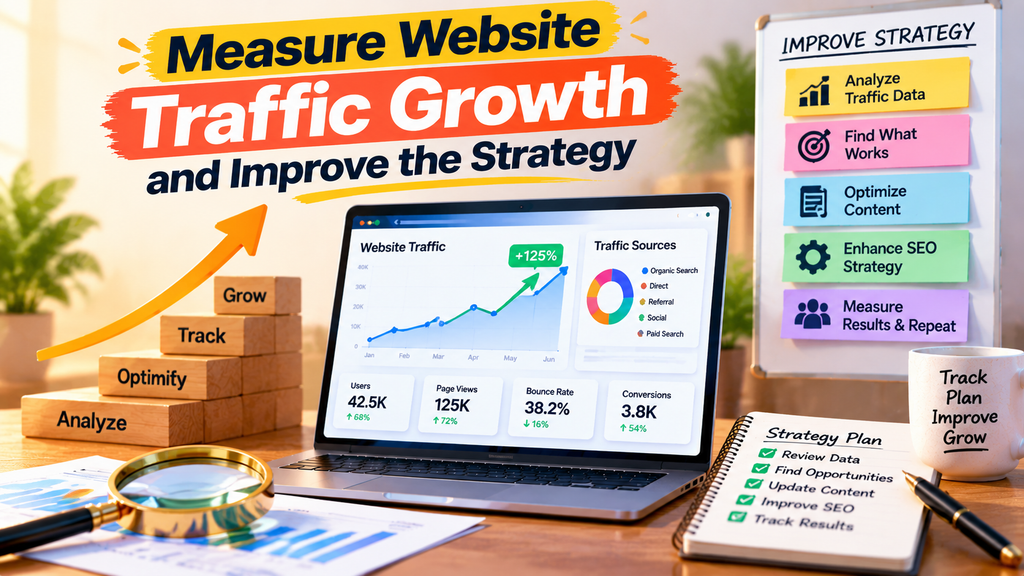
Measure Website Traffic Growth and Improve the Strategy
You can transform your digital presence by treating website traffic growth as a continuous cycle of refinement rather than a one-time project. By moving away from sporadic campaigns, you create a foundation for long-term success, more quality website traffic, and better results that rely on data rather than guesswork.
Track Quality Metrics by Channel and Landing Page
Understanding where your visitors come from is only the first step in your analysis. You must evaluate how these visitors interact with your site to determine if your current efforts are truly effective.
Compare engaged sessions, qualified leads, conversion rate, revenue, and assisted conversions
Focusing on these specific metrics helps you see the full picture of your marketing performance. Engaged sessions provide a better indicator of interest than simple page views, while tracking qualified leads ensures you are attracting the right audience. By monitoring revenue and assisted conversions, you can clearly see which channels contribute most to your bottom line.
Review Search Performance on a Consistent Schedule
Search engine optimization is a dynamic field that requires regular attention to maintain your competitive edge. Establishing a routine for performance reviews prevents you from missing critical shifts in search behavior.
Monitor clicks, impressions, rankings, click-through rate, and emerging opportunities
Use your analytics tools to keep a close eye on your search visibility and identify opportunities to attract more quality website traffic. A high number of impressions with a low click-through rate often signals a need to refine your meta titles or descriptions. Regularly checking your rankings allows you to spot emerging opportunities where you can capture more traffic with minimal effort.
Identify and Expand Your Most Valuable Traffic Sources
Not all traffic is created equal, and your resources are best spent on the channels that yield the highest return. Once you identify your top performers, you can double down on the strategies that work best for your business and consistently attract more quality website traffic.
Invest more effort in topics, formats, partnerships, and pages that produce business outcomes
Look for patterns in your data to see which content formats or partnerships drive the most meaningful engagement. When you find a topic that resonates with your audience, expand upon it to solidify your authority. Prioritizing high-impact pages ensures that your time is always spent on activities that move the needle.
Use a Sustainable Optimization Cycle
The most successful brands view their digital strategy as a living document that evolves with their audience. This repeatable process ensures that you are always improving rather than chasing short-term, unsustainable tactics.
Plan, publish, measure, update, and document improvements instead of chasing short-term tactics
- Plan: Set clear objectives based on previous performance data.
- Publish: Create high-quality content that addresses specific user needs.
- Measure: Analyze the results to see what worked and what didn’t.
- Update: Refine existing assets to maintain relevance and boost website traffic growth.
- Document: Keep a record of your findings to inform future decision-making.
Build Your Quality Traffic Strategy
Ready to grow without increasing your ad spend? Put these traffic strategies into action and attract visitors who are more likely to engage and convert.
Conclusion
Achieving success online requires a shift in perspective. You do not need a massive advertising budget to see meaningful website traffic growth. By aligning your goals with user intent, you create a foundation for long-term digital success.
Your strategy relies on the synergy between technical performance, high-quality content, and authority building. When you refine your internal linking and prioritize user experience, you naturally attract more quality website traffic. These elements work together to turn casual visitors into loyal customers.
Commit to a cycle of consistent measurement and improvement. Use tools like Google Analytics 4 to track your progress and identify new opportunities. Focus your energy on the channels and topics that deliver the best business outcomes.
Start applying these principles to your site today. Consistent effort builds momentum that compounds over time. Your path to better visibility and higher conversion rates begins with these intentional, data-driven steps.
FAQs
How do you define and measure more quality website traffic compared to raw volume?
To achieve more quality website traffic, you must look beyond total hits and focus on visitor intent and business outcomes. Using tools like Google Analytics 4, you should evaluate success through engagement rates, qualified lead generation, and actual revenue. High-quality traffic consists of targeted website visitors who spend time on your pages, interact with your content, and move further down your conversion funnel because your site solves their specific problems.
What are the most effective ways to boost website traffic without increasing your advertising budget?
You can boost website traffic organically and attract more quality website traffic by optimizing your existing assets and improving your search visibility. This includes refreshing outdated content with new statistics and screenshots, strengthening your meta descriptions to improve click-through rates, and building a robust internal linking structure. By focusing on SEO and user experience (UX) rather than paid placements, you create a sustainable growth engine that attracts visitors through relevance and authority.
Why should you prioritize refreshing existing content to support website traffic growth?
Content refreshes are often the fastest path to website traffic growth because you are building on pages that Google Search Console already shows are gaining impressions. By updating facts, improving readability with descriptive subheadings, and optimizing images with useful alt text, you signal to search engines that your content is fresh and relevant. This often results in higher rankings and more qualified clicks with significantly less effort than creating a new asset from scratch.
How do you ensure your content attracts targeted website visitors rather than random searchers?
You can attract targeted website visitors by creating content based on real-world data from your sales calls, support tickets, and customer interviews. Instead of guessing what people want, answer the exact questions your best customers are asking. When you demonstrate firsthand expertise and provide actionable evidence, you naturally filter for an audience that finds your specific services or products valuable.
How can you build authority and earn backlinks without relying on paid placements?
Building authority requires a commitment to Digital PR and original research. By publishing surveys, internal benchmarks, or unique industry insights, you create “linkable assets” that other publications want to cite. Engaging in co-marketing with partners and contributing genuine expertise to platforms like LinkedIn or industry-specific communities helps you reach new audiences and earn targeted website visitors through credibility rather than advertising spend.
What technical factors are essential for maintaining a sustainable website traffic growth cycle?
Technical reliability is the foundation of website traffic growth. You must monitor Core Web Vitals to ensure fast loading speeds and mobile usability while using Structured Data to help search engines accurately interpret your content. A sustainable cycle involves regular technical audits, checking XML sitemaps, fixing broken redirects, and ensuring your site is easily crawlable, to prevent technical debt from undermining your content marketing efforts.
How do you maximize conversions from the traffic you already have?
To turn more quality website traffic into revenue, you must align every landing page with the visitor’s intent. This involves testing clear, benefit-driven calls to action (CTAs) and adding trust signals like customer testimonials and security credentials at key decision points. By systematically testing one variable at a time, such as form layouts or headlines, you reduce friction and ensure your site is optimized to convert more quality website traffic you have already worked hard to attract.
What is quality website traffic and how is it different from regular website traffic?
Quality website traffic comes from visitors who are genuinely interested in your products, services, or content and are more likely to convert. Unlike regular traffic, which focuses mainly on visitor volume, quality traffic focuses on relevance, search intent, engagement, and business results. For example, 1,000 targeted website visitors can generate more qualified leads than 10,000 unrelated visitors. Businesses can attract more quality website traffic by targeting relevant keywords, matching search intent, and creating helpful, optimized content.
How can I increase organic website traffic from Google?
Increase organic website traffic by creating content that closely matches what people are searching for. Start with search-intent research and target relevant long-tail keywords with specific user needs. Optimize titles, headings, URLs, and content while keeping the information genuinely useful. Add relevant internal links to help users and search engines discover related pages. Make sure your website has strong technical SEO, including mobile usability, crawlability, and fast page performance. Regularly review and update existing content to keep it accurate and relevant. These practices can help attract more quality website traffic over time by connecting your content with people who are actively looking for the solutions you provide.
How do I attract website visitors who are more likely to become customers?
Focus on attracting visitors whose search intent matches your products or services. Target commercial and transactional keywords that indicate users are researching, comparing, or ready to buy. Make sure your landing page directly addresses the search query and clearly explains the value of your offer. High-quality content builds trust, while strong calls to action and a simple conversion process help turn visitors into leads or customers. For example, a software company targeting “best email marketing software for small businesses” can create a comparison page with clear features, pricing, benefits, and a demo CTA. This combination of relevant keywords, useful content, landing-page relevance, and conversion optimization helps attract more targeted visitors and improve the likelihood of generating customers.
Can updating old blog posts help increase website traffic?
Yes, updating old blog posts can improve their usefulness and relevance, particularly when the content is outdated or no longer fully matches search intent. Review the page title, headings, statistics, examples, and outdated information. Add relevant internal links, improve images where useful, and expand sections that no longer adequately answer the searcher’s question. Google Search Console can help identify pages that already receive impressions or clicks but may have opportunities for improvement. Focus on making the content more accurate, comprehensive, and useful rather than simply adding keywords. Updating content does not automatically improve rankings, but keeping valuable pages current can help maintain their usefulness for both readers and search engines.
Which metrics should I track to measure website traffic quality?
Page views alone don’t show whether your website is attracting valuable visitors. Track engaged sessions to understand whether people interact with your content, and monitor conversion rate to see how effectively traffic produces desired actions. Qualified leads indicate whether visitors match your target audience, while revenue shows the direct business value generated by different traffic sources. Also review assisted conversions to identify channels that contribute to conversions even when they aren’t the final interaction. Comparing these metrics by traffic source, landing page, and keyword can help you identify which channels bring visitors who are most valuable to your business.
2 thoughts on “How to Get More Quality Website Traffic Without Increasing Your Ad Budget”