
Are your email campaigns getting opens and clicks, yet somehow those numbers are not translating into leads, sales, sign-ups, or customers?
If so, you are not alone.
Email marketing can be one of the most powerful channels for turning prospects into customers, but getting someone to open an email is only the beginning when you’re focused on improving conversion rate in email marketing.
The real challenge is getting that person to take the action you want, whether that means downloading a resource, joining your list, booking a call, requesting a demo, or making a purchase. Understanding conversion rate in email marketing helps you measure how effectively those actions turn into meaningful business results.
That is why understanding how to increase conversion rate in email marketing matters so much.
A successful email campaign is not necessarily the one with the highest open rate. It is the one that moves subscribers toward a meaningful business outcome. You can have thousands of opens and hundreds of clicks, but if subscribers do not complete the desired action, your campaign is leaving money on the table.
The good news? You do not necessarily need a bigger email list to generate better results. Often, you need a better strategy.
From audience segmentation and personalized messaging to stronger calls to action, better landing pages, compelling offers, testing, and consistent follow-up, there are many ways to improve your email conversion rates without simply sending more emails.
This guide walks you through exactly what you need to know, including what conversion rate means, how to calculate it, what influences it, and practical strategies you can implement immediately.
Key Takeaways
- Email conversion rate measures actions, not just engagement. Opens and clicks matter, but the ultimate goal is getting subscribers to complete your desired conversion action.
- Relevance drives conversions. Segment your audience and tailor your emails to subscribers’ interests, behaviors, needs, and stage in the buying journey.
- Your offer and CTA matter enormously. A clear value proposition paired with one compelling call to action can remove friction and make the next step obvious.
- Testing is essential. Test subject lines, copy, offers, CTAs, layouts, sending times, and landing pages rather than relying on assumptions.
- Traffic quality and funnel alignment affect email results. Your email can only perform as well as the audience, offer, landing page, and overall customer journey supporting it.
Turn More Email Clicks Into Conversions
Stop leaving revenue behind after the click. Discover practical strategies to turn subscribers into leads, customers, and sales with better offers, CTAs, targeting, and follow-up.
What Is Conversion Rate in Email Marketing?
Before learning how to increase conversion rate in email marketing, it is important to understand exactly what the metric represents.
So, what is conversion rate in email marketing?
Email conversion rate is the percentage of recipients or email-driven visitors who complete a specific action that you define as a conversion, making it a core measure of conversion rate in email marketing.
That action could be:
- Purchasing a product
- Signing up for a webinar
- Downloading an ebook
- Registering for a free trial
- Booking a consultation
- Filling out a form
- Requesting a quote
- Subscribing to a service
- Joining a membership
- Completing another desired goal
The important point is that there is no single conversion that applies to every email campaign.
For example, an ecommerce company might define a conversion as a completed purchase. A SaaS company might define it as a free-trial registration. A consultant might count a booked discovery call as a conversion.
This distinction is important because email performance should always be evaluated against the campaign’s objective.
Conversion Rate vs. Open Rate
Open rate tells you how many people opened your email.
Conversion rate tells you how many people completed the desired action. This makes conversion rate in email marketing more closely connected to your actual business objective than engagement alone.
These are very different metrics.
Imagine you send an email to 10,000 subscribers:
| Metric | Result |
|---|---|
| Emails delivered | 9,800 |
| Opens | 2,940 |
| Clicks | 490 |
| Conversions | 98 |
| Revenue | $4,900 |
Your open rate may tell you that your subject line and sender information generated interest. Your click-through rate tells you that some readers were interested enough to visit your offer.
But the conversion rate tells you whether those interested people actually completed the business goal.
That is why optimizing only for opens can lead you in the wrong direction.
How to Calculate Conversion Rate in Email Marketing
One of the most important skills for any email marketer is knowing how to calculate conversion rate in email marketing.
To measure conversion rate in email marketing, use the following basic formula:
Email Conversion Rate = (Number of Conversions ÷ Number of Delivered Emails) × 100
For example, suppose you send 5,000 emails and 125 recipients complete the desired action.
Your conversion rate would be:
(125 ÷ 5,000) × 100 = 2.5%
Your email conversion rate is therefore 2.5%.
However, there is another way marketers sometimes evaluate conversion performance: based on clicks or email-driven visitors.
For example:
Click-to-Conversion Rate = (Conversions ÷ Clicks) × 100
If 500 subscribers clicked your email and 100 purchased, your click-to-conversion rate would be:
(100 ÷ 500) × 100 = 20%
Both measurements can be useful, but they answer different questions. Together, they give you a more complete understanding of conversion rate in email marketing.
The first tells you how effectively your overall email audience converted.
The second tells you how effectively the people who clicked converted after showing initial interest.
Which Formula Should You Use?
It depends on what you are trying to diagnose when analyzing conversion rate in email marketing.
| Metric | Formula | Best For |
|---|---|---|
| Email Conversion Rate | Conversions ÷ Delivered Emails × 100 | Measuring overall email effectiveness |
| Click-to-Conversion Rate | Conversions ÷ Clicks × 100 | Measuring offer/funnel effectiveness |
| Click-Through Rate | Clicks ÷ Delivered Emails × 100 | Measuring email engagement |
| Open Rate | Opens ÷ Delivered Emails × 100 | Evaluating initial attention |
| Revenue Per Email | Revenue ÷ Delivered Emails | Measuring financial performance |
A useful approach is to track the entire journey:
Delivered → Opened → Clicked → Converted → Revenue
This gives you a much clearer picture of where subscribers are dropping out.
For example, if your emails get plenty of clicks but very few conversions, the problem may not be your email at all. Your landing page, offer, pricing, checkout process, or audience targeting could be responsible.
What Affects Email Conversion Rates?
There is no magic number that guarantees a successful email campaign. The same is true when evaluating conversion rate in email marketing, because results vary significantly between audiences and campaigns.
Your email conversion rates depend on multiple factors, including:
- Audience quality
- Relevance of the offer
- Subscriber intent
- Email copy
- Subject line
- Call to action
- Landing page experience
- Product-market fit
- Trust
- Timing
- Segmentation
- Personalization
- Mobile experience
- Follow-up sequence
- List hygiene
- Traffic source
Think of your email as one part of a larger funnel. This broader view is essential when trying to improve conversion rate in email marketing.
If your subscribers are not interested in the offer, better copy may only produce a small improvement.
If your audience is highly relevant but your CTA is confusing, improving the CTA could produce a significant increase.
If your email is excellent but your landing page is slow or difficult to use, conversions can still suffer.
The goal is therefore not simply to “write better emails.” The goal is to improve the entire path from subscriber to conversion.
How to Increase Conversion Rate in Email Marketing
Now let’s get into the strategies.
If you have been wondering how can I increase conversion rate in email marketing, start with these practical techniques.
1. Define One Primary Conversion Goal
One of the biggest mistakes email marketers make is trying to accomplish too many things in one email.
Imagine receiving an email that asks you to:
- Buy a product
- Follow the brand on social media
- Read a blog post
- Download a guide
- Book a call
- Watch a video
What should you do first?
Too many options can create decision fatigue.
Instead, give each campaign one primary objective so you have a clear target for conversion rate in email marketing.
For example:
Goal: Get subscribers to book a consultation.
Your subject line, email copy, supporting information, and CTA should all reinforce that goal.
You can include secondary links when necessary, but avoid allowing them to compete with the main action.
Use the “One Email, One Job” Principle
Before sending an email, finish this sentence:
“The one thing I want the reader to do after reading this email is ______.”
If you cannot answer that clearly, the email may need to be simplified.
2. Segment Your Email List
If every subscriber receives the same message, you are probably missing conversion opportunities.
Your subscribers are not identical.
Some may be brand-new leads. Others may have purchased before. Some may have clicked your previous emails repeatedly. Others may have not engaged for months.
Treating them all the same can make your messaging less relevant.
Instead, segment your list based on meaningful characteristics.
Useful Segmentation Criteria
You can segment subscribers according to:
- Purchase history
- Geographic location
- Industry
- Interests
- Lead source
- Website behavior
- Previous email engagement
- Product interest
- Funnel stage
- Customer status
- Download history
- Purchase frequency
For example, a subscriber who downloaded a beginner’s guide should not necessarily receive the same message as an existing customer.
The more relevant the email is to the recipient, the easier it becomes to communicate value. Greater relevance can ultimately improve conversion rate in email marketing.
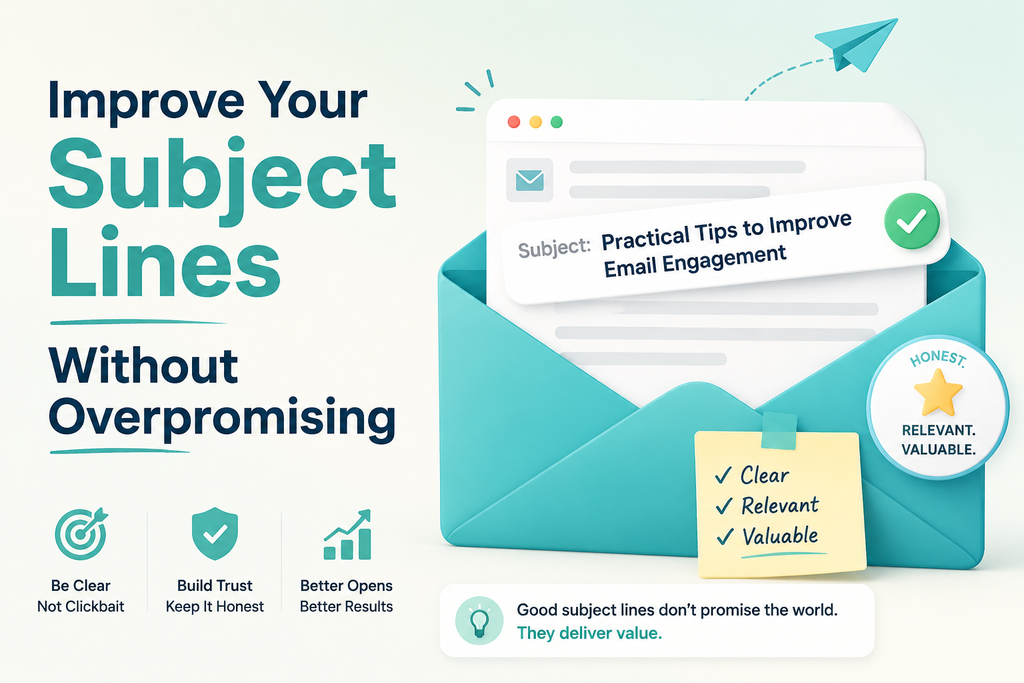
3. Improve Your Subject Lines Without Overpromising
Your subject line has one job: encourage the right person to open the email. Although opens are not the final goal, they are an important first step when optimizing conversion rate in email marketing.
But avoid misleading clickbait.
A subject line can generate curiosity while still accurately representing the content.
Instead of:
“IMPORTANT!!! You won’t believe this!!!”
Try something more specific:
“3 ways to improve your email conversions this week”
Or:
“Your email funnel may be losing buyers here”
Specificity often makes a message more compelling because the reader immediately understands why it might matter to them.
Test Different Subject Line Styles
Try testing:
- Questions
- Benefits
- Curiosity
- Numbers
- Personalization
- Urgency
- Direct statements
- Problem-focused messaging
Do not assume one style will always win.
Your audience decides what works.
Make the Value Proposition Crystal Clear
Once someone opens your email, they should quickly understand:
What’s in it for me?
Your email should communicate the benefit rather than simply describing the product.
For example:
Weak:
“We launched our new marketing software.”
Stronger:
“Automate your follow-ups and spend less time manually managing leads.”
The second version explains the outcome.
Your subscriber does not necessarily care about your feature list. They care about what those features help them accomplish. Communicating those outcomes clearly can help improve conversion rate in email marketing.
Focus on Outcomes
Instead of saying:
- 20 templates
- Advanced dashboard
- Automated workflows
- 15 integrations
Connect features to outcomes:
- Launch campaigns faster
- Reduce repetitive work
- See which campaigns generate results
- Connect your existing tools
That shift can make your email more persuasive.
5. Write Conversational Email Copy
People do not want to feel like they are reading a corporate brochure.
Write like you are talking to one person.
Instead of:
“Our company is pleased to announce the availability of our comprehensive marketing solution.”
Try:
“Want a simpler way to manage your campaigns? We built this to help you do exactly that.”
Conversational writing can make your email feel more personal and approachable.
Use:
- Short paragraphs
- Simple sentences
- Natural language
- Specific examples
- Direct questions
- Active voice
And do not be afraid to sound human.
6. Personalize More Than Just the First Name
Adding a subscriber’s first name is easy, but personalization can go much further.
Instead of:
“Hi John,”
followed by a generic message, use behavioral or contextual information.
For example:
“You downloaded our beginner’s email guide last week. If you’re ready to take the next step, here’s a simple way to start improving your campaigns.”
Now the email feels connected to the subscriber’s previous action.
You can personalize based on:
- Previous purchases
- Content downloads
- Browsing behavior
- Email engagement
- Product interest
- Customer status
- Previous conversations
- Geographic relevance
The objective is not to demonstrate how much data you have. The objective is not to demonstrate how much data you have, but to use relevant information to improve conversion rate in email marketing.
The objective is to make the message more useful.
7. Create Strong, Specific Calls to Action
Your CTA should tell people exactly what happens when they click.
Weak CTA:
Click Here
Better CTA:
Start My Free Trial
Even better when appropriate:
Get My Free Email Audit
Specific CTAs reduce uncertainty. Reducing uncertainty is especially important when optimizing conversion rate in email marketing.
A strong CTA generally answers:
What am I getting?
For example:
- Get the Guide
- Book My Free Call
- Start My Trial
- Claim the Discount
- See the Full Strategy
- Get Instant Access
Avoid CTA Overload
If the main objective is getting someone to download a guide, do not bury the primary CTA beneath five competing actions.
Make the desired next step obvious.
8. Match the Email With the Landing Page
This is one of the most overlooked factors when improving conversion rate in email marketing.
Imagine your email says:
“Download our free 30-page email marketing guide.”
You click the button and land on a generic homepage.
What happens?
You have to figure out where the guide is.
That creates friction.
Instead, send the subscriber to a landing page that continues the same message.
The email promises a guide.
The landing page should immediately reinforce:
Yes, you’re in the right place. Here’s the guide.
This is called message consistency.
Your:
Email → Landing Page → Offer → Checkout/Form
should feel like one continuous experience.
9. Reduce Friction
Every unnecessary step creates another opportunity for someone to leave.
Look at your conversion process and ask:
- Is the form too long?
- Does the page load quickly?
- Is the CTA visible?
- Are there unnecessary fields?
- Is the offer clearly explained?
- Does the page work on mobile?
- Is the checkout process complicated?
- Are there distractions?
If you only need an email address, do you really need ten additional form fields?
Sometimes the easiest way to improve conversion is simply to remove obstacles.
10. Use Social Proof to Build Trust
People are more likely to take action when they believe others have already had a positive experience.
Social proof can include:
- Testimonials
- Customer reviews
- Case studies
- Ratings
- Number of customers
- Results
- Client logos
- User-generated content
For example:
“More than 2,000 marketers have used our framework.”
Or:
“Here’s how one customer reduced the time spent managing campaigns.”
But keep your proof credible.
Avoid vague claims that sound exaggerated.
Specific, verifiable proof is generally more persuasive than empty superlatives.
11. Use a Strong Offer
Sometimes your email conversion problem is not an email problem.
It is an offer problem.
If your audience does not perceive enough value, even excellent copy may struggle.
Ask:
Why should someone act now?
Your offer might include:
- A free trial
- A bonus
- A discount
- A limited-time opportunity
- A free consultation
- A useful resource
- A product bundle
- Exclusive access
However, you do not always need a discount.
Value can come from convenience, speed, education, support, access, or solving an expensive problem.
12. Build Automated Follow-Up Sequences
A single email rarely needs to do all the selling.
Some subscribers need multiple touchpoints before taking action.
Build a Funnel That Converts
Ready to transform email engagement into measurable business results? Strengthen your landing pages, offers, tracking, and follow-up strategy to create a conversion-focused funnel that performs.
This is where automated sequences become valuable.
A simple sequence might look like this:
| Purpose | |
|---|---|
| Email 1 | Deliver value or welcome the subscriber |
| Email 2 | Address a major problem |
| Email 3 | Introduce your solution |
| Email 4 | Provide proof or a case study |
| Email 5 | Handle objections |
| Email 6 | Present a clear CTA |
| Email 7 | Follow up with urgency or additional value |
The sequence allows you to build trust instead of asking for a purchase immediately. Building that trust over multiple touchpoints can have a positive impact on conversion rate in email marketing.
For new subscribers, this can be particularly useful because they may not know who you are yet.
13. Test Your Emails Systematically
If you want to know how to increase conversion rate in email marketing, testing should become part of your process. Regular testing gives you evidence about what actually improves conversion rate in email marketing.
But do not randomly change five things at once.
Instead, isolate variables whenever practical.
Test:
- Subject line A vs. B
- CTA A vs. B
- Long copy vs. short copy
- Different offers
- Different headlines
- Different email layouts
- Different personalization
- Different sending times
- Different landing pages
Example A/B Test
Suppose version A says:
Get Started Today
Version B says:
Get Your Free Strategy Guide
If B generates more conversions, you have learned something about the motivation of your audience.
Over time, these small discoveries compound.
14. Optimize for Mobile Readers
A significant portion of email consumption happens on mobile devices.
That means your email should be easy to read on a small screen.
Check:
- Font size
- Button size
- Paragraph length
- Image scaling
- White space
- Link spacing
- Form experience
- Landing page responsiveness
A beautiful desktop email that becomes difficult to read on a phone is not a successful design. Mobile usability can therefore play an important role in conversion rate in email marketing.
Keep your layout simple.
Use short paragraphs and make important CTAs easy to tap.
15. Send at the Right Time for Your Audience
There is no universal “perfect” email sending time.
Your ideal timing depends on your audience, industry, location, behavior, and campaign type.
Instead of blindly following a generic recommendation, use your own performance data.
Test different:
- Days
- Times
- Frequencies
- Sending schedules
For example, B2B subscribers may behave differently from consumers. A global audience may also require different timing strategies than a concentrated regional audience.
The goal is to discover when your specific audience is most responsive.
16. Keep Your Email List Clean
A large list is not automatically a valuable list.
If a significant percentage of subscribers never engage, they can make your overall metrics less useful and may indicate declining list quality.
Regularly evaluate inactive subscribers.
You can create a re-engagement campaign asking whether they still want to hear from you.
For example:
“Still want our weekly marketing tips?”
Give them an easy choice.
If someone remains completely inactive, consider whether keeping them on your active marketing list makes sense.
Quality matters more than vanity numbers. Quality matters more than vanity numbers when you’re trying to improve conversion rate in email marketing.
17. Make Your Traffic and Audience More Relevant
Your conversion rate is heavily influenced by who enters your funnel.
Imagine promoting a B2B software product to an audience interested primarily in unrelated consumer products.
Even the best email sequence will struggle.
Relevant traffic gives your email campaigns a stronger starting point.
This is particularly important if you are using external traffic sources, lead-generation campaigns, or solo ads to grow your list.
OptinSoloAd, for example, positions its traffic around targeted buyer clicks and says its traffic comes from multiple sources rather than relying on a single acquisition channel. The company also emphasizes real visitors and funnel optimization as part of its approach.
The lesson is broader than any single traffic provider:
The quality and relevance of your subscribers matter.
If the people entering your funnel are genuinely interested in your offer, your email campaigns have a much stronger foundation.
18. Track the Entire Funnel, Not Just Email Metrics
One of the biggest mistakes marketers make is looking at email metrics in isolation when evaluating conversion rate in email marketing.
Suppose you have:
- 10,000 delivered emails
- 2,500 opens
- 500 clicks
- 20 conversions
You might conclude that the email is underperforming.
But what if the landing page converted 4% of visitors while your industry benchmark or internal historical performance is 1%?
The email might actually be doing its job.
The problem could be the number of people reaching the landing page.
This is why you should track:
Email Delivery → Engagement → Clicks → Landing Page → Conversion → Revenue
OptinSoloAd’s own guidance on tracking traffic similarly emphasizes measuring the complete journey from traffic and landing-page visits through opt-ins, sales, revenue, and ROI rather than relying on raw click counts alone.
19. Connect Email Conversion to Revenue
This is why conversion rate in email marketing should ultimately be connected to the revenue generated by your campaigns.
Suppose Campaign A generates 100 conversions.
Campaign B generates only 50.
At first glance, Campaign A looks better.
But imagine:
| Campaign | Conversions | Average Order Value | Revenue |
|---|---|---|---|
| A | 100 | $10 | $1,000 |
| B | 50 | $50 | $2,500 |
Campaign B generated fewer conversions but significantly more revenue.
This is why you should evaluate both:
Conversion volume
and
Conversion value
Depending on your business model, useful metrics may include:
- Revenue per email
- Revenue per subscriber
- Customer acquisition cost
- Average order value
- Customer lifetime value
- Return on investment
20. Use Urgency Carefully
Urgency can encourage action when it is genuine.
Examples include:
- A real deadline
- Limited enrollment
- A scheduled price change
- A limited promotion
- An event starting soon
But artificial urgency can damage trust.
Avoid repeatedly claiming:
“LAST CHANCE!!!”
when the same offer appears in another email tomorrow.
Good urgency gives people a legitimate reason to act.
Bad urgency makes people feel manipulated.
21. Address Objections Before Asking for the Sale
Sometimes subscribers are interested but hesitant.
They might be thinking:
- Is this worth the money?
- Will it work for someone like me?
- How difficult is it?
- Do I need technical skills?
- Can I cancel?
- What happens if it doesn’t work?
- Is this legitimate?
Your email can proactively address those concerns.
For example:
“No technical experience required.”
or:
“You can cancel anytime.”
or:
“Here’s exactly what you’ll receive.”
Reducing uncertainty can help subscribers feel more comfortable taking the next step. Removing these barriers can also improve conversion rate in email marketing.
22. Give Value Before Asking for Action
If every email from you asks for something, subscribers may eventually tune out.
Balance promotional emails with useful content.
You can provide:
- Tips
- Tutorials
- Checklists
- Case studies
- Mistakes to avoid
- Industry insights
- Templates
- Examples
This creates a healthier relationship with your audience.
When you consistently help subscribers, promotional emails can feel more relevant rather than intrusive. This relevance can contribute to a stronger conversion rate in email marketing over time.
23. Use Behavioral Triggers
Behavior-based email campaigns can be extremely effective because they respond to what subscribers actually do.
Examples include:
Welcome Trigger
Send a welcome email immediately.
Someone joins your list.
Abandoned Cart Trigger
Someone adds an item but does not purchase.
Send a reminder.
Product Interest Trigger
Someone repeatedly views a product.
Send relevant information or an offer.
Post-Purchase Trigger
Someone purchases.
Send onboarding instructions, recommendations, or support information.
Re-Engagement Trigger
Send a win-back campaign.
Behavioral automation allows your messaging to respond to the subscriber’s situation instead of sending identical messages to everyone.
Someone stops opening emails.
24. Improve Your Email Design
You do not need a complicated design to increase conversions.
In many cases, simplicity wins.
A high-converting email might contain:
- A clear headline
- A short explanation
- A compelling benefit
- Supporting proof
- One primary CTA
Avoid clutter.
Too many images, colors, buttons, fonts, and sections can distract from the action you want the subscriber to take.
Design should support the message—not compete with it.
25. Create a Conversion-Focused Testing Process
Random testing is better than no testing, but a structured process is much more powerful.
Use this framework:
Step 1: Identify the Problem
For example:
“Open rate is healthy, but clicks are low.”
Step 2: Create a Hypothesis
“Subscribers may not understand the benefit of clicking.”
Step 3: Make One Major Change
Rewrite the CTA and value proposition.
Step 4: Run the Test
Compare the new version against the original.
Step 5: Measure the Result
Look at clicks and, more importantly, downstream conversions.
Step 6: Document the Learning
Write down what happened.
Over time, you build your own conversion optimization playbook.
Common Email Marketing Conversion Mistakes to Avoid
Knowing what not to do can be just as valuable as knowing what to do.
Sending Too Many Promotional Emails
If every message asks subscribers to buy, your audience may disengage.
Writing About Yourself Too Much
Your subscribers care about their problems and desired outcomes.
Keep the focus on them.
Using Generic CTAs
“Click Here” provides little motivation.
Tell people what they will get.
Ignoring the Landing Page
Your email does not operate in isolation.
A poor post-click experience can destroy otherwise strong campaign performance.
Buying Low-Quality Traffic
A huge number of visitors or subscribers means little if they are not relevant to your offer.
Never Testing
What worked six months ago may not be what works today.
Keep learning.
Tracking Vanity Metrics
Opens and clicks are useful, but conversions and revenue ultimately matter more.
Making the Email Too Long
Long-form emails can work, but every sentence should earn its place.
If a shorter email can communicate the same idea, consider shortening it.
How to Build a High-Converting Email Funnel
If you want sustainable results, think beyond individual emails.
A basic funnel might look like this:
Traffic Source
↓
Landing Page
↓
Email Opt-In
↓
Welcome Sequence
↓
Value Emails
↓
Offer Email
↓
Sales Page
↓
Purchase
↓
Post-Purchase Follow-Up
Every stage has a job, and each stage can influence conversion rate in email marketing.
If your traffic is irrelevant, your opt-in rate may suffer.
If your landing page is weak, fewer visitors become subscribers.
If your welcome sequence is poor, subscribers may disengage.
If your offer is unclear, sales may be low.
If your sales page creates friction, clicks may not turn into customers.
This is why improving conversion rate requires a funnel-wide perspective.
OptinSoloAd’s own service materials emphasize the importance of having a well-optimized funnel, proper tracking, and an offer capable of converting traffic.
How to Increase Conversion Rate in Email Marketing With Solo Ad Traffic
If your strategy includes solo ads, the quality and targeting of the traffic feeding your funnel become especially important.
The basic process looks like this:
Solo Ad Traffic → Landing Page → Opt-In → Email Follow-Up → Offer → Conversion
Before sending traffic, make sure your funnel is ready.
Start With a Focused Landing Page
Do not overwhelm visitors with unrelated offers.
Give them one clear reason to opt in.
Track Every Campaign
Use campaign-specific tracking so you know which traffic source generated which results.
Measure Opt-In Rate
If traffic arrives but few visitors opt in, your landing page or offer may need work.
Measure Email Performance
Once those visitors become subscribers, monitor engagement and conversions.
Measure Revenue
Ultimately, determine whether the traffic and follow-up sequence produce profitable customers.
OptinSoloAd’s published guidance recommends using dedicated landing pages, tracking parameters, analytics, and full-funnel measurement to understand the quality and profitability of traffic.
Get More From Every Subscriber
You do not always need a bigger list to grow. Learn how to maximize your existing audience with relevant messaging, targeted traffic, compelling offers, and smarter conversion optimization.
Final Thoughts: Better Email Conversion Starts With Better Relevance
So, how can I increase conversion rate in email marketing without simply sending more emails?
Start by changing the way you think about conversion.
Conversion is not just an email problem, and improving conversion rate in email marketing requires looking at the entire customer journey.
It is a customer-journey problem.
Your audience needs to be relevant. Your message needs to be clear. Your offer needs to be valuable. Your CTA needs to be obvious. Your landing page needs to deliver on the promise made in the email. Your follow-up needs to build trust. And your tracking needs to show you what is actually generating results.
The strongest email campaigns are not necessarily the loudest ones. They are the ones that understand what the subscriber wants and make the next step easy.
Start with one campaign.
Choose one conversion goal.
Identify one major bottleneck.
Make one meaningful improvement.
Then test it.
For example, if your emails get plenty of opens but few clicks, focus on your value proposition and CTA. If clicks are strong but conversions are weak, examine your landing page and offer. If your conversion rate is healthy but revenue is low, look at pricing, average order value, upsells, and customer lifetime value.
This approach turns email marketing from guesswork into a measurable optimization process.
And remember: you do not always need more subscribers to generate better results. Sometimes you simply need to help the subscribers you already have take the next step.
That is the real answer to how to increase conversion rate in email marketing, understand your audience, deliver relevant value, remove friction, measure the complete funnel, and keep improving based on what the data tells you.
When those pieces work together, your emails can do much more than generate opens and clicks. They can become a reliable engine for leads, sales, and long-term customer growth.
Frequently Asked Questions
What is conversion rate in email marketing?
Email marketing conversion rate is the percentage of email recipients who complete a specific desired action after receiving your campaign. The action could be a purchase, registration, download, booking, free-trial sign-up, or another business goal. The exact conversion depends on what your campaign is designed to achieve.
How do you calculate conversion rate in email marketing?
The basic formula is:
Conversion Rate = (Conversions ÷ Delivered Emails) × 100
For example, if 50 people convert from 2,000 delivered emails, your conversion rate is 2.5%.
You can also calculate click-to-conversion rate by dividing conversions by clicks when you want to evaluate the performance of the post-click experience.
How can I increase conversion rate in email marketing?
Start by improving relevance. Segment your audience, create a clear offer, write benefit-focused copy, use a specific CTA, optimize the landing page, reduce friction, test different campaign elements, and build follow-up sequences. Also make sure the traffic entering your funnel is relevant to your offer.
What are good email conversion rates?
There is no single conversion rate that is universally considered “good.” Results vary significantly based on industry, audience, offer, funnel stage, traffic source, conversion definition, and purchase price. Instead of chasing an arbitrary benchmark, compare your results with your own historical performance and profitability.
Is email conversion rate more important than open rate?
For many campaigns, conversion rate is closer to the ultimate business objective because it measures the desired action. Open rate can still provide useful information about initial engagement, while clicks help diagnose interest. Ideally, track the entire funnel rather than relying on one metric.
Why are my emails getting clicks but no conversions?
If subscribers click but do not convert, examine the post-click experience. Your landing page may not match the email, the offer may be unclear, the price may create hesitation, the page may have too much friction, or the audience may not be sufficiently qualified. Test each part of the funnel systematically.
Should I send more emails to increase conversions?
Not necessarily. Sending more emails can increase opportunities, but excessive frequency may lead to unsubscribes and lower engagement. Focus on sending relevant messages with clear value. A well-designed sequence can often outperform a large volume of disconnected promotional emails.
Does personalization increase email conversions?
Relevant personalization can improve the usefulness of your messaging. Instead of simply inserting a first name, use information such as previous behavior, interests, purchases, or funnel stage when appropriate. The goal is to make the message more relevant rather than merely making it look personalized.
How often should I test my email campaigns?
Testing should be an ongoing part of email marketing. You do not need to test every minor detail in every campaign, but regularly test meaningful variables such as offers, subject lines, CTAs, copy, segmentation, and landing pages. Document the results so each test adds to your knowledge.
Can better traffic improve email conversion rates?
Absolutely. The relevance and quality of the people entering your funnel can strongly affect downstream conversions. If your subscribers are genuinely interested in the problem your product solves, your emails have a more qualified audience to work with. This is why traffic quality, targeting, landing pages, and email follow-up should be considered together.
2 thoughts on “How to Increase Conversion Rate in Email Marketing: 15 Proven Strategies That Actually Work”