
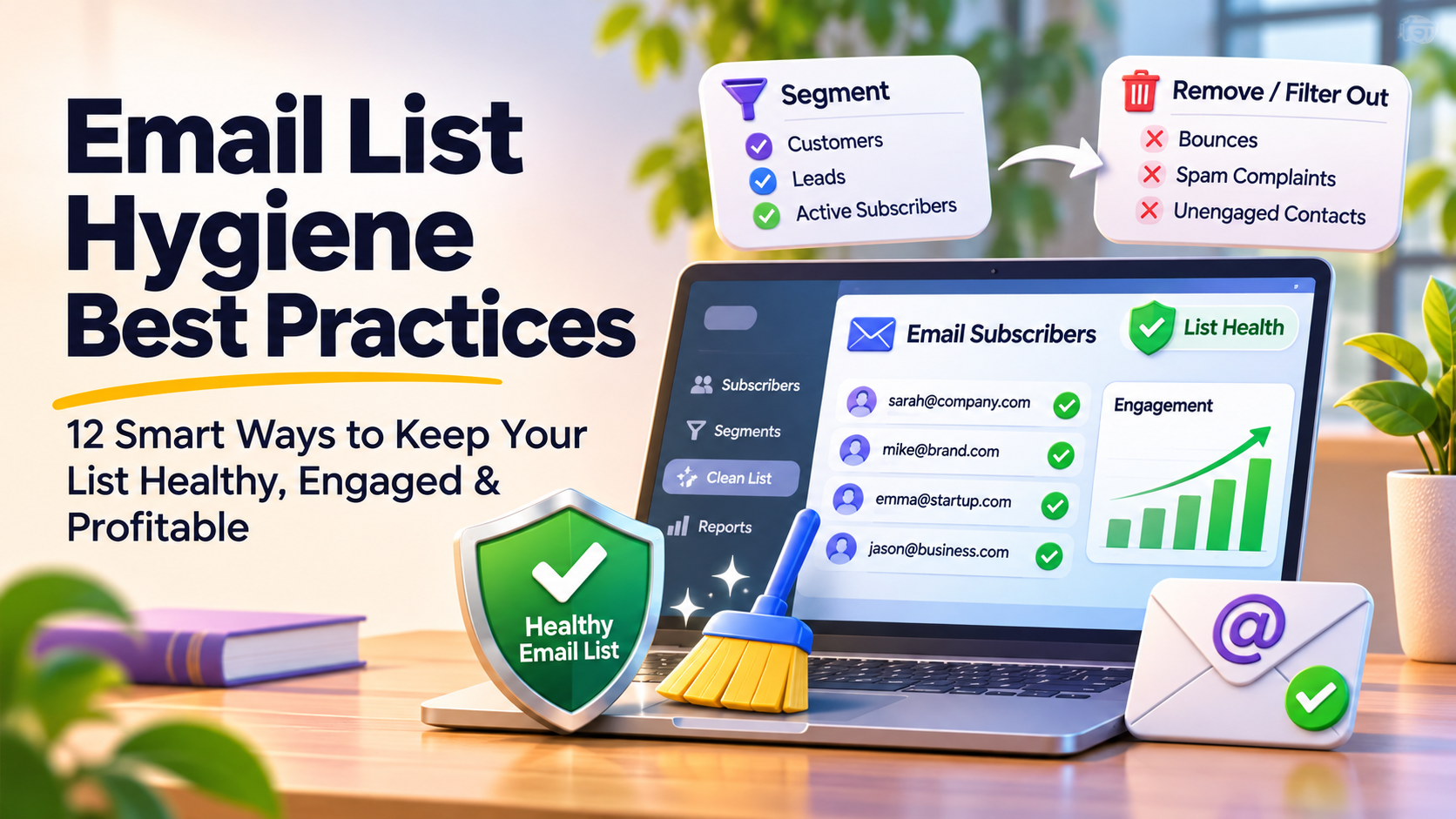
Have you ever wondered why your email list keeps growing, but your open rates, clicks, and conversions are moving in the opposite direction? You may have hundreds or even thousands of subscribers, yet your campaigns are getting fewer responses than expected. The problem might not be your email copy, subject lines, or offers. It could be the quality of your email list.
Building an email list is an important step in online marketing, but maintaining it is equally important. Every new subscriber represents an opportunity to build a relationship, share useful information, and eventually generate business. However, over time, email addresses become invalid, subscribers lose interest, people change their preferences, and some contacts stop interacting with your messages altogether.
This is where email list hygiene best practices become essential.
Think of your email list like a garden. Planting new seeds is important, but you also need to remove weeds, provide proper care, and give healthy plants enough attention to grow. Similarly, collecting email addresses is only the beginning. You must regularly maintain your subscriber database to keep it useful, relevant, and responsive.
Whether you are a beginner building your first subscriber list, an affiliate marketer promoting offers, or an experienced business owner managing thousands of contacts, maintaining a healthy list can make your email marketing more effective.
In this guide, we will explore 12 practical strategies to maintain subscriber quality, improve email deliverability, reduce unnecessary sending costs, and build stronger relationships with your audience. Understanding email list hygiene best practices can help you build a more reliable subscriber base from the very beginning.
Applying email list hygiene best practices from the beginning helps you maintain subscriber quality as your audience grows.
Key Takeaways
- A smaller, engaged email list can be more valuable than a large list filled with uninterested contacts.
- Regularly remove invalid addresses, monitor bounce rates, and review inactive subscribers.
- Use proper signup practices, email verification, segmentation, and re-engagement campaigns.
- Monitor sender reputation, authentication, spam complaints, and unsubscribe requests.
- Treat email list maintenance as an ongoing marketing activity rather than a one-time cleaning task.
Build a Healthier Email List Today
Keep your subscriber database clean, engaged, and valuable. Apply these practical strategies today to improve email deliverability, strengthen relationships, and support better marketing results.
What Is Email List Hygiene?
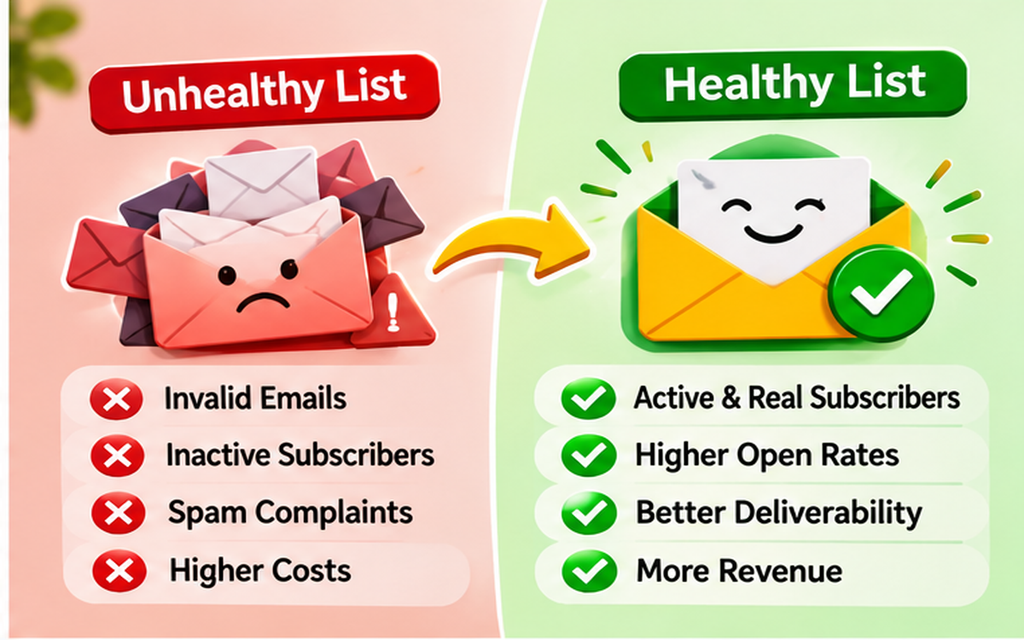
Email list hygiene refers to the process of maintaining an accurate, permission-based, and engaged subscriber database. It involves identifying invalid email addresses, monitoring subscriber activity, removing unwanted contacts, correcting data where appropriate, and ensuring that people receive messages they actually expect.
Following email list hygiene best practices makes each of these maintenance activities easier to manage consistently.
The purpose of email list hygiene best practices is not simply to reduce the number of subscribers. It is to improve the overall quality of your audience.
For example, imagine two marketers.
Marketer A has 20,000 subscribers but regularly sends emails to people who have not opened or clicked a message in over a year. Some addresses are invalid, and several contacts never requested promotional emails.
Marketer B has 5,000 subscribers who signed up voluntarily, receive relevant content, and regularly interact with campaigns.
Although Marketer A has a larger database, Marketer B may have a more valuable audience because the subscribers are genuinely interested.
A healthy list helps marketers focus their efforts on people who are more likely to read, click, respond, and become customers.
It is important to understand that list hygiene does not guarantee inbox placement or sales. Email deliverability also depends on authentication, sending infrastructure, recipient behavior, content, and other factors. However, maintaining good subscriber data is an important part of a responsible email marketing strategy.
These simple habits form the foundation of effective email list hygiene best practices for businesses of every size.
Why Does Email List Hygiene Matter?
Before discussing the practical steps, let’s understand why maintaining your subscriber database deserves regular attention.
1. It Supports Better Email Deliverability
Email service providers evaluate many signals when deciding where messages should go. Invalid addresses, spam complaints, authentication problems, and unwanted messages can create delivery problems.
Sending repeated campaigns to addresses that cannot receive your emails can increase hard bounces. Sending unwanted messages can also encourage recipients to report your campaigns as spam. Applying email list hygiene best practices helps you maintain a more relevant audience and avoid unnecessary sending to unsuitable contacts.
Following email list hygiene best practices helps you reduce avoidable delivery problems by maintaining accurate recipient records and respecting subscriber preferences.
2. It Helps Protect Your Sender Reputation
Your sender reputation is influenced by how recipients and mailbox providers respond to your emails.
Frequent complaints, poor engagement patterns, and sending to invalid recipients can create warning signs. This is another reason email list hygiene best practices should be part of your regular email marketing routine.
Maintaining your database, removing addresses that permanently bounce, and sending relevant content can help reduce unnecessary risks.
Consistent email list hygiene best practices can help you identify potential problems before they affect your future campaigns.
3. It Makes Your Marketing Budget More Efficient
Many email marketing platforms calculate pricing according to the number of contacts or the volume of emails sent.
If you are paying to maintain thousands of outdated contacts, you may be spending money without receiving meaningful marketing value.
Removing unnecessary records can help you manage your subscription costs and concentrate on the subscribers who still want your content. Email list hygiene best practices also help you avoid paying to maintain contacts who no longer provide meaningful marketing value.
This makes email list hygiene best practices useful not only for deliverability but also for managing your marketing expenses.
4. It Improves Campaign Measurement
Suppose you send an email to 10,000 people, but 4,000 of them are inactive or invalid. Your campaign reports may not provide a useful picture of how interested your actual audience is.
A well-maintained database makes it easier to interpret engagement metrics, compare campaigns, and identify which audience segments respond positively. Using email list hygiene best practices gives you cleaner data for evaluating your campaign performance.
Better subscriber data makes email list hygiene best practices an important part of measuring campaign performance accurately.
5. It Creates a Better Subscriber Experience
Nobody enjoys receiving irrelevant promotional emails every day.
When people receive useful messages at a reasonable frequency, they are more likely to maintain their subscription and develop trust in your brand.
Good list management is not only about protecting your marketing performance. It is also about respecting the people who gave you their contact information.
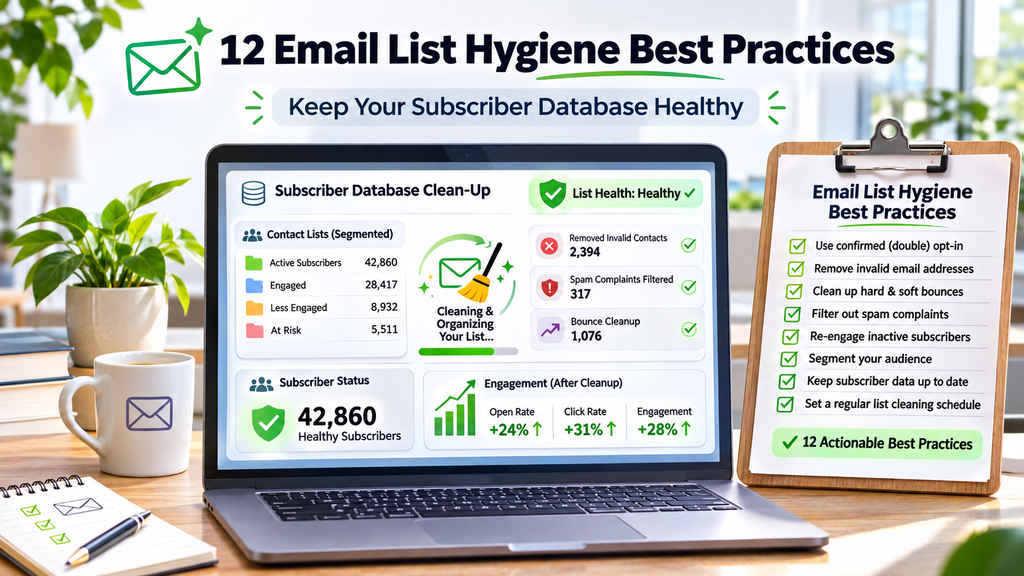
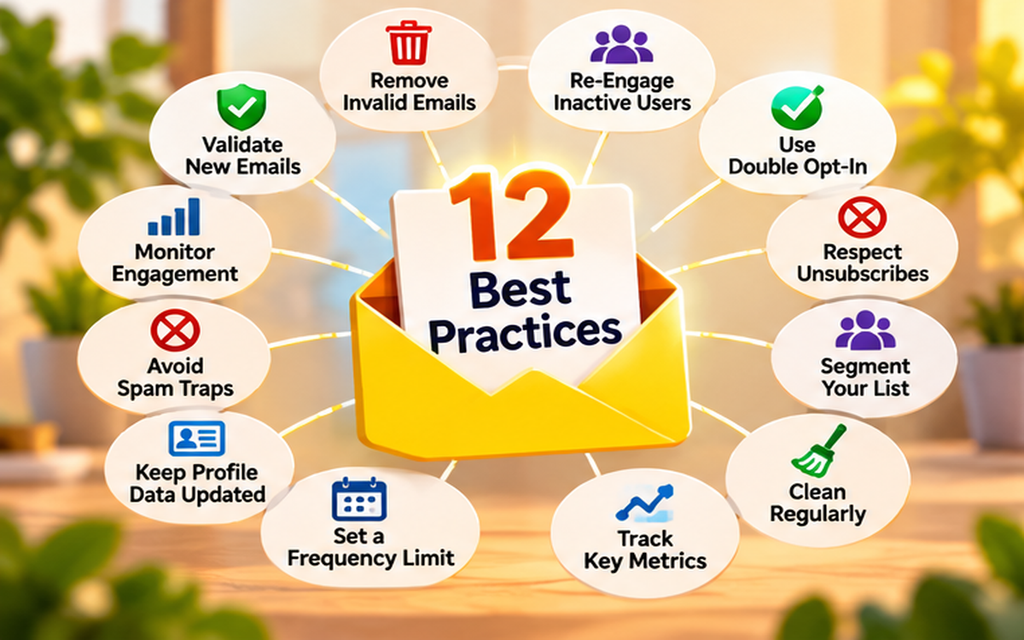
12 Email List Hygiene Best Practices to Keep Your Subscriber Database Healthy
Let’s get into the practical strategies. These 12 methods can help beginners and experienced marketers build a healthier, more responsive email database.
1. Remove Invalid and Undeliverable Email Addresses
One of the first steps in maintaining a healthy subscriber database is identifying addresses that cannot receive your messages.
People sometimes enter incorrect email addresses when completing signup forms. Others abandon old accounts, change email providers, or lose access to their inboxes.
As a result, your database may gradually accumulate invalid contacts.
Start by reviewing your email campaign reports and identifying addresses associated with permanent delivery failures.
Pay particular attention to:
- Addresses containing obvious spelling mistakes.
- Email addresses with incorrect domain names.
- Accounts that repeatedly return permanent delivery failures.
- Addresses that your email platform identifies as undeliverable.
- Duplicate records that represent the same contact.
Use a reputable email verification service to identify potentially invalid addresses before sending campaigns.
However, remember that verification results are not perfect. A valid-looking address does not automatically mean the owner wants your emails, and some mail servers do not reveal whether an address exists.
A practical approach is to combine verification results with actual delivery information and signup records. This combination makes email list hygiene best practices more reliable than depending on a single verification tool.
Following email list hygiene best practices means removing genuinely undeliverable addresses rather than randomly deleting contacts.
Practical tip: Export your subscriber database, review the bounce information, and create a separate record of addresses that need attention. Always retain the information necessary to respect previous unsubscribe requests and suppression preferences.
2. Identify and Monitor Inactive Subscribers
Not every subscriber who stops opening emails has lost interest.
Some people read messages through notification previews, use privacy features that affect tracking, or simply prefer visiting websites directly.
That is why you should not automatically remove everyone who has not opened your recent emails.
Instead, evaluate subscriber activity using several signals.
Look at:
- Email clicks.
- Website visits from email campaigns.
- Purchases or completed registrations.
- Replies to your messages.
- Recent signup dates.
- Previous engagement history.
For example, someone may never open your newsletter but regularly click links and purchase products. Removing that person based only on open tracking would be a mistake.
Create an inactive segment for subscribers who have shown little or no meaningful activity over a reasonable period. Including this review in your email list hygiene best practices helps you make better decisions about inactive contacts.
The appropriate period depends on your sending frequency and business model. A daily newsletter may use a shorter review period than a quarterly industry update.
This is one of the most useful email list hygiene best practices because it helps you identify contacts who need a different communication approach.
Practical tip: Start with subscribers who have not clicked, purchased, replied, or otherwise interacted for six months. Treat this as a review starting point, not a universal deletion rule.
3. Use Double Opt-In to Collect Genuine Subscribers
How do you know whether someone actually wants to receive your emails?
A double opt-in process provides an additional confirmation step.
Here is how it works:
- A visitor enters their email address into your signup form.
- Your email platform sends a confirmation message.
- The visitor clicks the confirmation link.
- The platform records the confirmed subscription.
This process helps reduce accidental signups, incorrectly entered addresses, and some automated registrations.
It also creates a clearer record that the person completed the subscription process.
For example, imagine someone enters another person’s email address into your website form as a joke. With double opt-in, the person receiving the confirmation message can simply ignore it.
However, double opt-in is not a complete solution to email quality problems. It does not guarantee future engagement, eliminate every bot signup, or replace applicable consent requirements.
You should also make your signup expectations clear. Clear signup expectations are an important part of email list hygiene best practices because they help attract subscribers who understand what they are joining. Explain what type of emails people will receive and how frequently you plan to contact them.
If you are deciding between signup methods, your existing guide on Single Opt In vs Double Opt In: Which Is Better for Email Lists? can help readers understand the differences.
Practical tip: Use a confirmation email that clearly identifies your brand and explains why the recipient is being contacted. Avoid confusing confirmation messages that look like promotional advertisements.
Combining confirmed signups with email list hygiene best practices gives you a stronger starting point for building a reliable subscriber database.
4. Segment Your Email List Based on Subscriber Engagement
Would you send exactly the same message to someone who joined yesterday and someone who has purchased from you five times?
Probably not.
Different subscribers have different interests, needs, and levels of familiarity with your business.
Email segmentation allows you to divide your audience into smaller groups based on useful information.
You can create segments using:
- Signup source.
- Signup date.
- Previous purchases.
- Product interests.
- Email clicks.
- Website activity.
- Geographic location, where relevant and appropriate.
- Subscriber preferences.
For example, an affiliate marketer may have subscribers interested in email marketing, website traffic, affiliate tools, and online business training.
Sending relevant content to each group is generally more useful than sending every offer to everyone. Effective email list hygiene best practices encourage this kind of organized and interest-based communication.
Segmentation also helps you identify subscribers who are no longer responding to particular types of content.
One of the central ideas behind email list hygiene best practices is making sure that subscribers receive messages that match their interests.
Practical tip: Start with three simple segments: new subscribers, actively engaged subscribers, and subscribers who need re-engagement. You can create more detailed groups as your database grows.
5. Run Regular Email Re-Engagement Campaigns
Before removing inactive subscribers, consider giving them an opportunity to reconnect.
A re-engagement campaign is a short series of emails designed to find out whether inactive contacts still want to hear from you.
You do not need complicated automation to get started.
A simple campaign can include:
Email 1: A Friendly Check-In
Ask whether the subscriber still wants to receive your updates. Remind them what kind of content they signed up for.
Email 2: Share Something Useful
Send a helpful resource, practical guide, or relevant update that may encourage them to interact again.
Email 3: Confirm Their Preferences
Give subscribers an opportunity to choose the topics they prefer or confirm that they want to continue receiving your messages.
Make the process easy. Including respectful re-engagement campaigns in your email list hygiene best practices gives inactive subscribers a clear opportunity to remain connected.
If someone does not respond, apply your stated inactivity policy and stop sending regular marketing emails to that contact.
Do not continue sending repeated reminders indefinitely.
Also, avoid deceptive subject lines such as “Your account will be deleted” when no such action is taking place.
Following email list hygiene best practices means recognizing that inactive subscribers deserve a respectful choice rather than endless promotional messages.
Practical tip: Run a re-engagement campaign before suppressing long-term inactive subscribers. Keep the campaign focused, useful, and limited.
6. Monitor Hard Bounces and Soft Bounces
Bounce management is an essential part of maintaining email quality.
A bounced email is a message that could not be delivered to its intended recipient.
There are two common types.
Hard Bounce
A hard bounce indicates a permanent delivery failure.
Possible reasons include:
- The recipient’s email address does not exist.
- The domain is invalid.
- The recipient address is permanently unavailable.
Hard-bounced addresses should generally be removed from active marketing sends promptly.
Soft Bounce
A soft bounce usually indicates a temporary delivery problem.
Possible reasons include:
- The recipient’s inbox is full.
- The receiving server is temporarily unavailable.
- The message exceeds a receiving system’s size limit.
- Temporary server restrictions prevent delivery.
A soft bounce does not necessarily mean the address is permanently invalid.
For example, if a subscriber’s mailbox is full today, the same address might successfully receive your next campaign.
Do not immediately delete every soft-bounced contact. Review repeated failures and follow your email service provider’s bounce-handling rules. Regular bounce monitoring is one of the most practical email list hygiene best practices for maintaining accurate subscriber records.
This is where email list hygiene best practices become especially important: distinguish temporary delivery problems from permanent ones.
Practical tip: Check bounce reports after every major campaign. Monitor repeated soft bounces and remove permanent failures from active sending.
Grow Your Email List with Better Traffic
Attract relevant visitors to your offers and capture pages with OptinSoloAd. Explore targeted traffic opportunities and build a stronger foundation for sustainable email growth.
7. Use Email Verification at the Signup Stage
Why wait until your database contains thousands of questionable addresses before checking its quality?
Preventing poor-quality data from entering your list is often easier than correcting it later. This preventive approach makes email list hygiene best practices more effective over the long term.
Email verification tools can help identify:
- Incorrectly formatted email addresses.
- Invalid domains.
- Addresses that appear undeliverable.
- Certain disposable email addresses.
- Some risky or suspicious address patterns.
You can integrate verification into your signup process or review new contacts before importing them into your main email platform.
However, be careful with aggressive verification rules.
Some legitimate business addresses use security settings that make verification difficult. A verification tool may classify an address as unknown even when it is genuinely active.
Do not treat every uncertain result as proof of a bad subscriber.
A sensible process combines signup confirmation, verification results, consent records, and delivery history.
Practical tip: Test your verification process with legitimate addresses from different email providers before applying automatic rejection rules to every new signup. Including these checks in your email list hygiene best practices helps prevent questionable contact records from entering your database.
8. Remove Spam Traps and Avoid Risky Email Sources
Spam traps are email addresses used by anti-spam organizations, mailbox providers, and other operators to identify potentially problematic sending practices.
They can be created for monitoring spam activity or may be old addresses that have been repurposed.
Sending to spam traps can indicate that your acquisition or list-management practices need attention.
There is no universally reliable public list of all spam traps. You should be cautious of services promising to identify every trap with complete accuracy.
The best prevention is to maintain responsible signup practices.
Avoid:
- Scraping email addresses from websites.
- Buying random contact databases.
- Importing contacts without permission.
- Using outdated lists from unrelated sources.
- Sending promotional emails to people who never requested them.
A purchased list may look attractive because it offers thousands of addresses immediately. However, those contacts may not know your brand, may not have agreed to receive your emails, and may generate complaints.
For affiliate marketers, this matters even more because a large number of low-quality contacts does not automatically translate into genuine buyers.
Email list hygiene best practices should begin with responsible acquisition, not just cleaning after a problem occurs.
Practical tip: Maintain records showing where subscribers came from, when they signed up, and what they agreed to receive. Keeping these records supports email list hygiene best practices by making subscriber acquisition easier to review and manage.
9. Make Unsubscribing Easy and Respect Subscriber Preferences
Here is something every email marketer should remember: not every subscriber will remain interested forever.
People change jobs, switch interests, reduce their online activity, or simply decide they no longer want promotional messages.
That is normal. Accepting these changes is an important part of email list hygiene best practices because subscriber preferences can change over time.
Making unsubscribing difficult can create frustration and increase the likelihood that people report your messages as spam.
Provide a clearly visible unsubscribe option in your marketing emails.
Where appropriate, offer a preference center so subscribers can choose:
- Which topics they want to receive.
- How frequently they want emails.
- Whether they prefer newsletters or promotional updates.
- Whether they want to pause certain types of communication.
You should also process unsubscribe requests promptly and maintain a suppression list so unsubscribed contacts are not accidentally re-added to future campaigns.
For qualifying bulk marketing senders, Gmail and Yahoo have specific requirements for one-click unsubscribe functionality in addition to a visible unsubscribe link in the message body.
Google recommends fulfilling one-click unsubscribe requests within 48 hours, while Yahoo requires covered bulk senders to honor requests within two days.
Legal obligations vary by location. For example, the US CAN-SPAM Act requires covered commercial email senders to honor opt-out requests within ten business days. Other jurisdictions may impose different requirements.
Following email list hygiene best practices means treating an unsubscribe as a preference that must be respected, not as a problem to work around.
Practical tip: Test your unsubscribe link regularly. Make sure it works on mobile devices and does not require subscribers to log in or provide unnecessary information.
10. Maintain Proper Email Authentication
You can have an excellent subscriber database and still experience deliverability problems if your email authentication is not configured properly.
Email authentication helps receiving mail servers verify that messages are legitimately associated with your sending domain.
Three important technologies are SPF, DKIM, and DMARC.
SPF (Sender Policy Framework)
SPF identifies which mail servers are authorized to send email on behalf of your domain.
DKIM (DomainKeys Identified Mail)
DKIM adds a digital signature to outgoing messages so receiving systems can verify that the message is associated with an authorized domain and has not been altered in transit.
DMARC (Domain-based Message Authentication, Reporting, and Conformance)
DMARC builds on SPF and DKIM. It tells receiving systems how to handle messages that fail authentication checks and provides reporting information.
These technologies work together to help protect your domain from spoofing and improve trust in your outgoing email.
Google’s sender guidelines require all senders to use SPF or DKIM, while bulk senders must configure SPF, DKIM, and DMARC. Yahoo also has authentication requirements for bulk senders.
You should consult your email service provider or domain administrator when configuring these records. Incorrect DNS settings can interrupt legitimate email delivery. Reviewing your technical setup alongside email list hygiene best practices helps you maintain a more dependable email marketing system.
Remember that authentication and subscriber hygiene solve different problems. One verifies your sending identity; the other helps maintain the quality and relevance of your audience. Combining authentication with email list hygiene best practices supports a more responsible and reliable email-sending process.
Practical tip: Check your SPF, DKIM, and DMARC configuration before launching large campaigns. Review authentication reports periodically and make sure your records reflect your actual email-sending services.
11. Maintain a Consistent and Relevant Sending Schedule
Imagine subscribing to a weekly newsletter and suddenly receiving five promotional emails every day.
Even if you initially liked the brand, the sudden increase could become frustrating.
Sending frequency plays an important role in subscriber experience.
There is no single ideal email frequency for every business. The right schedule depends on your content, audience expectations, and the reason people subscribed.
For example:
- A daily news publication may send updates every day.
- A marketing newsletter may send one or two emails weekly.
- A software company may send product updates when meaningful changes occur.
- An affiliate marketer may use a planned sequence followed by occasional promotional campaigns.
The important thing is to set expectations and follow a reasonably consistent schedule. Maintaining this consistency is another useful way to apply email list hygiene best practices to everyday campaigns.
If you plan to increase your sending frequency, communicate the change where appropriate.
Also monitor engagement after making adjustments. If complaints or unsubscribes rise, review whether the content and frequency match subscriber expectations.
Email list hygiene best practices are not limited to deleting bad addresses. They also involve maintaining a communication pattern that subscribers find useful.
Practical tip: Create a simple monthly email calendar. Include newsletter dates, promotional campaigns, educational content, and important announcements. Avoid sending messages simply because you have not emailed your list recently.
12. Schedule Regular Email List Audits
Email list maintenance should not be something you remember only after your deliverability starts declining.
Create a regular review process.
An email list audit helps you examine the overall condition of your subscriber database and identify issues before they become larger problems.
Your audit should cover several areas.
Subscriber Data
- Are there duplicate records?
- Are important contact fields missing?
- Are signup dates recorded?
- Are subscriber sources identifiable?
Delivery Performance
- Are hard bounces increasing?
- Are repeated soft bounces occurring?
- Are there unusual delivery failures?
- Are authentication checks passing?
Subscriber Engagement
- Which segments receive the most clicks?
- Are inactive subscribers increasing?
- Are re-engagement campaigns producing responses?
- Which content topics receive the strongest interest?
Compliance and Preferences
- Are unsubscribe requests processed correctly?
- Are suppression records maintained?
- Are consent records available where required?
- Are marketing emails following applicable regulations?
For a small business, a monthly review may be sufficient as a starting point. Larger senders or businesses with frequent campaigns may need more frequent monitoring.
Create a record of every audit so you can compare results over time.
The goal of email list hygiene best practices is to create a repeatable process rather than depend on occasional manual cleaning.
Practical tip: Maintain a simple spreadsheet with the audit date, total active subscribers, hard bounces, soft bounces, inactive contacts, unsubscribes, and actions taken.
How Often Should You Clean Your Email List?
There is no universal cleaning schedule that works for every business.
Your ideal frequency depends on how quickly your database grows, how often you send emails, the type of audience you target, and your campaign results.
Here is a practical starting schedule:
| Activity | Suggested frequency |
|---|---|
| Review hard bounces | After every campaign |
| Monitor spam complaints | Regularly, ideally after major sends |
| Check new signup quality | Continuously |
| Review inactive subscribers | Monthly |
| Review duplicate records | Monthly or quarterly |
| Run re-engagement campaigns | Based on inactivity segments |
| Review authentication | During setup and periodically |
| Complete a full list audit | Monthly or quarterly |
These are suggested operational intervals, not fixed industry rules.
For example, a marketer sending several campaigns each week should review delivery reports more frequently than someone who sends a monthly newsletter.
The important thing is consistency. Waiting until your email list becomes full of invalid contacts makes the process harder. Following email list hygiene best practices on a regular schedule makes subscriber maintenance easier to manage.
Email List Hygiene Checklist for Marketers
Want a simple way to put everything into action?
Use the following checklist whenever you review your subscriber database.
Subscriber Acquisition
- Use clear signup forms.
- Explain what subscribers will receive.
- Record signup sources and dates.
- Use confirmation processes where appropriate.
- Avoid scraped and unauthorized contact lists.
Database Management
- Remove confirmed invalid addresses.
- Identify duplicate records.
- Monitor hard and soft bounces.
- Review inactive subscribers.
- Verify questionable new addresses.
Engagement Management
- Segment subscribers by relevant interests.
- Review clicks and other meaningful activity.
- Send re-engagement campaigns where appropriate.
- Adjust sending frequency when necessary.
- Provide relevant content.
Deliverability and Compliance
- Configure SPF, DKIM, and DMARC.
- Monitor spam complaints.
- Include an easy unsubscribe option.
- Maintain suppression records.
- Follow applicable email marketing laws.
Keep this checklist accessible to your marketing team. A simple, repeatable process can prevent many avoidable mistakes. Use email list hygiene best practices as a regular reference whenever you review or update your subscriber database.
Common Email List Hygiene Mistakes to Avoid
Even experienced marketers sometimes make mistakes when managing their databases.
Here are some common problems worth avoiding.
1. Buying Email Lists to Increase Subscriber Numbers
A purchased list may contain thousands of addresses, but that does not mean the people behind those addresses agreed to receive your messages.
Unsolicited campaigns can generate complaints and damage your sending reputation.
Build your audience through legitimate signup methods and permission-based acquisition.
2. Deleting Subscribers Based Only on Open Rates
Open tracking is not completely reliable because privacy features and automated image loading can affect the results.
A subscriber who does not register an open may still be interested.
Consider clicks, purchases, replies, and other engagement signals before making decisions.
3. Ignoring Soft Bounces
A temporary delivery problem does not necessarily mean an address is invalid.
Review repeated soft bounces instead of deleting every affected contact immediately.
4. Sending Too Many Promotional Emails
Constant promotions can make subscribers lose interest.
Balance promotional messages with educational content, helpful resources, and relevant updates.
5. Forgetting to Maintain Unsubscribe Records
One of the most serious mistakes is accidentally sending promotional emails to people who previously unsubscribed.
Maintain suppression records and check them before importing or merging contact lists.
6. Treating Verification as a Guarantee
Email verification services can help identify risky addresses, but they cannot guarantee that a contact is genuine, interested, or willing to receive marketing messages.
Use verification as one part of your overall process.
7. Cleaning Your List Only Once
A database changes constantly. New subscribers join, old contacts become inactive, and some addresses stop working.
Regular maintenance is more useful than a single large cleanup exercise. Avoiding these mistakes is just as important as following email list hygiene best practices when managing your subscriber database.
How OptinSoloAd Fits Into a Smarter Email List Growth Strategy
Maintaining your existing subscriber database is important, but where do your new subscribers come from?
For affiliate marketers, online entrepreneurs, and lead generation professionals, finding relevant traffic is another important part of building a useful email list.
A landing page may be perfectly designed, but it cannot capture subscribers if the right people never visit it.
This is where understanding your traffic sources becomes valuable.

OptinSoloAd focuses on providing solo ad and targeted buyer traffic for marketers who want to bring visitors to their offers and lead capture pages.
According to its website, the platform works with traffic from multiple sources, including Facebook, YouTube, Google and Bing PPC, banner advertising, Warrior Plus, CPA marketing, and selected solo ad sources.
Its approach emphasizes fresh traffic, lead quality, and engagement rather than relying on a single acquisition channel.
For someone building an email marketing funnel, the process can look like this:
- Choose an audience-focused offer: Decide what product, service, or lead magnet you want to promote.
- Create a relevant capture page: Give visitors a clear reason to subscribe.
- Attract targeted visitors: Use suitable traffic sources to bring potential subscribers to your page.
- Set up your welcome sequence: Introduce your business and deliver the promised resource.
- Measure subscriber quality: Monitor delivery, engagement, conversions, and other meaningful signals.
- Maintain your database: Apply the maintenance strategies discussed in this guide.
It is important to remember that purchasing traffic does not automatically guarantee email subscribers, sales, or long-term engagement. Your results depend on audience relevance, landing page quality, the offer, follow-up messages, and the quality of the acquisition process.
If you are exploring new ways to attract visitors to your funnel, you can learn more about OptinSoloAd and evaluate whether its traffic options suit your marketing goals.
The bigger lesson is simple: acquiring traffic and maintaining subscriber quality should work together. A marketer who focuses only on collecting email addresses may miss the importance of building relationships with the people behind those addresses.
Turn Your Email Marketing into Better Results
A healthy email list starts with smart decisions. Maintain subscriber quality, deliver relevant messages, and explore OptinSoloAd to support your next audience growth campaign.
Conclusion: Build a Healthier Email List for Long-Term Marketing Results
A large email list may look impressive, but subscriber quality, engagement, and trust are what make it useful.
Invalid addresses, inactive contacts, poor signup practices, excessive promotional messages, and neglected unsubscribe requests can gradually reduce the value of your marketing database.
The solution is to make maintenance a regular part of your email marketing strategy.
Start by reviewing your bounce reports, identifying inactive contacts, improving signup processes, segmenting your audience, and monitoring engagement. Make unsubscribing easy, maintain proper email authentication, and conduct regular database audits.
You do not need to implement every change overnight. Begin with the issues that have the biggest impact on your current campaigns and improve your process step by step. Consistently applying email list hygiene best practices can help you maintain subscriber quality as your business and email audience grow.
Remember, email list hygiene best practices are not about chasing a perfect subscriber count. They are about building a permission-based audience that receives relevant messages and has a genuine reason to stay connected with your brand.
And if you are looking to grow your audience, remember that traffic quality matters just as much as traffic quantity. Explore the resources and traffic solutions available at OptinSoloAd as you develop a more complete approach to lead generation and email marketing.
A healthy list, relevant content, and consistent communication can give your marketing efforts a much stronger foundation.
FAQs
1. What are email list hygiene best practices?
Email list hygiene best practices are the methods used to maintain a clean, accurate, permission-based, and engaged subscriber database. They include removing invalid addresses, monitoring inactive subscribers, managing bounces, segmenting contacts, verifying new addresses, and honoring unsubscribe requests. The objective is to improve database quality and support responsible email marketing.
2. How often should I clean my email list?
The frequency depends on your sending volume, audience size, and engagement patterns. As a starting point, review bounce reports after every campaign, monitor inactive subscribers monthly, and perform a complete database audit monthly or quarterly. Businesses sending emails frequently may need more regular reviews.
3. What is considered an inactive email subscriber?
An inactive subscriber is someone who has shown little or no meaningful engagement with your emails over a defined period. This may include not clicking links, replying, purchasing, or completing other relevant actions. However, do not rely exclusively on open rates because privacy features can make open tracking inaccurate.
4. Does cleaning an email list improve deliverability?
It can help reduce avoidable delivery problems by removing permanently invalid addresses, managing inactive contacts, and reducing unwanted messages. However, cleaning alone does not guarantee inbox placement. Authentication, sender reputation, content quality, sending practices, and recipient behavior also influence deliverability.
5. Should I delete subscribers who never open my emails?
Not immediately. Open tracking is imperfect, and some subscribers may read your messages without triggering an open event. Review other engagement signals, including clicks, purchases, replies, and website visits. Consider a re-engagement campaign before suppressing contacts who have shown no meaningful activity.
6. What is the difference between a hard bounce and a soft bounce?
A hard bounce indicates a permanent delivery failure, such as an invalid recipient address. A soft bounce usually indicates a temporary issue, such as a full inbox or unavailable receiving server. Hard-bounced addresses should generally be removed from active sending, while repeated soft bounces should be investigated according to your email provider’s policies.
7. Is double opt-in necessary for maintaining a healthy email list?
Double opt-in is a useful way to confirm that someone completing a signup form controls the email address and wants to subscribe. It can reduce accidental registrations and certain types of fraudulent signups. However, it does not guarantee future engagement or replace applicable legal consent requirements. Whether it is required depends on the relevant jurisdiction and circumstances.
8. Can I use an email verification tool to clean my subscriber database?
Yes. Email verification tools can help identify invalid, risky, disposable, or potentially undeliverable addresses. However, their results are not always conclusive. Some legitimate addresses cannot be verified reliably. Combine verification results with bounce reports, signup records, consent information, and engagement data before taking action.
9. What is a good email spam complaint rate?
There is no single universal threshold that guarantees good deliverability. Google recommends keeping user-reported spam rates below 0.1% and preventing them from reaching 0.3% or higher. Yahoo also specifies a 0.3% threshold for covered bulk senders. Lower complaint rates are preferable, and marketers should monitor their provider-specific reporting regularly.
10. How can I grow my email list without sacrificing subscriber quality?
Use relevant lead magnets, clear signup forms, permission-based acquisition, targeted traffic, and useful landing pages. Explain what subscribers will receive and maintain a consistent follow-up process. If you are exploring paid traffic, platforms such as OptinSoloAd offer solo ad traffic options that marketers can evaluate for their campaigns. Track the resulting subscriber engagement rather than judging traffic only by the number of clicks or signups.
1 thought on “Email List Hygiene Best Practices: 12 Smart Ways to Keep Your List Healthy, Engaged & Profitable”