
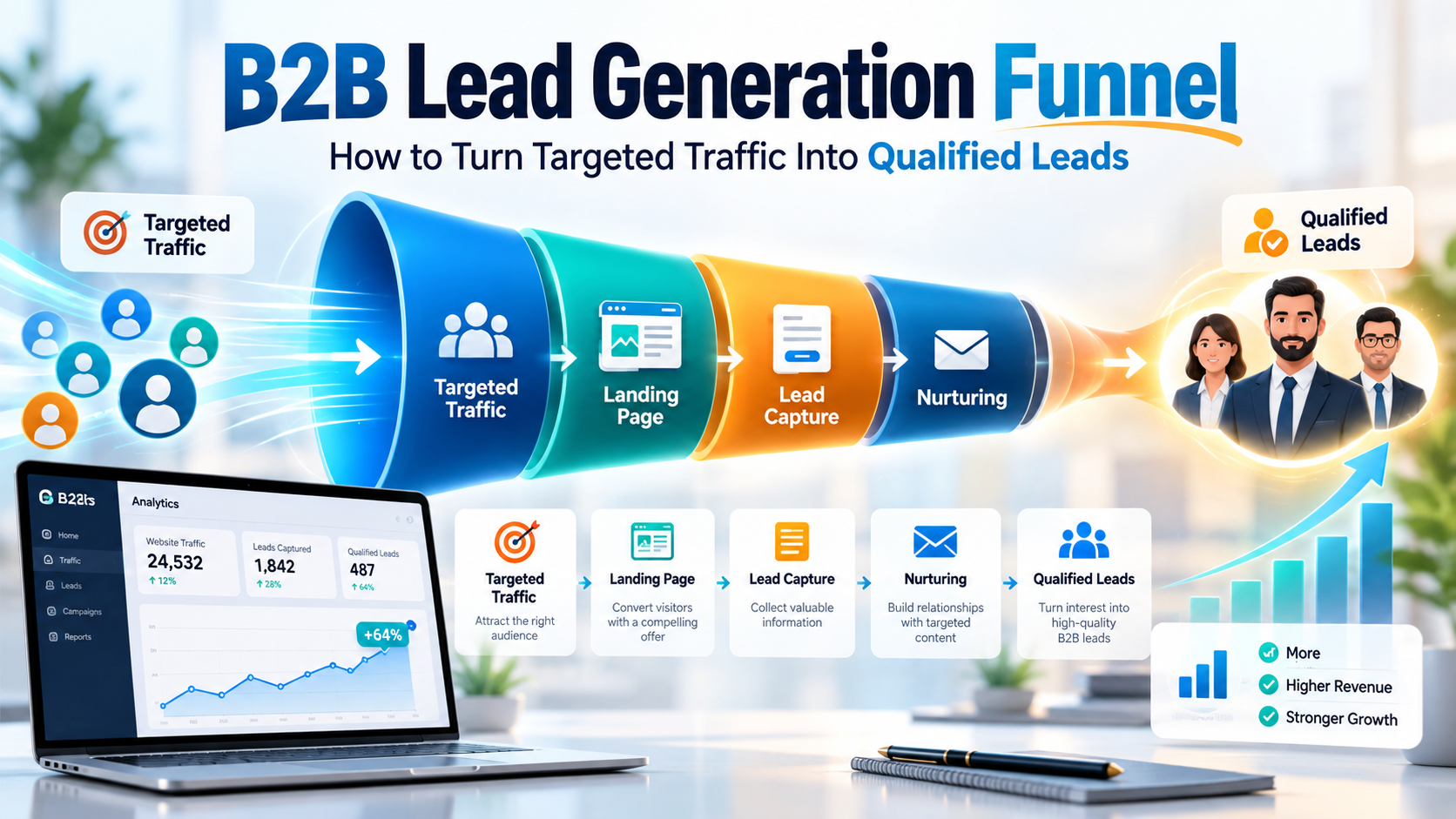
Have you ever wondered why your website attracts plenty of visitors, yet your sales pipeline remains frustratingly empty? Many companies struggle to bridge the gap between casual browsers and high-value clients. The secret lies in mastering a structured b2b lead generation funnel that guides prospects through a clear, intentional journey. A well-designed b2b lead generation funnel helps businesses turn initial interest into measurable sales opportunities.
This guide provides a comprehensive roadmap for United States businesses looking to refine their outreach. This guide provides a comprehensive roadmap for United States businesses looking to refine their outreach through a b2b lead generation funnel.
We will explore how to transform raw traffic into qualified business opportunities through strategic acquisition and consistent nurturing. By aligning your marketing efforts with sales goals, you can significantly improve your conversion performance.
Throughout these thirteen sections, you will learn how to optimize every stage of the process. Each component of the b2b lead generation funnel plays an important role in moving prospects toward conversion. From initial awareness to final revenue measurement, we focus on actionable tactics that drive growth. Let’s start building a system that turns your digital presence into a reliable engine for sustainable revenue.
Key Takeaways
- Understand the core stages of a high-performing marketing framework.
- Learn how to align your sales and marketing teams for better results.
- Discover techniques to nurture prospects effectively until they are ready to buy.
- Identify key metrics to measure your success and improve lead quality.
- Master the transition from attracting traffic to closing high-value deals.
Build Your B2B Lead Generation Funnel
Turn targeted traffic into qualified B2B opportunities with a structured funnel designed to attract, capture, nurture, and qualify high-intent prospects.
Define Your B2B Lead Generation Funnel Strategy
Strategic alignment is the bedrock of any high-performing b2b lead generation funnel. Instead of chasing raw lead volume, you must design your architecture to support specific business growth objectives. By focusing on quality over quantity, you ensure that every interaction moves a prospect closer to a closed deal.
Set the funnel goal around revenue outcomes
Your primary objective should be pipeline contribution rather than simple lead counts. This is one of the most important principles when building a scalable b2b lead generation funnel. When you align your b2b lead generation funnel with revenue targets, you prioritize prospects who have the budget and authority to buy. This shift forces your team to focus on high-value opportunities that directly impact the bottom line.
Identify the buying committee and decision stages
Modern B2B sales rarely involve a single decision-maker. A successful b2b lead generation funnel must account for each stakeholder involved in the buying decision. You must map out the entire buying committee, including influencers, end-users, and financial gatekeepers. Understanding their unique objections at each stage allows you to tailor your messaging effectively.
| Committee Role | Primary Concern | Decision Influence |
|---|---|---|
| Economic Buyer | ROI and Budget | High |
| Technical Lead | Integration and Security | Medium |
| End User | Usability and Efficiency | Medium |
| Executive Sponsor | Strategic Alignment | High |
Align marketing and sales responsibilities
Marketing and sales must operate as a unified revenue engine. This alignment gives the b2b lead generation funnel a clear path from marketing engagement to sales conversion. When these teams share the same definitions of success, the b2b lead generation funnel becomes significantly more efficient. Clear ownership prevents leads from falling through the cracks during the transition from interest to active evaluation.
Document handoff requirements between teams
To maintain momentum, you must formalize the handoff process. To maintain momentum within your b2b lead generation funnel, you must formalize the handoff process. Every lead passed to sales should include essential context, such as the prospect’s industry, specific pain points, and engagement history. Documenting these requirements ensures that sales representatives have the necessary information to conduct a productive discovery call immediately.
Map the B2B Buyer Journey From Awareness to Purchase
Your ability to guide a prospect from initial awareness to a final purchase decision depends on how well you map their journey. This journey forms the foundation of an effective b2b lead generation funnel. Effective sales funnel optimization requires you to visualize the path a buyer takes long before they engage with your brand. By understanding their mindset, you can provide the right information at the exact moment they need it.
Recognize the questions buyers ask at each stage
At the awareness stage, buyers are usually trying to define a problem or identify an opportunity. They ask questions like, “Why is this happening?” or “What are the industry trends?” They are not looking for a product yet; they are looking for insights.
As they move into the consideration stage, their questions shift toward solutions. They want to know, “How can I solve this?” or “What are the different approaches available?” This is where they begin to compare various methods and strategies.
Finally, at the decision stage, the focus turns to specific vendors. They ask, “Is this company reliable?” or “What is the total cost of ownership?” Addressing these specific concerns is vital for closing the deal.
Match content to awareness, consideration, and decision intent
To succeed with sales funnel optimization, you must align your content with the buyer’s current intent. Awareness content should be educational and broad, focusing on industry challenges. Consideration content should be more specific, highlighting how your solution category addresses those challenges.
Decision-intent content must be highly persuasive and proof-based. Use case studies, ROI calculators, and technical documentation to prove your value. By matching the content to the intent, you reduce friction and keep the prospect moving forward.
Account for long sales cycles and multiple stakeholders
B2B buying is rarely a solo activity. You are often selling to a committee that includes IT, finance, and department heads. Each stakeholder has different priorities and needs that you must address throughout the process.
Because these cycles are long, you must maintain engagement over several months. Consistent, relevant communication ensures your brand stays top-of-mind. You should provide resources that help your internal champion sell your solution to their peers.
Separate education needs from vendor evaluation needs
It is a mistake to push product features too early in the journey. Early-stage prospects need educational content that builds trust and authority. They are not ready to evaluate your specific features or pricing yet.
Once they reach the vendor evaluation phase, the tone of your sales funnel optimization strategy must change. Now, you should focus on competitive advantages and implementation support. Clearly separating these two needs prevents you from overwhelming the buyer with premature sales pitches.
Attract Targeted Traffic With High-Intent Acquisition Channels
Building a high-performing lead generation funnel b2b requires more than just volume; it demands precision. You must prioritize visitors who align with your ideal customer profile to ensure your marketing efforts translate into actual revenue. By focusing on high-intent channels, you stop wasting resources on traffic that will never convert into a sale.
Use search engine optimization to capture active demand
Search engine optimization remains the most effective way to reach buyers who are actively searching for solutions. When you target long-tail keywords related to specific business pain points, you capture prospects at the exact moment they express interest. High-intent search traffic is often the most qualified because the user has already identified a problem and is seeking a remedy.
Build paid campaigns around firmographic and behavioral signals
Paid advertising allows you to bypass the wait times of organic growth by targeting specific segments. You should leverage firmographic data—such as company size, industry, and revenue—to ensure your ads reach the right organizations. Furthermore, behavioral signals like previous site visits or whitepaper downloads help you identify which prospects are ready for a deeper conversation.
Combine LinkedIn, industry media, partnerships, and events
Diversifying your acquisition strategy helps you reach decision-makers where they already spend their time. LinkedIn provides unmatched professional targeting, while industry media placements build authority within your niche. Strategic partnerships and targeted events allow you to engage with high-value accounts in a more personal, trust-based environment.
Filter traffic quality by company fit and buying intent
Not all traffic is created equal, and your lead generation funnel b2b strategy must account for this reality. You should implement strict filtering criteria to separate casual browsers from serious buyers. By analyzing firmographic fit and engagement depth, you can focus your sales team’s energy on the prospects most likely to close.
| Channel | Primary Benefit | Best For |
|---|---|---|
| Search Engine Optimization | Captures active intent | Problem-aware buyers |
| Paid Social (LinkedIn) | Precise firmographic targeting | Account-based marketing |
| Industry Partnerships | High trust and credibility | Niche market penetration |
| Events and Webinars | Direct engagement | Complex sales cycles |
Build Landing Pages That Convert B2B Visitors Into Leads
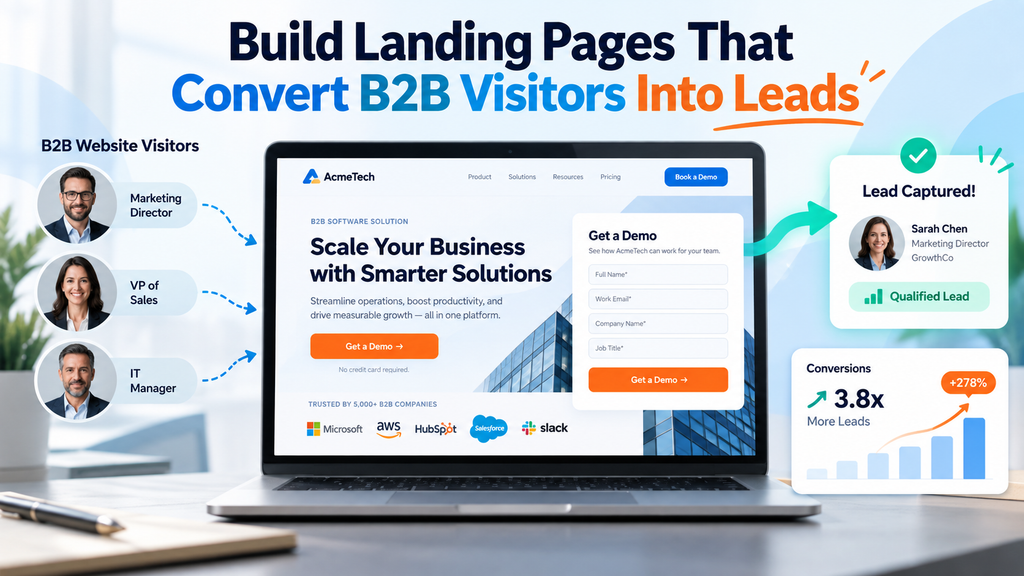
A well-crafted landing page acts as the final gatekeeper for your b2b lead generation marketing funnel. It is the specific point where a visitor decides whether to engage further or leave your site entirely. By focusing on one clear objective, you ensure that your traffic does not get distracted by unnecessary navigation or broad messaging.
Write a value proposition for a specific business problem
Your landing page must address a single, urgent pain point that your target audience faces. Avoid generic claims about your company’s history or broad service offerings. Instead, clearly articulate how your solution solves a specific challenge for the user.
When your value proposition aligns with the intent of the visitor, conversion rates naturally increase. Keep your headline concise and ensure it promises a tangible benefit that the reader can immediately understand.
Choose forms that balance qualification with completion rate
The length of your form is a critical factor in your b2b lead generation marketing funnel. While you want to collect as much data as possible, long forms often discourage busy professionals from finishing the process. You must find the right balance between gathering enough information to qualify a lead and keeping the barrier to entry low.
Consider using progressive profiling to collect data over time rather than all at once. This strategy allows you to capture essential contact details first while gathering deeper insights during subsequent interactions.
Use proof, outcomes, and relevant calls to action
Trust is the currency of the digital B2B landscape. Incorporate social proof such as client logos, industry certifications, or brief testimonials to validate your claims. Clearly state the measurable outcomes a client can expect, such as time saved or revenue growth.
Your call to action (CTA) should be specific and action-oriented. Avoid vague buttons like “Submit” and use descriptive language like “Get Your Free Audit” or “Download the Strategy Guide.”
Test headlines, form fields, page length, and conversion paths
Never rely on assumptions when optimizing your pages. A/B testing allows you to compare different versions of your content to see what truly drives results. You should test your headlines, the number of form fields, and the overall length of the page to identify what works best for your audience.
| Element | High-Conversion Approach | Common Pitfall |
|---|---|---|
| Headline | Problem-focused benefit | Company-centric jargon |
| Form Fields | Essential data only | Excessive qualification |
| CTA Button | Action-oriented text | Generic “Submit” label |
| Proof Points | Specific case study results | Vague marketing claims |
By continuously refining these elements, you strengthen your b2b lead generation marketing funnel. Data-driven adjustments ensure that your landing pages remain effective tools for turning targeted traffic into high-quality leads.
Offer Lead Magnets That Earn Trust From B2B Buyers
Providing high-value assets is the most effective way to build trust within your lead generation funnel b2b strategy. When you offer solutions that address specific pain points, you demonstrate expertise while gathering essential contact information. This exchange establishes a foundation for a long-term professional relationship.
Create content for urgent and measurable buyer challenges
Your prospects are often overwhelmed by complex business problems that require immediate attention. By creating content that offers a clear, measurable path to a solution, you position your brand as a helpful partner. Focus on topics that provide quantifiable results, such as cost-saving strategies or efficiency improvements.
When your content addresses an urgent need, buyers are more likely to engage with your brand. Ensure that every piece of content provides actionable insights that the user can implement right away. This approach builds credibility and encourages further interaction with your business.
Use original research, calculators, templates, and buying guides
Different types of content serve unique purposes depending on the buyer’s current needs. Using a variety of formats allows you to cater to different learning styles and decision-making processes. The following table outlines how these assets function within your strategy:
| Asset Type | Best Use Case | Buyer Commitment |
|---|---|---|
| Original Research | Establishing authority | High |
| Calculators | Measuring ROI | Medium |
| Templates | Solving tactical tasks | Low |
| Buying Guides | Comparing solutions | High |
Set the right value exchange for each funnel stage
The value exchange must align with the level of commitment you request from the prospect. At the top of the lead generation funnel b2b, keep forms simple to encourage high conversion rates. As prospects move deeper into the funnel, you can ask for more detailed information in exchange for higher-value assets like comprehensive white papers or custom assessments.
Always be transparent about what the user will receive after submitting their details. Clearly state the benefits of the content to ensure the user feels the exchange is fair. This transparency reduces friction and improves the overall quality of your incoming leads.
Protect gated content from low-quality or misleading submissions
Maintaining high data quality is vital for your sales team’s success. Implement validation tools on your forms to prevent the submission of fake email addresses or irrelevant contact information. Using business-email-only requirements can significantly filter out low-intent or fraudulent entries.
Additionally, consider using progressive profiling to gather information over time rather than all at once. This strategy helps you verify the accuracy of the data while keeping the user experience smooth. By safeguarding your gated content, you ensure that your lead generation funnel b2b remains focused on high-quality, actionable prospects.
Design Lead Nurturing Sequences That Move Prospects Forward
A successful b2b lead generation marketing funnel relies on keeping prospects engaged over time. Most buyers require multiple touchpoints before they feel comfortable committing to a purchase. By providing consistent value, you stay top-of-mind throughout their decision-making process.
Segment contacts by role, industry, behavior, and funnel stage
Effective nurturing starts with deep segmentation. You should categorize your leads based on their specific job title, the industry they serve, and their recent interactions with your brand. This ensures that your communication remains relevant to their unique business challenges.
Personalization is the key to higher engagement rates. When you tailor your messaging to the specific stage of the b2b lead generation marketing funnel, you demonstrate that you understand their current needs. This targeted approach prevents your content from feeling like generic spam.
Sequence educational, proof-based, and sales enablement content
Your nurturing sequence should follow a logical progression that mirrors the buyer’s journey. Start by offering educational content that addresses high-level industry problems. This builds initial trust without asking for an immediate commitment.
As prospects move deeper into the funnel, introduce proof-based assets like case studies and original research. Finally, provide sales enablement tools such as pricing calculators or implementation guides. This strategy helps prospects feel confident in their decision to move forward with your solution.
Use email, retargeting, and personalized website experiences
Consistency across channels reinforces your message and keeps your brand visible. You can use email campaigns to deliver personalized content directly to a prospect’s inbox. Simultaneously, retargeting ads can keep your brand in front of them while they browse other industry sites.
Personalized website experiences further enhance this journey by showing dynamic content based on the visitor’s history. When a user returns to your site, they should see information that aligns with their previous interests. This creates a cohesive b2b lead generation marketing funnel that feels intuitive and helpful.
Set frequency rules to prevent fatigue and unsubscribes
While staying top-of-mind is important, you must avoid overwhelming your audience. Establish strict frequency rules to ensure you do not send too many messages in a short window. Respecting the prospect’s time is essential for maintaining a healthy relationship.
Monitor your unsubscribe rates closely to identify when your cadence becomes too aggressive. By balancing the volume of your outreach, you ensure that your nurturing efforts remain a welcome resource rather than a nuisance. This careful management protects your sender reputation and keeps your leads engaged for the long term.
Apply Lead Scoring Methods to Identify Sales-Ready Prospects
Mastering lead scoring methods allows you to prioritize your most valuable opportunities. By assigning numerical values to specific behaviors and attributes, you ensure your sales team focuses on the prospects most likely to convert. This systematic approach removes guesswork from the qualification process.
Turn More B2B Traffic Into Leads
Give your prospects valuable resources while capturing quality business leads and building a stronger pipeline with smarter funnel strategies.
Combine demographic fit scores with engagement scores
A robust model starts by evaluating both who the prospect is and how they interact with your brand. Demographic fit scores look at firmographic data such as company size, industry, and job title to ensure the lead matches your ideal customer profile.
Engagement scores track the depth of interaction, such as whitepaper downloads or webinar attendance. When you combine these two metrics, you create a comprehensive view of a prospect’s readiness. This dual-layer approach prevents you from chasing high-engagement leads that lack the budget or authority to make a purchase.
Assign meaningful values to high-intent actions
Not all interactions carry the same weight in your funnel. You should assign higher point values to actions that signal a clear intent to buy, such as requesting a product demo or viewing pricing pages.
These high-intent actions indicate that a prospect has moved beyond simple research. By prioritizing these individuals, your sales team can reach out while the interest is at its peak. This responsiveness often results in higher conversion rates and shorter sales cycles.
Use negative scoring for inactivity and poor-fit behavior
Effective lead scoring methods also account for signals that suggest a lead is not a good match. You should apply negative points for behaviors like unsubscribing from emails, visiting career pages, or providing invalid contact information.
Inactivity over a long period should also trigger a score reduction. This keeps your database clean and ensures that your sales representatives do not waste time on cold or irrelevant prospects. Maintaining a clean list allows for more accurate reporting and better resource allocation.
Recalibrate scores using closed-won and closed-lost data
Your scoring model should never be static. You must regularly review your closed-won and closed-lost data to see if your current point values align with actual business outcomes.
If you find that leads with high scores are consistently resulting in closed-lost deals, your criteria may be too lenient. Conversely, if your best customers are coming from lower-scoring segments, you need to adjust your weights. This continuous loop of feedback ensures your model remains accurate and effective over time.
| Action Type | Score Impact | Priority Level |
|---|---|---|
| Requesting a Demo | +50 | High |
| Viewing Pricing Page | +20 | Medium |
| Email Unsubscribe | -30 | Low |
| Invalid Email Address | -100 | Remove |
Qualify and Route Leads Before the Sales Conversation
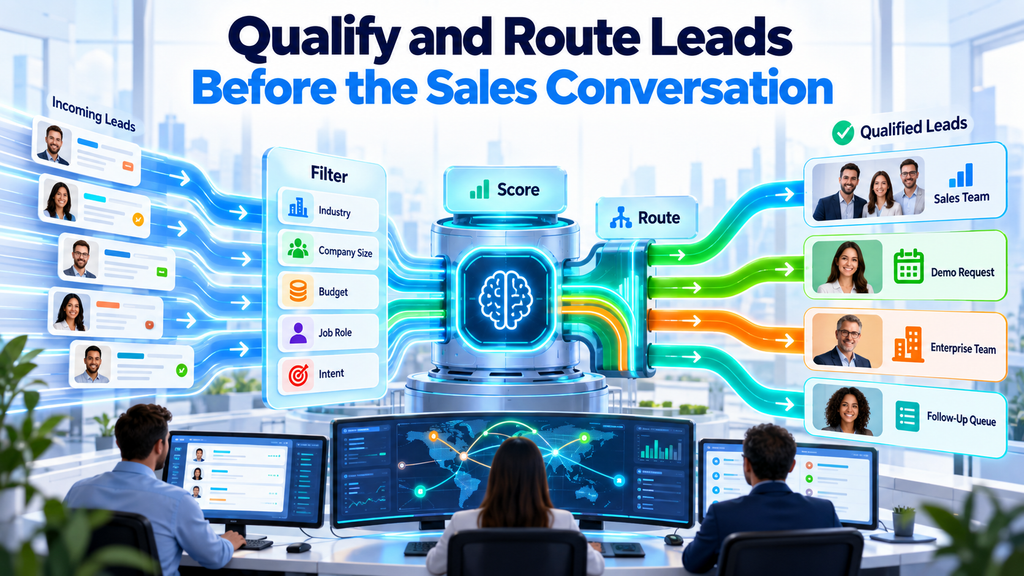
Precision in lead routing and qualification is the backbone of a high-performing revenue engine. By establishing clear protocols, you ensure that your sales representatives spend their time on the most promising opportunities rather than chasing cold prospects.
Define marketing-qualified lead and sales-qualified lead criteria
To maintain alignment, you must distinguish between a marketing-qualified lead (MQL) and a sales-qualified lead (SQL). Lead scoring methods provide the objective framework needed to make this distinction. An MQL typically shows interest through content engagement, while an SQL demonstrates clear intent to purchase.
By assigning numerical values to specific actions, you create a transparent threshold for handoff. This prevents marketing from passing unqualified traffic to sales, which protects your team’s productivity and morale.
Use progressive profiling to collect qualification data
You do not need to ask for every detail during the first interaction. Progressive profiling allows you to gather information incrementally as a prospect engages with your brand over time.
This strategy reduces friction on initial landing pages, leading to higher conversion rates. As users return, your forms dynamically update to ask for missing data points like job title, company size, or specific pain points.
Route leads according to territory, segment, and expertise
Once a lead is qualified, the routing process must be instantaneous and accurate. You should distribute leads based on specific criteria to ensure the right representative handles the account.
- Territory: Assign leads based on geographic location to match local time zones.
- Segment: Route enterprise leads to senior account executives and SMB leads to specialized teams.
- Expertise: Match prospects with representatives who have deep knowledge of the specific product or industry vertical.
Set service-level agreements for follow-up speed and ownership
A service-level agreement (SLA) acts as a contract between your marketing and sales departments. It defines exactly how quickly a lead must be contacted and who is responsible for the follow-up.
Effective SLAs include escalation paths if a lead remains untouched for too long. They also dictate the specific context—such as lead source, recent page views, and content downloads—that must accompany every handoff.
| Lead Status | Qualification Criteria | Primary Routing Logic | SLA Response Time |
|---|---|---|---|
| Marketing-Qualified | High engagement score via lead scoring methods | Round-robin by segment | Within 24 hours |
| Sales-Qualified | High intent and budget authority | Dedicated account owner | Within 2 hours |
| Nurture-Ready | Low engagement, good fit | Automated email sequence | N/A |
Connect Your B2B Lead Generation Marketing Funnel to Sales
Your lead generation funnel b2b strategy only succeeds when sales teams have full visibility into prospect behavior. When marketing and sales operate in silos, valuable insights about buyer intent are often lost. By integrating these two functions, you ensure that every conversation is informed by data rather than guesswork.
Give sales teams context from every meaningful interaction
Sales representatives perform best when they understand the specific journey a prospect has taken. You should provide them with a comprehensive history of page visits, content downloads, and campaign sources. This contextual intelligence allows the sales team to tailor their outreach to the prospect’s stated needs and previous engagement.
Knowing which whitepapers a lead read or which webinars they attended helps sales professionals frame their initial calls effectively. This level of detail transforms a cold outreach attempt into a relevant, value-driven conversation. It is the foundation of a high-performing b2b lead generation sales funnel.
Build account-based views for complex buying committees
In modern B2B sales, you rarely sell to a single individual. Instead, you must engage a buying committee consisting of multiple stakeholders with different priorities. Account-based views allow your team to see all contacts associated with a single company in one place.
This approach helps sales teams identify who is the champion, who is the decision-maker, and who might be a detractor. By mapping these roles, you can coordinate your messaging to address the unique concerns of each stakeholder. This visibility prevents conflicting communications and keeps the entire account moving toward a purchase.
Create feedback loops between campaign performance and pipeline quality
A healthy b2b lead generation sales funnel requires constant refinement based on real-world results. You must establish a formal feedback loop where sales teams report on the quality of leads passed from marketing. This data helps you identify which campaigns attract high-intent buyers and which ones bring in low-quality traffic.
Standardize rejection reasons and re-engagement workflows
When a lead is rejected, the reason must be clearly documented to improve future targeting. Common categories include “bad fit,” “not ready,” or “competitor.” By standardizing these reasons, you can analyze trends and adjust your lead generation funnel b2b tactics accordingly.
Furthermore, rejected leads should not be discarded permanently. You can implement automated re-engagement workflows that nurture these prospects with different content until they reach a higher level of maturity. The following table outlines how to handle different lead statuses effectively.
| Lead Status | Primary Reason | Recommended Action |
|---|---|---|
| Qualified | High Intent | Immediate Sales Outreach |
| Nurture | Early Stage | Add to Educational Sequence |
| Disqualified | Poor Fit | Exclude from Future Campaigns |
| Re-engage | Inactive | Trigger Retargeting Campaign |
Measure Sales Funnel Optimization With Full-Funnel Metrics
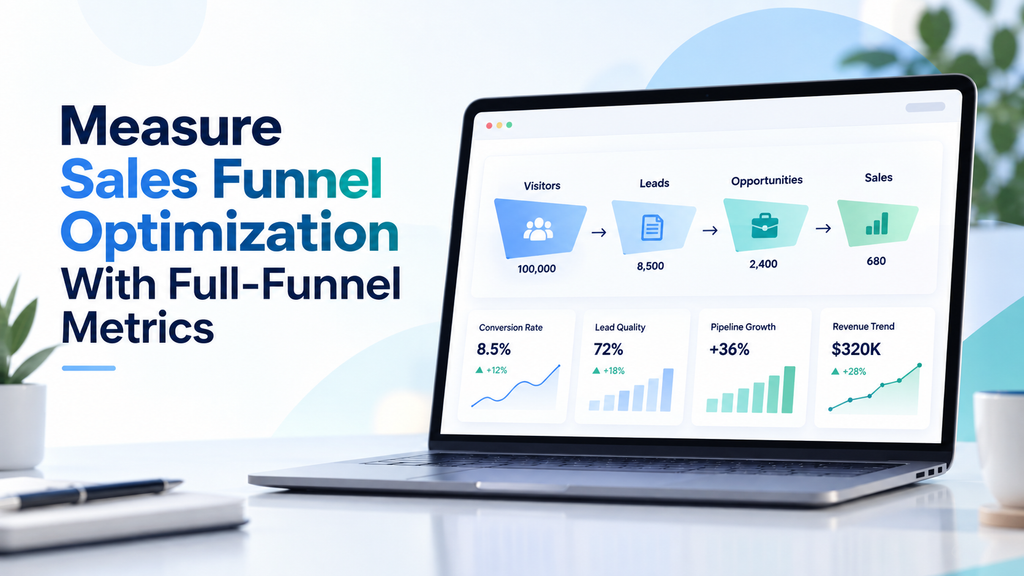
Effective sales funnel optimization relies on your ability to connect every touchpoint to actual revenue outcomes. By monitoring the entire lifecycle of a prospect, you gain the clarity needed to refine your strategy and eliminate inefficiencies. This holistic approach ensures that your marketing efforts directly support your bottom line.
Track traffic quality, conversion rates, and lead velocity
You must look beyond simple traffic volume to understand the intent behind your visitors. High-quality traffic is defined by how well your audience aligns with your ideal customer profile. Tracking these metrics helps you identify which channels bring the most valuable prospects to your site.
- Traffic Quality: Measure the percentage of visitors from target industries and job roles.
- Conversion Rates: Monitor how effectively your landing pages turn visitors into known leads.
- Lead Velocity: Track the speed at which leads move through your funnel to identify bottlenecks.
Measure marketing-qualified leads, sales-qualified leads, and opportunities
Defining clear thresholds for lead qualification is essential for alignment between departments. You should track the transition from a marketing-qualified lead (MQL) to a sales-qualified lead (SQL) to ensure your nurturing efforts are working. This progression provides a clear view of how many prospects are becoming viable sales opportunities.
| Metric Type | Primary Goal | Impact on Revenue |
|---|---|---|
| MQL | Engagement | Low |
| SQL | Qualification | Medium |
| Opportunity | Commitment | High |
Connect campaign performance to pipeline and revenue
Your marketing campaigns should be judged by their contribution to the total pipeline. By linking specific activities to closed-won deals, you can justify your budget and double down on high-performing tactics. This connection turns your marketing department into a revenue-generating engine rather than a cost center.
Use attribution carefully across long and multi-touch journeys
B2B buying decisions often involve multiple stakeholders and long sales cycles. Relying on a single attribution model can lead to skewed data and poor decision-making. Instead, compare multiple views to understand how different touchpoints influence the final purchase decision during your sales funnel optimization process.
Improve the Lead Generation Funnel B2B Performance Over Time
Your work does not end once your lead generation system goes live. To maintain a competitive edge, you must treat your b2b lead generation sales funnel as a dynamic asset that requires constant refinement. By monitoring performance data, you can identify hidden inefficiencies that prevent your business from reaching its full potential.
Find leaks between acquisition, conversion, nurturing, and sales
You should begin by auditing the transitions between each stage of your funnel. A leak often occurs where traffic drops off significantly, such as a landing page with a high bounce rate or an email sequence that fails to drive clicks. Pinpointing these friction points allows you to address specific barriers that stop prospects from moving forward.
Regularly review your conversion rates at every touchpoint to ensure your messaging remains consistent. When you identify a bottleneck, investigate whether the issue stems from poor targeting, unclear value propositions, or technical friction. Fixing these small gaps often leads to significant improvements in your overall conversion efficiency.
Prioritize experiments by expected business impact
Not every optimization task deserves the same level of attention. You can use the ICE framework—Impact, Confidence, and Effort—to rank your experiments effectively. This method ensures you focus on changes that offer the highest potential revenue growth while minimizing wasted resources.
High-impact experiments should target the largest segments of your audience first. By balancing the expected outcome against the effort required, you create a sustainable roadmap for sales funnel optimization. This structured approach prevents you from chasing minor tweaks that provide little value to your bottom line.
Use cohort analysis to evaluate lead quality after conversion
Many marketers make the mistake of judging success solely by immediate form completions. Instead, you should use cohort analysis to track how leads behave over several months. This allows you to see which acquisition channels actually produce high-value opportunities and closed revenue.
By grouping leads based on their entry point or campaign, you gain a clearer picture of long-term performance. This data helps you distinguish between high-volume, low-quality leads and smaller groups of prospects who eventually become loyal customers. Focusing on these quality metrics ensures your efforts align with actual business growth.
Document winning changes and repeatable optimization processes
Consistency is the hallmark of a high-performing team. You must document every successful experiment and the rationale behind your changes. This creates a knowledge base that allows your team to replicate wins and avoid repeating past mistakes.
| Metric Category | Primary Goal | Optimization Focus |
|---|---|---|
| Acquisition | Traffic Quality | Channel Efficiency |
| Conversion | Lead Volume | Landing Page UX |
| Nurturing | Engagement Rate | Content Relevance |
| Sales | Revenue Impact | Lead Qualification |
Establishing a repeatable process turns your optimization efforts into a standard operating procedure. When you codify these insights, your b2b lead generation sales funnel becomes more resilient and easier to scale. This commitment to documentation ensures that your growth strategy remains effective regardless of personnel changes or market shifts.
Start Generating Better B2B Leads
Build a conversion-focused funnel that connects targeted traffic, lead nurturing, qualification, and sales to create more valuable business opportunities.
Conclusion
Your success depends on how well you integrate every stage of your b2b lead generation funnel. You turn raw traffic into qualified opportunities by aligning your marketing goals with sales realities. This framework provides the structure needed to capture demand and nurture prospects effectively.
You must prioritize clear communication between your teams to ensure lead quality remains high. Use data from your pipeline to identify where you can improve your conversion rates. Every interaction serves as a chance to refine your approach and better serve your target audience.
Successful companies like HubSpot and Salesforce demonstrate that a unified b2b lead generation funnel creates predictable growth. You should view your strategy as a living system that requires constant testing and adjustment. Focus on the metrics that impact your bottom line to drive long-term business results.
Start applying these principles to your current campaigns today. You will see stronger alignment and better outcomes when you treat your funnel as a collaborative effort. Your commitment to this process builds a scalable path toward consistent revenue generation.
FAQs
What is the primary goal of a B2B lead generation funnel?
Your b2b lead generation funnel is designed to act as a strategic framework that transforms targeted traffic into qualified business opportunities. Rather than focusing solely on raw volume, you should align your funnel goals with actual revenue outcomes, pipeline contribution, and the specific needs of the buying committee within your target accounts.
How can I achieve effective sales funnel optimization for my business?
To achieve sales funnel optimization, you must map the buyer journey from awareness to purchase, ensuring your content addresses the specific questions stakeholders ask at each stage. This process involves identifying “leaks” where prospects drop off, such as between the landing page and the nurturing sequence and using A/B testing on platforms like HubSpot or Unbounce to refine your conversion paths.
Which lead scoring methods are most effective for identifying sales-ready prospects?
The most effective lead scoring methods combine demographic fit (firmographics like company size and industry) with behavioral engagement signals. You should assign higher values to high-intent actions, such as visiting a pricing page or downloading a vendor comparison guide, while using negative scoring for inactivity or poor-fit indicators to ensure your sales team focuses only on the most promising leads.
How does a lead generation funnel B2B strategy differ from consumer-focused funnels?
A lead generation funnel b2b strategy must account for significantly longer sales cycles and the involvement of multiple stakeholders. Unlike B2C, where a single person often makes a quick decision, a B2B funnel requires you to nurture an entire buying committee with educational content, original research, and proof points that build trust over several months.
What role does content play in a B2B lead generation marketing funnel?
In a b2b lead generation marketing funnel, content serves as the bridge between initial interest and qualified intent. By offering high-value lead magnets like industry calculators, templates, or white papers via LinkedIn or targeted search campaigns, you earn the right to collect prospect data. This allows you to segment your audience and deliver personalized nurturing sequences that move them toward a sales conversation.
How do I ensure my B2B lead generation sales funnel is aligned with my marketing efforts?
You can align your b2b lead generation sales funnel by establishing clear definitions for Marketing Qualified Leads (MQLs) and Sales Qualified Leads (SQLs). Implementing a Service-Level Agreement (SLA) ensures that your sales team receives full context from marketing interactions—such as which webinars a prospect attended, and guarantees a standardized follow-up speed to maximize conversion rates.
What metrics should I track to measure the success of my funnel?
You should track full-funnel metrics including traffic quality, conversion rates, and lead velocity. By connecting your campaign performance in Salesforce or Google Analytics to actual pipeline and revenue, you can determine which acquisition channels provide the highest return on investment and refine your strategy based on evidence rather than assumptions.
2 thoughts on “B2B Lead Generation Funnel: How to Turn Targeted Traffic Into Qualified Leads”