
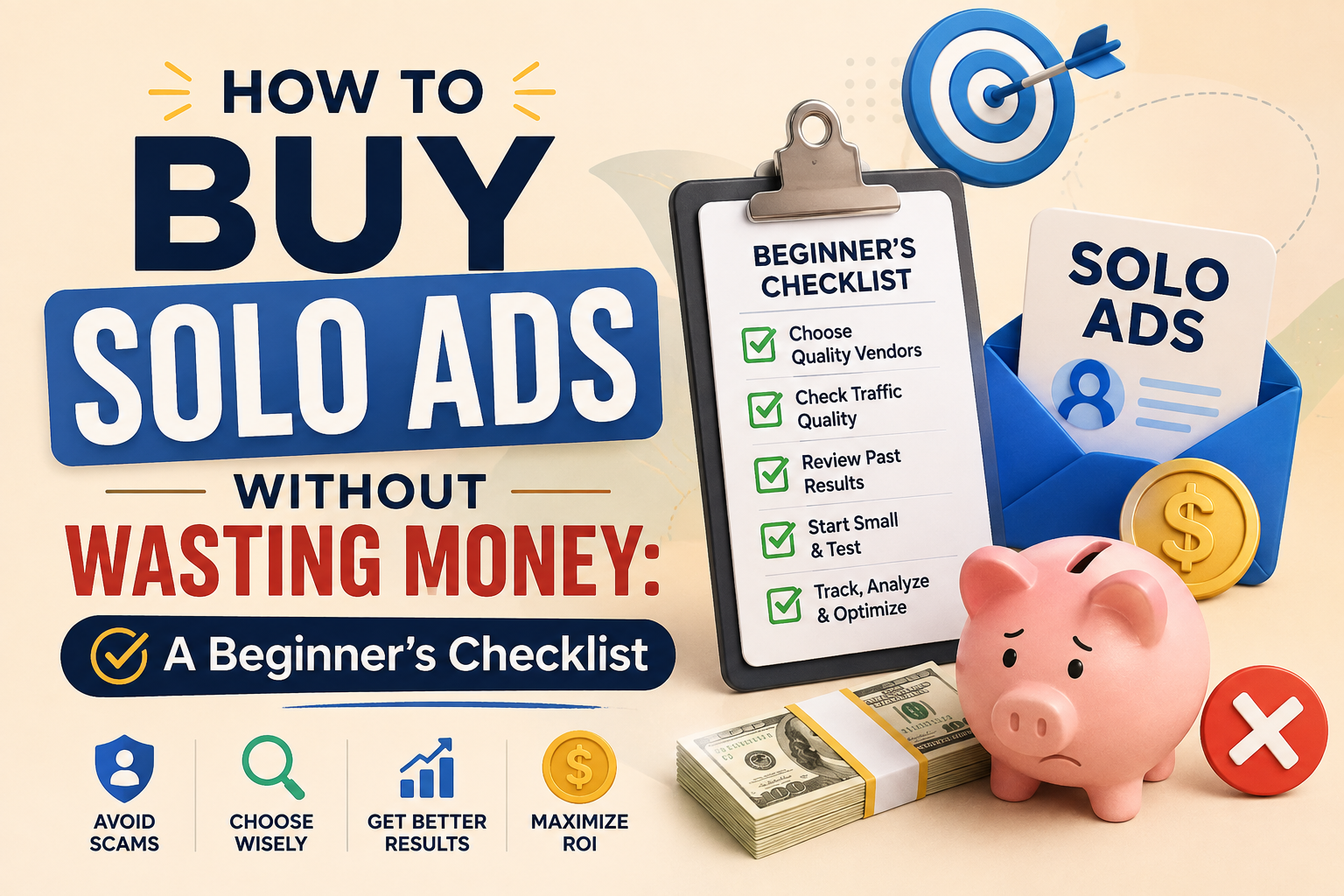
How much money could you lose if you buy solo ads before checking the traffic, vendor, and funnel?
If you are new to paid traffic, that question matters more than you might think.
Solo ads can look incredibly simple. You find someone with an email list, pay for a certain number of clicks, and the seller sends your offer to their subscribers. You get traffic, hopefully generate leads, and eventually make sales.
Sounds easy, right?
The problem is that buying solo ads without a plan can turn into an expensive guessing game.
A vendor may promise high-quality clicks, but clicks alone do not pay your bills. You need the right audience, a relevant offer, a strong landing page, reliable tracking, and a follow-up system that turns new visitors into actual customers.
That is why the goal when you buy solo ads should not simply be to find the cheapest solo ad.
The goal is to buy solo ads intelligently, test them carefully, understand the numbers, and scale only when the data gives you a reason to do so.
In this guide, you will learn exactly how to do that.
Key Takeaways
- Researching solo ad vendors helps you avoid low-quality traffic and unreliable sellers.
- Starting with a small test lets you evaluate audience quality and campaign performance without risking a large budget.
- Tracking clicks, leads, sales, and acquisition costs shows whether your solo ads are actually profitable.
- A strong landing page, relevant offer, and consistent email follow-up are essential for turning paid traffic into customers.
- Scaling should happen only after your data shows that the traffic, funnel, and economics are producing repeatable results.
Start Your Solo Ad Smarter
Stop guessing with paid traffic. Choose a smarter plan, test quality traffic, track results, and build a funnel designed for profitable growth with confidence today.
What Are Solo Ads?
A solo ad is a type of paid email advertising in which an email list owner sends your promotional message, or a message containing your link, to their subscribers.
Instead of building an audience from scratch, you are paying for access to an audience that someone else has already built.
For example, imagine you sell a productivity course for small business owners.
A solo ad provider has an email list of people interested in entrepreneurship, online business, productivity, or marketing. You pay the provider for 200 clicks. The provider sends an email promoting your landing page to a relevant portion of that audience.
Some subscribers click.
Some may opt in.
Some may eventually buy.
That is the basic model.
However, there is an important distinction:
When you buy solo ads, you are usually buying traffic, not guaranteed sales.
A reputable seller can generally promise delivery of a certain number of clicks or explain the conditions of their traffic guarantee. They cannot honestly guarantee that every visitor will buy your product.
Your conversion when you buy solo ads depends on several factors:
- Audience relevance
- Traffic quality
- Your offer
- Your landing page
- Your price
- Your sales process
- Your email follow-up
- Your tracking
- The level of trust you build
This is why two marketers can buy a similar number of clicks and get completely different results.
Why Beginners Waste Money on Solo Ads
Most beginners do not waste money when they buy solo ads because solo ads are automatically bad.
They waste money because they approach them like a lottery.
They see a vendor promising thousands of clicks, assume more clicks mean more sales, and place a large order before understanding what happens when they buy solo ads.
Here are some of the biggest mistakes.
1. Choosing the cheapest vendor
A low cost per click can look attractive.
But if those clicks come from people who have no interest in your offer, you are simply buying inexpensive traffic when you buy solo ads that does not help your business.
The real question when you buy solo ads is not:
“How cheap are the clicks?”
Ask:
“How much does it cost me to acquire a qualified lead or customer?”
That number matters far more.
2. Buying too many clicks at once
If you buy solo ads from a new vendor, there is no reason to immediately spend hundreds or thousands of dollars.
A small test can tell you much more.
Start with an amount you can afford to lose while learning. Depending on the vendor, a test might involve 100 to 200 clicks.
Your first campaign when you buy solo ads is a learning exercise.
Once you find a vendor, audience, offer, and funnel combination that produces acceptable results, you can consider increasing your order.
3. Looking only at clicks
When you buy solo ads, a campaign can deliver exactly the number of clicks you purchased and still perform terribly.
Imagine you purchase 500 clicks.
You receive 500 clicks.
Everything looks good.
But only five people become leads, nobody purchases, and the visitors disappear.
Technically, the vendor delivered.
From a business perspective, the campaign failed.
That is why your checklist must go beyond click delivery.
4. Sending traffic directly to a weak sales page
Cold traffic usually needs context.
Someone who has never heard of you may not be ready to purchase after one click.
A simple landing page or lead magnet can give you an opportunity to start a relationship.
Instead of immediately asking for a sale, you can offer something useful, collect a lead where appropriate, and follow up with helpful information.
This turns a one-time click into a potential long-term customer.
5. Not tracking individual campaigns
If you buy from five vendors and send everyone to the same link without proper tracking, you will have no idea which vendor performed best.
That makes scaling almost impossible.
Every campaign should have its own tracking setup when you buy solo ads.
The Beginner’s Checklist Before You Buy Solo Ads
Before you buy solo ads and spend your first dollar, work through the following checklist.
Step 1: Know What You Want the Traffic to Do
Never buy solo ads simply because you want “more visitors.”
Define the actual goal.
Do you want:
- Email subscribers?
- Webinar registrations?
- Free trial users?
- Product sales?
- Affiliate conversions?
- Consultation calls?
- Downloads?
- App signups?
Your goal determines the right funnel when you buy solo ads.
For a beginner, building an email list can be especially useful because it gives you a way to continue communicating with people after the original solo ad ends.
When you buy solo ads, you are not just buying visitors.
You are trying to create an asset.
Step 2: Check Whether Solo Ads Fit Your Niche
Solo ads are not equally useful for every business that wants to buy solo ads.
They tend to make more sense when an existing email audience has a strong connection to your target market.
For example, an audience interested in:
- Online business
- Personal development
- Entrepreneurship
- Marketing
- Career growth
- Certain hobbies
- Education
- Specialized interests
may be easier to target through relevant email lists.
But relevance is everything.
If a vendor has a huge list of general consumers and your product is highly specialized, a large click count does not necessarily mean useful traffic.
Ask yourself:
Would these people naturally care about what I am selling?
If the answer is unclear, stop before buying.
Step 3: Research the Solo Ad Vendor
This is one of the most important steps.
Do not choose a vendor because their sales page looks impressive.Do not choose a vendor when you buy solo ads simply because their sales page looks impressive.
Research them before you buy solo ads.
Look for:
- Recent customer reviews
- Independent testimonials
- Repeat buyers
- Delivery history
- Traffic sources
- Niche specialization
- Geographic targeting
- Tracking information
- Click guarantees
- Refund policies
- Communication quality
Community discussions around solo ads repeatedly emphasize checking seller reputation, asking about list ownership, reviewing testimonials, and starting with a smaller test before increasing volume.
A vendor who answers your questions clearly is usually easier to work with when you buy solo ads than someone who avoids basic questions.
Questions to ask the vendor
Before you pay, ask:
- Do you own the email list?
- How did subscribers join the list?
- What niche is the list focused on?
- Which countries are most common?
- What percentage of traffic is from the United States?
- How do you track clicks?
- Are clicks unique or total?
- What happens if you cannot deliver the agreed clicks?
- Can I see recent customer feedback?
- Can I test a smaller order first?
- Do you review offers before accepting campaigns?
- What information will I receive after delivery?
If a vendor becomes defensive when you ask reasonable questions, consider that a warning sign.
Step 4: Understand List Quality
This is where things become more complicated when you buy solo ads.
A list can contain thousands of email addresses and still have poor marketing value.
You want people who:
- Actually signed up to receive emails
- Are interested in the relevant subject
- Open and engage with emails
- Have a reasonable history of responding to offers
- Are located in the markets you care about
- Are not being bombarded with irrelevant promotions
Do not assume that a huge subscriber count means a valuable audience.
A smaller, focused list can be much more useful than a massive but poorly targeted list.
Also remember that list ownership matters.
If a person is selling traffic from an audience they do not actually control, you need to understand exactly where that traffic originates.
Step 5: Ask Where the Traffic Comes From
A simple question can reveal a lot:
“Where did these subscribers come from?”
The answer should be clear before you buy solo ads.
You want to understand whether subscribers joined through:
- Opt-in forms
- Lead magnets
- Content
- Newsletters
- Webinars
- Paid acquisition
- Partnerships
- Other legitimate acquisition methods
Be cautious when a seller cannot explain the origin of the audience.
You should also be careful about buying email lists yourself.
Buying a list of addresses is not the same thing as buying a solo ad. The Federal Trade Commission notes that purchased lists can create risks, including addresses that may have opted out or been collected through questionable methods.
The safer model is to work with a vendor who sends your promotion to their own audience while you build your own permission-based list through your funnel.
Step 6: Check Geographic Targeting
Location can dramatically affect your results when you buy solo ads.
If your product is designed for U.S. customers, you probably do not want most of your traffic coming from countries where your offer has little relevance.
Ask the vendor about:
- United States traffic
- Canada
- United Kingdom
- Australia
- New Zealand
- Other countries relevant to your offer
Do not assume “Tier 1 traffic” automatically means high-quality traffic.
Geography is only one part of quality.
A person in your target country can still be a poor prospect if they have no interest in your product.
Step 7: Build Your Funnel Before You Buy
This is one of the most important rules in this entire guide:
Do not buy solo ads before your funnel is ready.
At minimum, you should have:
- A clear landing page
- A strong headline
- One primary call to action
- A relevant lead magnet or offer
- A thank-you or next-step page
- Email follow-up
- Tracking
- A clear sales path
Your landing page should match the promise made in the solo ad.
If the email says:
“Get the free guide to improve your productivity”
but the landing page says:
“Buy our $997 business coaching program”
the visitor may feel misled.
Keep the message consistent.
Scale Your Campaign Confidently
Turn your next solo ad campaign into a measurable growth opportunity. Get the plan, reduce wasted spend, and scale only what proves profitable for you.
Step 8: Test Your Landing Page First
Your campaign cannot fix a bad landing page when you buy solo ads.
Before you spend money on traffic, send some test visitors to your page and make sure:
- It loads quickly
- The form works
- The button works
- The thank-you page works
- The email automation triggers correctly
- Mobile users can read everything
- Tracking is recording conversions
- Your offer is easy to understand
Imagine paying for 300 clicks and discovering afterward that your opt-in form was broken.
That is not a traffic problem.
That is a preparation problem.
Step 9: Track More Than Clicks
Tracking is what turns paid traffic into a measurable business decision when you buy solo ads.
At minimum, track:
Ad spend → clicks → leads → sales → revenue
You can then calculate:
Cost Per Click
Cost Per Click = Total Spend ÷ Clicks
Cost Per Lead
Cost Per Lead = Total Spend ÷ Leads
Conversion Rate
Conversion Rate = Leads ÷ Clicks × 100
Return on Ad Spend
ROAS = Revenue ÷ Ad Spend
For example, suppose you spend $100 and receive 200 clicks.
Your cost per click is $0.50.
If 40 people opt in, your opt-in rate is 20%.
Your cost per lead is $2.50.
Now suppose three people purchase a $50 product.
You generated $150 in revenue from $100 in ad spend.
That gives you a 1.5x ROAS before considering other costs.
This is much more useful than saying:
“The vendor sent me 200 clicks.”
Step 10: Start With a Small Test
Your first purchase should answer questions when you buy solo ads.
You want to learn:
- Is the audience relevant?
- Does the traffic convert?
- Does the landing page work?
- Are the leads engaging?
- Does the offer make sense to them?
- Do they buy?
- Do they continue engaging with your emails?
A small campaign gives you data when you buy solo ads without putting your entire budget at risk.
If the campaign performs well after you buy solo ads, test again.
If the campaign performs poorly, investigate.
When you buy solo ads, do not automatically blame the vendor.
The problem could be:
- Bad traffic
- Weak headline
- Poor offer
- Wrong audience
- Bad landing page
- Weak follow-up
- Poor pricing
- Slow website
- Misleading ad copy
Paid traffic is valuable partly because it exposes weaknesses quickly.
What Should You Expect From Your First Solo Ad?
Do not start with unrealistic expectations.
Your first campaign may not be profitable when you buy solo ads.
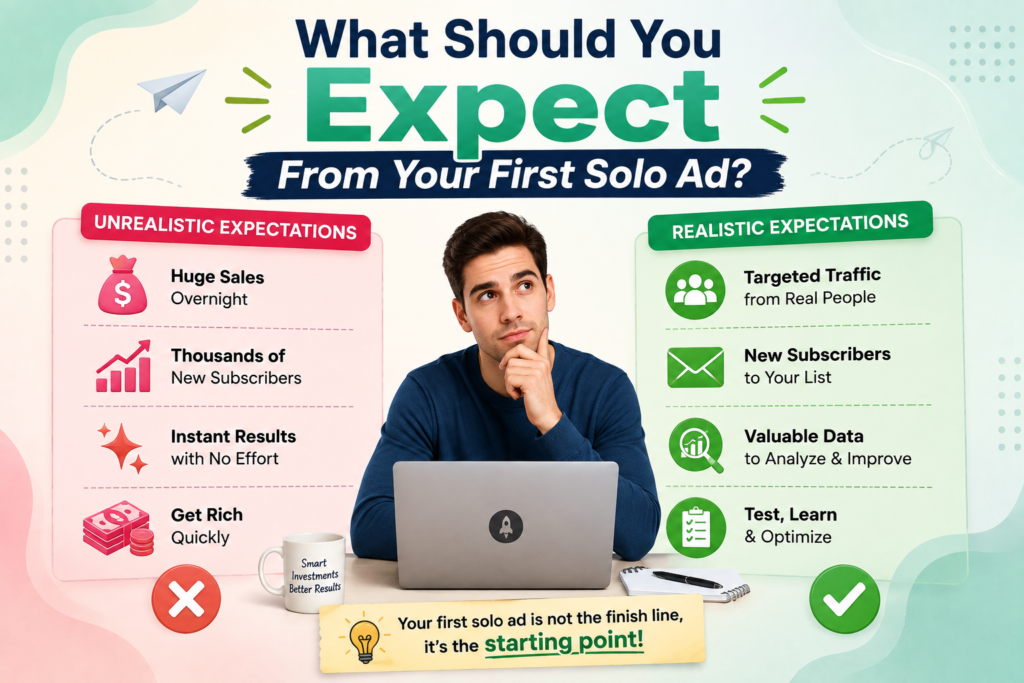
That does not automatically mean it was worthless.
Suppose you spend $100 and generate 40 leads.
You did not make your money back immediately.
But now you have learned:
- The vendor can deliver traffic.
- The audience responds to your topic.
- Your landing page converts at a certain rate.
- Your follow-up emails receive a certain level of engagement.
- You have real data to improve your funnel.
The next campaign might perform better because you changed the landing page or offer.
This is why successful marketers often think in terms of testing and optimization, rather than one-shot campaigns.
The Email Follow-Up Is Where Your Real Opportunity Begins
One of the biggest mistakes beginners make is treating the solo ad as the entire marketing strategy.
It is not.
The click is only the beginning.
Once someone joins your email list through your own opt-in process, you have an opportunity to build trust.
Your follow-up might include:
Email 1: Welcome and deliver the promised resource.
Email 2: Explain the problem your audience is facing.
Email 3: Share a useful strategy or quick win.
Email 4: Tell a relevant story or case study.
Email 5: Introduce your solution.
Email 6: Answer common objections.
Email 7: Present the offer clearly.
The exact sequence depends on your business.
But the principle is simple:
Do not expect a stranger to become a customer instantly.
Email Marketing Frequency: How Often Should You Email Your List?
This is where email marketing frequency becomes important.
If your solo ad campaign successfully builds your list, you need to decide how often to communicate with subscribers.
So, how often to send marketing emails?
There is no universal number that works for every business.
Your ideal frequency depends on:
- Your audience
- Your industry
- Your content
- Your sales cycle
- Subscriber expectations
- Engagement levels
- The type of emails you send
HubSpot’s research and guidance similarly emphasizes that there is no single perfect frequency. Different businesses and audiences respond differently, so marketers should test and adjust their cadence.
For many businesses, starting with one valuable email per week can be a reasonable baseline.
New subscribers may receive a short welcome sequence with more frequent messages.
Highly engaged subscribers may tolerate more communication.
Inactive subscribers usually should not receive endless promotions.
That is why email frequency best practices are less about hitting a magic number and more about delivering useful content at a frequency your audience expects.
Instead of constantly asking:
“How often should you email your list?”
ask:
“Am I sending something useful enough to justify this email?”
That question will usually lead to better decisions.
How Email Frequency Can Affect Solo Ad Results?
Imagine you generate 100 new leads from a solo ad.
You send one promotional email every three months.
Your subscribers may forget who you are.
Now imagine sending five sales emails every day.
Your subscribers may become frustrated and unsubscribe.
Neither extreme is ideal.
The goal is consistency.
Tell people what they can expect when they subscribe, then deliver on that expectation.
For example:
“You’ll receive one practical marketing tip every Tuesday.”
That creates a clear expectation.
You can also segment your audience.
Highly engaged subscribers can receive more relevant offers, while inactive subscribers can receive fewer emails or a re-engagement campaign.
Google’s current sender guidance also emphasizes authentication, avoiding unwanted email, and making it easy for recipients to unsubscribe. For larger senders, Google requires additional authentication and one-click unsubscribe support for marketing messages.
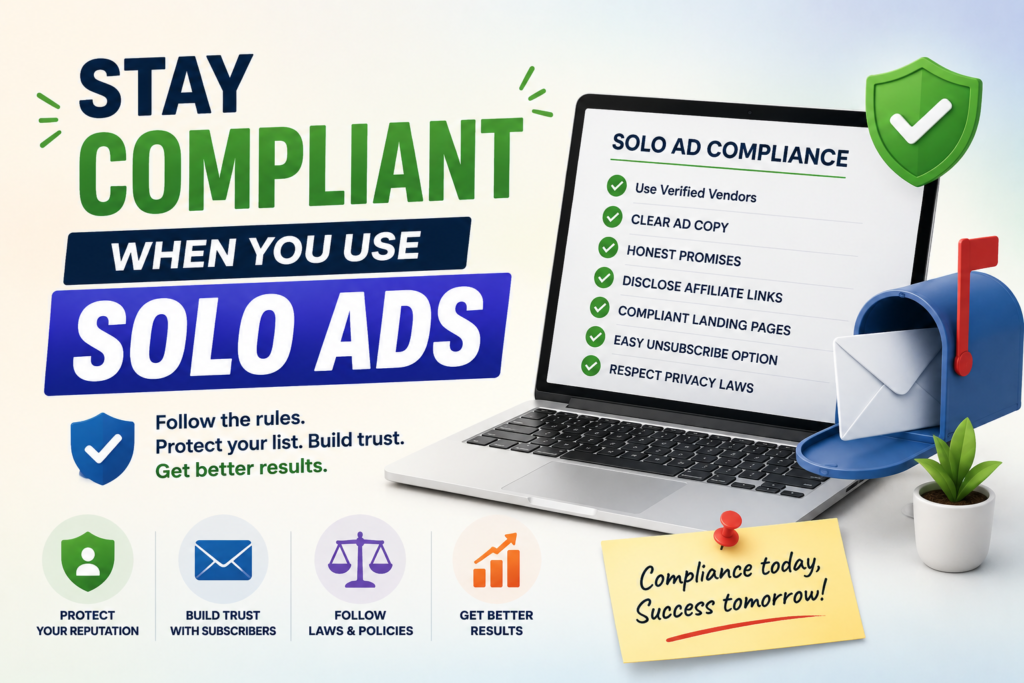
Stay Compliant When You Use Solo Ads
Paid email traffic does not remove your legal responsibilities.
If you are marketing to U.S. recipients, understand the requirements of the CAN-SPAM Act.
The Federal Trade Commission says commercial email must use accurate header information, avoid deceptive subject lines, include a valid physical postal address, and provide a way for recipients to opt out of future marketing messages.
You should also understand the rules of your email service provider and the laws that apply to your audience.
An important point for beginners:
Do not assume that because someone is subscribed to another person’s email list, you automatically have permission to add that person to your own list.
Your own lead-generation process should be clear about what people are signing up for.
Compliance is not just about avoiding penalties.
It also protects your sender reputation and helps preserve deliverability.
Red Flags to Watch for Before You Buy Solo Ads
Not every seller is trustworthy.
Watch for these warning signs.
“Guaranteed Sales”
No legitimate traffic provider can control what every visitor does after clicking.
Traffic can be delivered.
Sales depend on your entire funnel.
Huge Claims With No Evidence
Be cautious when you see claims like:
- “Guaranteed profits”
- “100% conversion”
- “Every click becomes a buyer”
- “Instant six figures”
- “Risk-free guaranteed income”
Marketing claims should be supported by credible evidence.
No Clear Traffic Source
If the seller cannot explain where the audience comes from, walk away.
Pressure to Buy Immediately
A trustworthy vendor should not need to manipulate you with artificial urgency.
No Tracking
If the vendor cannot explain how clicks are measured, you have a problem.
No Small Test
You do not necessarily need to reject every vendor without a small package, but beginners should strongly prefer an opportunity to test before making a large commitment.
Suspiciously Cheap Traffic
Cheap is not always good.
If one seller offers traffic at a dramatically lower price than comparable vendors, find out why.
A Simple Solo Ad Budget Strategy for Beginners
You do not need a huge advertising budget to start learning.
Instead, create a testing budget.
For example:
Test Budget: $100–$300
Divide it into several controlled experiments instead of placing everything into one campaign.
You might test:
- Vendor A
- Vendor B
- Different landing page headline
- Different lead magnet
- Different offer angle
The exact budget depends on your business and customer value.
If one customer is worth $500 to you over time, you can afford to acquire leads differently than a business selling a $10 product.
That brings us to an important concept:
Know Your Customer Lifetime Value
Suppose your average customer generates $20 in profit.
Spending $25 to acquire a customer is not sustainable unless there is additional revenue later.
But suppose your average customer generates $200 over six months.
A $25 acquisition cost may be very attractive.
This is why you should not judge solo ads based only on the first purchase.
Look at the entire customer journey.
How to Decide Whether to Scale?
After your first campaign, resist the urge to immediately double your budget.
Review the data.
Ask:
Did the vendor deliver what was promised?
If not, contact the vendor before making another purchase.
Did visitors match the target audience?
If the audience was wrong, changing your landing page may not solve the problem.
Did the landing page convert?
If traffic was relevant but nobody opted in, test your page.
Did leads engage?
Look at email clicks, replies, purchases, and other meaningful actions.
Did the economics work?
Calculate your cost per lead and customer acquisition cost.
If the numbers make sense, run another controlled campaign.
If results remain consistent, increase gradually.
Scaling should feel boring.
That is a good thing.
You want predictable growth, not dramatic gambling.
A Practical Buy Solo Ads Checklist
Before you click the payment button, run through this list.
Vendor Checklist
- I researched the seller.
- I found recent customer feedback.
- I know where the traffic comes from.
- I understand the niche.
- I know the geographic breakdown.
- I know whether the vendor owns the list.
- I understand the click guarantee.
- I understand the refund policy.
- I can track the campaign.
- I can start with a manageable test.
Funnel Checklist
- My landing page is live.
- My headline matches the ad.
- My offer is clear.
- My opt-in form works.
- My thank-you page works.
- My email automation works.
- My tracking works.
- My follow-up sequence is ready.
- My sales process is clear.
Budget Checklist
- I can afford to lose the test budget.
- I know my target cost per lead.
- I know my target customer acquisition cost.
- I know my product margin.
- I understand my customer lifetime value.
- I will not scale based on clicks alone.
Compliance Checklist
- My email practices follow applicable laws.
- My sender information is accurate.
- My marketing emails include appropriate unsubscribe options.
- My landing page clearly explains what subscribers receive.
- My email platform allows the campaign.
- I understand the rules that apply to my audience.
The 5 Numbers You Should Watch After Every Campaign
If you want a simple way to evaluate solo ads, focus on five numbers.
1. Cost Per Click
How much did each visitor cost?
Useful for comparing vendors, but not enough to judge profitability.
2. Opt-In Rate
What percentage of visitors became leads?
A low rate may indicate a poor landing page, weak offer, or audience mismatch.
3. Cost Per Lead
How much did each lead cost?
This is often more useful than cost per click because it measures a meaningful action.
4. Customer Conversion Rate
How many leads became customers?
This tells you whether your follow-up and offer are working.
5. Customer Acquisition Cost
How much did you spend to generate each customer?
This is one of the most important numbers for deciding whether to scale.
A campaign that produces cheap clicks but expensive customers is not a good campaign.
A campaign that produces moderately priced clicks and profitable customers may be excellent.
What to Do If Your Solo Ad Campaign Fails
Do not panic.
Instead, diagnose the problem.
Scenario 1: Lots of clicks, few opt-ins
Check:
- Landing page
- Headline
- Lead magnet
- Page speed
- Audience relevance
- Call to action
Scenario 2: Lots of opt-ins, no sales
Check:
- Offer
- Product-market fit
- Follow-up emails
- Price
- Trust
- Sales page
- Audience intent
Scenario 3: Very few clicks
Check:
- Email copy
- Vendor delivery
- Audience engagement
- Campaign timing
- Link tracking
Scenario 4: Lots of clicks but poor-quality visitors
Talk to the vendor and examine your tracking data.
If the audience is consistently wrong, do not keep spending just because the seller promises more clicks.
Scenario 5: Good leads but poor long-term engagement
Look at your welcome sequence, content, email marketing frequency, segmentation, and overall value.
Your acquisition may be working, but your email strategy needs improvement.
Should You Buy Solo Ads or Use Another Traffic Source?
Solo ads are one option among many.
You can also use:
- SEO
- Content marketing
- Social media
- Search advertising
- Display advertising
- Influencer marketing
- Partnerships
- Referral programs
- Webinars
- Community marketing
The right channel depends on your business when you buy solo ads or use another traffic source.
One advantage of solo ads is speed when you buy solo ads.
You do not necessarily have to spend months building an audience before getting traffic.
The downside is that you are paying for access to someone else’s audience.
That is why your long-term goal should be to build an audience you can communicate with appropriately and consistently.
A useful way to think about it is:
Solo ads can rent attention. Your email list can become an owned marketing asset.
That difference matters.
The Smartest Way to Buy Solo Ads
If you remember only one process from this guide, use this:
Research → Test → Track → Improve → Retest → Scale
Do not skip the testing stage.
Do not scale because a seller tells you that you should.
Do not judge success by clicks alone.
And do not expect paid traffic to rescue a weak offer or broken funnel.
The strongest solo ad strategy is not really about buying as many clicks as possible.
It is about finding a repeatable system where the right audience sees the right message, lands on the right page, receives useful follow-up, and eventually becomes a customer.
Turn Traffic Into Growth
Ready to stop buying clicks blindly? Get the plan that helps you choose better traffic, protect your budget, track conversions, and grow confidently with data.
Final Thoughts
Learning how to buy solo ads can be useful for beginners who want to generate targeted traffic faster, but the process should be treated as marketing experimentation rather than guaranteed income.
Start small.
Research the seller.
Understand the audience.
Ask where the traffic comes from.
Build your funnel before you pay for traffic.
Track every important step.
Pay attention to cost per lead and customer acquisition cost.
Most importantly, understand that the vendor controls only part of the equation.
Your landing page, offer, email sequence, pricing, positioning, and follow-up all influence the final result.
And once you start building your own list, do not forget about how often to send marketing emails. Consistency matters, but value matters more. There is no magic number for email frequency; the best approach is to test a cadence that fits your audience and the expectations you establish when people subscribe.
When you combine careful vendor selection with smart testing, good tracking, a strong funnel, and thoughtful email frequency, solo ads become much easier to evaluate.
You may still have campaigns that lose money.
That is part of paid marketing.
The difference is that you will know why they lost money—and you will have the data to make the next campaign better.
That is the real goal.
Not simply to buy traffic.
To buy traffic intelligently, learn from it, and build a marketing system that becomes more predictable over time.
FAQs
Are solo ads worth it for beginners?
Solo ads can work, but they are not guaranteed-profit traffic. Results depend on list quality, offer fit, landing-page conversion, follow-up, and tracking. Treat your first purchase as a controlled test, not a shortcut to instant sales or guaranteed revenue ever.
How many solo ad clicks should I buy first?
Start with a small test, often 100 to 200 clicks, if the seller offers that option. Your goal is to learn about traffic quality and conversion before scaling. Increase volume only after the numbers show a repeatable, profitable result consistently.
What should I ask a solo ad vendor?
Ask where the traffic comes from, how subscribers joined, which countries dominate the list, how clicks are tracked, whether the seller owns the list, and what delivery guarantee applies. Also request recent, verifiable buyer feedback before paying anything at all.
How much do solo ads cost?
There is no universal price because vendors price traffic differently based on niche, geography, list quality, and demand. Compare vendors by cost per qualified click and resulting lead, not by the lowest advertised click price alone in isolation today first.
Is buying a list the same as buying solo ads?
Buying a list and buying solo ads are different. With a solo ad, a list owner sends your promotion to subscribers on your behalf. You generally receive the resulting traffic, while the vendor retains ownership of the audience itself alone.
Can solo ads help build an email list?
Yes, but a solo ad should usually feed a clear funnel rather than a random sales page. Use a relevant landing page, collect permission-based leads where appropriate, deliver promised value, and follow up consistently before asking for the sale directly.
How should I track solo ad results?
Use unique tracking links for each vendor and record clicks, opt-ins, cost per lead, sales, revenue, refunds, and longer-term engagement. This lets you compare vendors fairly and identify whether the problem is traffic, the funnel, or the offer accurately afterward.
How often should you email your list?
Email frequency should match audience expectations, content value, and engagement. A practical starting point for many newsletters is weekly, then adjust based on results. New leads may need a more frequent welcome sequence, while inactive subscribers usually need less contact.
Can I make sales directly from solo ads?
Yes, a solo ad can help you build your own email list if the traffic goes to a relevant opt-in page and the audience is a good match. Your goal should be to turn rented attention into an owned relationship.
When should I stop buying solo ads?
Stop or pause when traffic quality is poor, the vendor cannot explain delivery, tracking data looks inconsistent, complaints rise, or the campaign repeatedly loses money after reasonable funnel improvements. Never scale simply because a vendor promises more clicks or urgency.
3 thoughts on “How to Buy Solo Ads Without Wasting Money: A Beginner’s Checklist”